poniedziałek, 21 lipca 2014

Nowy okręt podwodny


Kolejną jednostką dla naszej floty jest okręt podwodny – rozwinięcie konstrukcji z 1892 r., prezentowanej 14 kwietnia:  http://springsharp.blogspot.com/2014/04/okret-podwodny.html
Zasada działania jest analogiczna – na powierzchni okręt napędza maszyna parowa, a pod wodą – powietrze sprężone uprzednio przez silnik parowy.  Pomimo oczywistych wad takiego rozwiązania i ewidentnej niedoskonałości okrętu jako jednostki bojowej, uważam jego powstanie za konieczny etap na drodze do budowy w przyszłości znaczącej floty podwodnej:)


 Rekin, polish submarine laid down 1897

Displacement:
    78 t light; 80 t standard; 84 t normal; 88 t full load, 101 t submerged

Dimensions: Length overall / water x beam x draught
    92,95 ft / 92,95 ft x 10,47 ft x 6,73 ft (normal load)
    28,33 m / 28,33 m x 3,19 m  x 2,05 m
                2 - 18,0" / 457 mm submerged torpedo tubes

Machinery:
    Coal fired boilers, complex reciprocating steam engines,
    Direct drive, 1 shaft, 183 ihp / 137 Kw = 12,00 kts (80 hp / 60 Kw = 6,00 kts)
    Range 800nm at 8,00 kts (20nm at 5,00 kts)
    Bunker at max displacement = 8 tons (100% coal)

Complement:
    7

Cost:
    £0,007 million / $0,027 million

Distribution of weights at normal displacement:
    Armament: 0 tons, 0,0%
    Machinery: 29 tons, 34,7%
    Hull, fittings & equipment: 22 tons, 26,0%
    Fuel, ammunition & stores: 6 tons, 7,3%
    Miscellaneous weights: 27 tons, 32,1%

Overall survivability and seakeeping ability:
    Survivability (Non-critical penetrating hits needed to sink ship):
      7 lbs / 3 Kg = 0,1 x 6 " / 152 mm shells or 0,0 torpedoes
    Stability (Unstable if below 1.00): 0,77
    Metacentric height 0,1 ft / 0,0 m
    Roll period: 14,5 seconds
    Steadiness    - As gun platform (Average = 50 %): 0 %
            - Recoil effect (Restricted arc if above 1.00): 0,00
    Seaboat quality  (Average = 1.00): 0,00

Hull form characteristics:
    Hull has a flush deck
    Block coefficient: 0,450
    Length to Beam Ratio: 8,88 : 1
    'Natural speed' for length: 9,64 kts
    Power going to wave formation at top speed: 50 %
    Trim (Max stability = 0, Max steadiness = 100): 50
    Bow angle (Positive = bow angles forward): 0,00 degrees
    Stern overhang: 0,00 ft / 0,00 m
    Freeboard (% = measuring location as a percentage of overall length):
       - Stem:        0,00 ft / 0,00 m
       - Forecastle (20%):    0,00 ft / 0,00 m
       - Mid (50%):        0,00 ft / 0,00 m
       - Quarterdeck (15%):    0,00 ft / 0,00 m
       - Stern:        0,00 ft / 0,00 m
       - Average freeboard:    0,00 ft / 0,00 m
    Ship tends to be wet forward

Ship space, strength and comments:
    Space    - Hull below water (magazines/engines, low = better): 146,9%
        - Above water (accommodation/working, high = better): 0,0%
    Waterplane Area: 591 Square feet or 55 Square metres
    Displacement factor (Displacement / loading): 97%
    Structure weight / hull surface area: 23 lbs/sq ft or 114 Kg/sq metre
    Hull strength (Relative):
        - Cross-sectional: 1,59
        - Longitudinal: 1,12
        - Overall: 1,22
    Hull space for machinery, storage, compartmentation is cramped
    Room for accommodation and workspaces is extremely poor
    Ship has quick, lively roll, not a steady gun platform
    Caution: Lacks seaworthiness - very limited seakeeping ability

Operational depth: 61 ft / 19 m
Emergency diving depth: 98 ft / 30 m
Crush depth: 153 ft / 47 m

sobota, 19 lipca 2014

Kolejny okręt szkolny

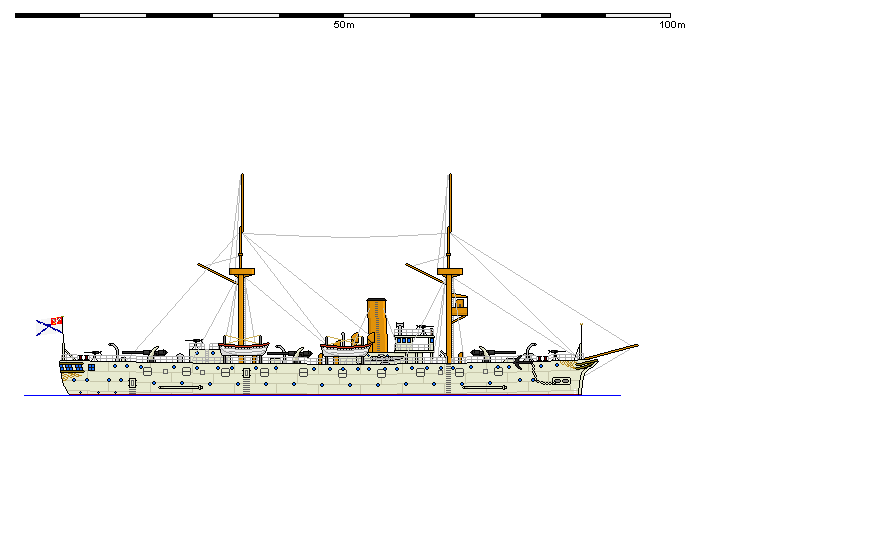
A oto następca jednostki z poprzedniego posta. Okręt szkolny przebudowany z krążownika (dawnej korwety) Strzybóg, w służbie w nowej roli od 1897 r. Wzorem poprzednika, pomieszczenia kadetów zostały zaaranżowane na dawnym pokładzie bateryjnym, oprócz tego zlikwidowałem część lekkiej artylerii, w tym działa 47 mm usytuowane na masztach bojowych.


Strzybóg, polish training cruiser laid down 1876 (Engine 1893, rebuilt 1897)

Displacement:
    2 566 t light; 2 686 t standard; 3 172 t normal; 3 562 t full load

Dimensions: Length overall / water x beam x draught
    268,83 ft / 255,48 ft x 44,19 ft x 19,95 ft (normal load)
    81,94 m / 77,87 m x 13,47 m  x 6,08 m

Armament:
      6 - 5,98" / 152 mm guns in single mounts, 107,15lbs / 48,60kg shells, 1891 Model
      Quick firing guns in deck mounts with hoists
      on side, evenly spread
      4 - 2,24" / 57,0 mm guns in single mounts, 5,23lbs / 2,37kg shells, 1885 Model
      Quick firing guns in deck mounts
      on centreline, evenly spread, 2 raised mounts
    Weight of broadside 664 lbs / 301 kg
    Shells per gun, main battery: 150
    2 - 18,0" / 457 mm above water torpedoes

Armour:
   - Gun armour:    Face (max)    Other gunhouse (avg)    Barbette/hoist (max)
    Main:    1,57" / 40 mm          -                  -

   - Conning tower: 2,95" / 75 mm

Machinery:
    Coal fired boilers, complex reciprocating steam engines,
    Direct drive, 1 shaft, 6 750 ihp / 5 035 Kw = 18,40 kts
    Range 5 600nm at 10,00 kts
    Bunker at max displacement = 876 tons (100% coal)

Complement:
    210 - 274

Cost:
    £0,325 million / $1,301 million

Distribution of weights at normal displacement:
    Armament: 83 tons, 2,6%
    Armour: 47 tons, 1,5%
       - Belts: 0 tons, 0,0%
       - Torpedo bulkhead: 0 tons, 0,0%
       - Armament: 33 tons, 1,0%
       - Armour Deck: 0 tons, 0,0%
       - Conning Tower: 14 tons, 0,4%
    Machinery: 1 184 tons, 37,3%
    Hull, fittings & equipment: 1 250 tons, 39,4%
    Fuel, ammunition & stores: 606 tons, 19,1%
    Miscellaneous weights: 2 tons, 0,1%

Overall survivability and seakeeping ability:
    Survivability (Non-critical penetrating hits needed to sink ship):
      1 461 lbs / 663 Kg = 17,3 x 6,0 " / 152 mm shells or 0,4 torpedoes
    Stability (Unstable if below 1.00): 1,30
    Metacentric height 2,4 ft / 0,7 m
    Roll period: 12,1 seconds
    Steadiness    - As gun platform (Average = 50 %): 96 %
            - Recoil effect (Restricted arc if above 1.00): 0,58
    Seaboat quality  (Average = 1.00): 1,92

Hull form characteristics:
    Hull has a flush deck
    Block coefficient: 0,493
    Length to Beam Ratio: 5,78 : 1
    'Natural speed' for length: 15,98 kts
    Power going to wave formation at top speed: 57 %
    Trim (Max stability = 0, Max steadiness = 100): 50
    Bow angle (Positive = bow angles forward): 25,00 degrees
    Stern overhang: 4,99 ft / 1,52 m
    Freeboard (% = measuring location as a percentage of overall length):
       - Stem:        17,95 ft / 5,47 m
       - Forecastle (18%):    16,47 ft / 5,02 m
       - Mid (50%):        15,45 ft / 4,71 m
       - Quarterdeck (21%):    16,47 ft / 5,02 m
       - Stern:        17,45 ft / 5,32 m
       - Average freeboard:    16,37 ft / 4,99 m

Ship space, strength and comments:
    Space    - Hull below water (magazines/engines, low = better): 141,0%
        - Above water (accommodation/working, high = better): 94,6%
    Waterplane Area: 7 176 Square feet or 667 Square metres
    Displacement factor (Displacement / loading): 103%
    Structure weight / hull surface area: 91 lbs/sq ft or 445 Kg/sq metre
    Hull strength (Relative):
        - Cross-sectional: 0,84
        - Longitudinal: 5,15
        - Overall: 1,01
    Hull space for machinery, storage, compartmentation is cramped
    Room for accommodation and workspaces is adequate
    Ship has slow, easy roll, a good, steady gun platform
    Excellent seaboat, comfortable, can fire her guns in the heaviest weather

środa, 16 lipca 2014

Okręt szkolny


Jakiś czas temu w komentarzach poruszona została kwestia okrętu szkolnego. Dawna jednostka szkolna, korweta Gryf, została wycofana w 1890 r. Jako rozwiązanie tymczasowe, proponuję przebudowanie na okręt szkolny nieco młodszej fregaty Atena (z 1870 r.), która jako okręt bojowy jest już zupełnie nieprzydatna a przez parę lat, doraźnie może pełnić funkcję jednostki szkolnej. W tym celu pozbawiłem okręt całego dotychczasowego uzbrojenia na pokładzie bateryjnym, a uzyskana w ten sposób przestrzeń została zaaranżowana na pomieszczenia kadetów. Celem szkolenia zamontowałem nowoczesne uzbrojenie, choć w symbolicznej ilości: po 2 działa szybkostrzelne kal. 120 mm i 57 mm, oraz 2 wyrzutnie torped. Zastanawiałem się co zrobić z omasztowaniem i ożaglowaniem, ostatecznie pozostawiłem je w formie zredukowanej (usunięte zostały bramstengi i bramreje z przynależnymi im żaglami rejowymi, ponadto skrócona została reja bukszprytu). Zaszkodzić nie zaszkodzi, a może się czasem przydać (choćby po to by krnąbrnego kadeta przegonić po wantach w te i z powrotem;)) Oczywiście, jest to prowizorka, i dlatego w najbliższym czasie przedstawię jakiś inny okręt szkolny, zaadaptowany zapewne z któregoś z krążowników, np. z którejś ze zmodernizowanych korwet typu Strzybóg?


Atena, polish training ship laid down 1869 (Engine 1891)

Displacement:
    2 617 t light; 2 691 t standard; 3 041 t normal; 3 320 t full load

Dimensions: Length overall / water x beam x draught
    230,22 ft / 222,18 ft x 44,06 ft x 19,95 ft (normal load)
    70,17 m / 67,72 m x 13,43 m  x 6,08 m

Armament:
      2 - 4,72" / 120 mm guns in single mounts, 52,72lbs / 23,91kg shells, 1891 Model
      Quick firing guns in deck mounts
      on centreline, all amidships
      2 - 2,24" / 57,0 mm guns in single mounts, 5,23lbs / 2,37kg shells, 1885 Model
      Quick firing guns in deck mounts
      on centreline ends, evenly spread
    Weight of broadside 116 lbs / 53 kg
    Shells per gun, main battery: 200
    2 - 18,0" / 457 mm above water torpedoes

Machinery:
    Coal fired boilers, simple reciprocating steam engines,
    Direct drive, 1 shaft, 5 281 ihp / 3 940 Kw = 17,00 kts
    Range 3 650nm at 10,00 kts
    Bunker at max displacement = 629 tons (100% coal)

Complement:
    328

Cost:
    £0,246 million / $0,984 million

Distribution of weights at normal displacement:
    Armament: 14 tons, 0,5%
    Machinery: 1 016 tons, 33,4%
    Hull, fittings & equipment: 1 428 tons, 47,0%
    Fuel, ammunition & stores: 424 tons, 13,9%
    Miscellaneous weights: 159 tons, 5,2%

Overall survivability and seakeeping ability:
    Survivability (Non-critical penetrating hits needed to sink ship):
      1 629 lbs / 739 Kg = 45,1 x 4,7 " / 120 mm shells or 0,4 torpedoes
    Stability (Unstable if below 1.00): 1,24
    Metacentric height 2,2 ft / 0,7 m
    Roll period: 12,6 seconds
    Steadiness    - As gun platform (Average = 50 %): 85 %
            - Recoil effect (Restricted arc if above 1.00): 0,05
    Seaboat quality  (Average = 1.00): 1,70

Hull form characteristics:
    Hull has a flush deck
    Block coefficient: 0,545
    Length to Beam Ratio: 5,04 : 1
    'Natural speed' for length: 14,91 kts
    Power going to wave formation at top speed: 60 %
    Trim (Max stability = 0, Max steadiness = 100): 50
    Bow angle (Positive = bow angles forward): -3,00 degrees
    Stern overhang: 8,04 ft / 2,45 m
    Freeboard (% = measuring location as a percentage of overall length):
       - Stem:        16,96 ft / 5,17 m
       - Forecastle (19%):    15,94 ft / 4,86 m
       - Mid (50%):        14,99 ft / 4,57 m
       - Quarterdeck (18%):    15,94 ft / 4,86 m
       - Stern:        16,47 ft / 5,02 m
       - Average freeboard:    15,77 ft / 4,81 m

Ship space, strength and comments:
    Space    - Hull below water (magazines/engines, low = better): 118,0%
        - Above water (accommodation/working, high = better): 85,3%
    Waterplane Area: 6 589 Square feet or 612 Square metres
    Displacement factor (Displacement / loading): 132%
    Structure weight / hull surface area: 119 lbs/sq ft or 579 Kg/sq metre
    Hull strength (Relative):
        - Cross-sectional: 1,20
        - Longitudinal: 7,55
        - Overall: 1,44
    Hull space for machinery, storage, compartmentation is cramped
    Room for accommodation and workspaces is cramped
    Ship has slow, easy roll, a good, steady gun platform
    Excellent seaboat, comfortable, can fire her guns in the heaviest weather

sobota, 12 lipca 2014

Kolejny niszczyciel


Dzisiejszy niszczyciel to modyfikacja poprzednika, ze wzmocnionym uzbrojeniem torpedowym.

Bryza, polish torpedo boat destroyer laid down 1898

Displacement:
    364 t light; 378 t standard; 415 t normal; 445 t full load

Dimensions: Length overall / water x beam x draught
    218,83 ft / 218,31 ft x 21,59 ft x 7,41 ft (normal load)
    66,70 m / 66,54 m x 6,58 m  x 2,26 m

Armament:
      1 - 2,95" / 75,0 mm guns in single mounts, 12,87lbs / 5,84kg shells, 1891 Model
      Quick firing gun in deck mount
      on centreline forward, 1 raised gun
      4 - 2,24" / 57,0 mm guns in single mounts, 5,23lbs / 2,37kg shells, 1885 Model
      Quick firing guns in deck mounts
      on side, all forward
      1 - 2,24" / 57,0 mm guns in single mounts, 5,23lbs / 2,37kg shells, 1885 Model
      Quick firing gun in deck mount
      on centreline aft
    Weight of broadside 39 lbs / 18 kg
    Shells per gun, main battery: 220
    4 - 18,0" / 457 mm above water torpedoes

Machinery:
    Coal fired boilers, complex reciprocating steam engines,
    Direct drive, 2 shafts, 9 427 ihp / 7 032 Kw = 27,40 kts
    Range 1 700nm at 10,00 kts
    Bunker at max displacement = 67 tons (100% coal)
      Caution: Delicate, lightweight machinery

Complement:
    45 - 59

Cost:
    £0,053 million / $0,213 million

Distribution of weights at normal displacement:
    Armament: 5 tons, 1,2%
    Machinery: 260 tons, 62,7%
    Hull, fittings & equipment: 94 tons, 22,7%
    Fuel, ammunition & stores: 52 tons, 12,4%
    Miscellaneous weights: 4 tons, 1,0%

Overall survivability and seakeeping ability:
    Survivability (Non-critical penetrating hits needed to sink ship):
      74 lbs / 34 Kg = 5,8 x 3,0 " / 75 mm shells or 0,1 torpedoes
    Stability (Unstable if below 1.00): 1,63
    Metacentric height 1,1 ft / 0,3 m
    Roll period: 8,5 seconds
    Steadiness    - As gun platform (Average = 50 %): 36 %
            - Recoil effect (Restricted arc if above 1.00): 0,08
    Seaboat quality  (Average = 1.00): 0,51

Hull form characteristics:
    Hull has rise forward of midbreak
    Block coefficient: 0,416
    Length to Beam Ratio: 10,11 : 1
    'Natural speed' for length: 14,78 kts
    Power going to wave formation at top speed: 68 %
    Trim (Max stability = 0, Max steadiness = 100): 50
    Bow angle (Positive = bow angles forward): 3,00 degrees
    Stern overhang: 0,00 ft / 0,00 m
    Freeboard (% = measuring location as a percentage of overall length):
       - Stem:        10,01 ft / 3,05 m
       - Forecastle (21%):    11,45 ft / 3,49 m
       - Mid (25%):        11,45 ft / 3,49 m (7,51 ft / 2,29 m aft of break)
       - Quarterdeck (12%):    6,99 ft / 2,13 m
       - Stern:        7,51 ft / 2,29 m
       - Average freeboard:    8,19 ft / 2,50 m
    Ship tends to be wet forward

Ship space, strength and comments:
    Space    - Hull below water (magazines/engines, low = better): 212,9%
        - Above water (accommodation/working, high = better): 53,3%
    Waterplane Area: 2 930 Square feet or 272 Square metres
    Displacement factor (Displacement / loading): 13%
    Structure weight / hull surface area: 18 lbs/sq ft or 88 Kg/sq metre
    Hull strength (Relative):
        - Cross-sectional: 0,46
        - Longitudinal: 1,09
        - Overall: 0,50
    Hull space for machinery, storage, compartmentation is extremely poor
    Room for accommodation and workspaces is cramped
    Caution: Lacks seaworthiness - very limited seakeeping ability

Bryza (1898)
Tornado (1898)
Sztorm (1898)

sobota, 5 lipca 2014

Pancernik kolonialny


Czas na coś konkretniejszego:) tym razem prezentuję obiecywany od dawna pancernik kolonialny. Z wiadomych powodów nasza stocznia cierpiała na brak mocy przerobowych i budowa ślimaczyła się niemiłosiernie ale wreszcie okręt jest na wodzie. Można powiedzieć że jest to nasz odpowiednik brytyjskich pancerników II klasy (kolonialnych)  typu Centurion, choć nieco od nich mniejszy. Zgodnie z zapowiedziami okręt jest uzbrojony w 4 działa 254 mm i opancerzony nowoczesną stalą Harvey’a. Grubością pancerza i kalibrem dział specjalnie może nie imponuje, ale też nie spodziewam się, by w koloniach musiał walczyć z wrogimi pancernikami I klasy. A wygląda chyba wystarczająco groźnie, by stanowić dobrą demonstrację siły;)


Mieszko I, polish colonial battleship laid down 1894 (Engine 1896)

Displacement:
    7 026 t light; 7 360 t standard; 8 160 t normal; 8 800 t full load

Dimensions: Length overall / water x beam x draught
    315,09 ft / 314,11 ft x 64,70 ft x 22,74 ft (normal load)
    96,04 m / 95,74 m x 19,72 m  x 6,93 m

Armament:
      4 - 10,00" / 254 mm guns (2x2 guns), 500,00lbs / 226,80kg shells, 1891 Model
      Breech loading guns in turrets (on barbettes)
      on centreline ends, evenly spread
      8 - 5,98" / 152 mm guns in single mounts, 107,15lbs / 48,60kg shells, 1891 Model
      Quick firing guns in casemate mounts
      on side, all amidships
      8 - 2,24" / 57,0 mm guns in single mounts, 5,14lbs / 2,33kg shells, 1885 Model
      Quick firing guns in deck mounts
      on side ends, evenly spread, 4 raised mounts - superfiring
    Weight of broadside 2 898 lbs / 1 315 kg
    Shells per gun, main battery: 100
    4 - 18,0" / 457 mm submerged torpedo tubes

Armour:
   - Belts:        Width (max)    Length (avg)        Height (avg)
    Main:    10,0" / 254 mm    133,07 ft / 40,56 m    9,28 ft / 2,83 m
    Ends:    6,50" / 165 mm    100,00 ft / 30,48 m    8,33 ft / 2,54 m
      81,04 ft / 24,70 m Unarmoured ends
      Main Belt covers 65% of normal length
      Main belt does not fully cover magazines and engineering spaces

   - Gun armour:    Face (max)    Other gunhouse (avg)    Barbette/hoist (max)
    Main:    10,0" / 254 mm    7,01" / 178 mm        10,0" / 254 mm
    2nd:    7,99" / 203 mm          -                  -

   - Armour deck: 2,60" / 66 mm, Conning tower: 12,01" / 305 mm

Machinery:
    Coal fired boilers, complex reciprocating steam engines,
    Direct drive, 2 shafts, 10 985 ihp / 8 195 Kw = 18,00 kts
    Range 6 200nm at 10,00 kts
    Bunker at max displacement = 1 441 tons (100% coal)

Complement:
    429 - 558

Cost:
    £0,807 million / $3,226 million

Distribution of weights at normal displacement:
    Armament: 362 tons, 4,4%
    Armour: 2 391 tons, 29,3%
       - Belts: 843 tons, 10,3%
       - Torpedo bulkhead: 0 tons, 0,0%
       - Armament: 716 tons, 8,8%
       - Armour Deck: 728 tons, 8,9%
       - Conning Tower: 105 tons, 1,3%
    Machinery: 1 831 tons, 22,4%
    Hull, fittings & equipment: 2 438 tons, 29,9%
    Fuel, ammunition & stores: 1 134 tons, 13,9%
    Miscellaneous weights: 4 tons, 0,0%

Overall survivability and seakeeping ability:
    Survivability (Non-critical penetrating hits needed to sink ship):
      5 782 lbs / 2 623 Kg = 11,6 x 10,0 " / 254 mm shells or 1,1 torpedoes
    Stability (Unstable if below 1.00): 1,27
    Metacentric height 4,0 ft / 1,2 m
    Roll period: 13,5 seconds
    Steadiness    - As gun platform (Average = 50 %): 52 %
            - Recoil effect (Restricted arc if above 1.00): 0,28
    Seaboat quality  (Average = 1.00): 1,04

Hull form characteristics:
    Hull has a flush deck
    Block coefficient: 0,620
    Length to Beam Ratio: 4,87 : 1
    'Natural speed' for length: 17,72 kts
    Power going to wave formation at top speed: 56 %
    Trim (Max stability = 0, Max steadiness = 100): 50
    Bow angle (Positive = bow angles forward): -21,00 degrees
    Stern overhang: 0,98 ft / 0,30 m
    Freeboard (% = measuring location as a percentage of overall length):
       - Stem:        14,47 ft / 4,41 m
       - Forecastle (22%):    12,50 ft / 3,81 m
       - Mid (50%):        12,01 ft / 3,66 m
       - Quarterdeck (23%):    12,01 ft / 3,66 m
       - Stern:        13,45 ft / 4,10 m
       - Average freeboard:    12,52 ft / 3,82 m
    Ship tends to be wet forward

Ship space, strength and comments:
    Space    - Hull below water (magazines/engines, low = better): 114,4%
        - Above water (accommodation/working, high = better): 81,6%
    Waterplane Area: 15 143 Square feet or 1 407 Square metres
    Displacement factor (Displacement / loading): 91%
    Structure weight / hull surface area: 114 lbs/sq ft or 559 Kg/sq metre
    Hull strength (Relative):
        - Cross-sectional: 0,92
        - Longitudinal: 2,35
        - Overall: 1,01
    Hull space for machinery, storage, compartmentation is cramped
    Room for accommodation and workspaces is cramped

Mieszko I (1896) 
Kazimierz II Sprawiedliwy (1897)