
Po bitwie pod Lissą w 1866 r., gdzie austriacki pancernik Erzherzog Ferdinand Max skutecznie staranował i zatopił włoski pancernik Re d’Italia na całym świecie zapanowała moda na taran jako podstawowe narzędzie walki na morzu. W tarany wyposażano wiele okrętów różnych klas, nie wyłączając pancerników, a i budowano jednostki specjalnie przeznaczone do walki w ten sposób. Okręt, który poniżej prezentuję, stanowi propozycję taranowca dla floty austro-węgierskiej w okresie bezpośrednio po bitwie pod Lissą. Jest to stosunkowo niedużych rozmiarów jednostka parowo-żaglowa, oprócz tarana wyposażona w nowoczesną artylerię odtylcową produkcji Kruppa (której tak brakowało w wojnie 1866 r.) oraz zgodnie z realiami epoki - dwumasztowe ożaglowanie. Taranowiec rozwija ponad 15 w. i jak sądzę mógłby być ciekawą propozycją dla floty austro-węgierskiej działającej na wodach Morza Adriatyckiego, cechującego się skomplikowaną i urozmaiconą linią brzegową, mogącą sprzyjać niespodziewanym i nieszablonowym akcjom tego rodzaju jednostek.


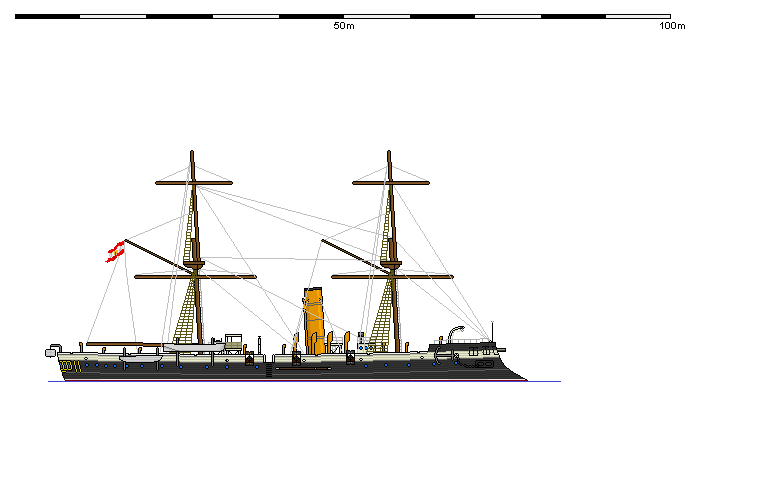

Condor, austro-hungarian ram laid down 1868 (Engine 1869)
Displacement:
1 602 t light; 1 651 t standard; 1 750 t normal; 1 829 t full load
Dimensions: Length overall / water x beam x draught
235,14 ft / 231,14 ft x 37,04 ft x 13,94 ft (normal load)
71,67 m / 70,45 m x 11,29 m x 4,25 m
Armament:
1 - 8,27" / 210 mm guns in single mounts, 189,32lbs / 85,87kg shells, 1868 Model
Breech loading gun in casemate mount
on centreline forward
6 - 4,72" / 120 mm guns in single mounts, 32,16lbs / 14,59kg shells, 1864 Model
Breech loading guns in deck mounts
on side, all amidships
Weight of broadside 382 lbs / 173 kg
Shells per gun, main battery: 60
Armour:
- Gun armour: Face (max) Other gunhouse (avg) Barbette/hoist (max)
Main: 3,94" / 100 mm - -
Machinery:
Coal fired boilers, simple reciprocating steam engines,
Direct drive, 1 shaft, 2 818 ihp / 2 102 Kw = 15,30 kts
Range 1 500nm at 7,50 kts
Bunker at max displacement = 178 tons (100% coal)
Complement:
216
Cost:
£0,191 million / $0,762 million
Distribution of weights at normal displacement:
Armament: 48 tons, 2,7%
Armour: 20 tons, 1,2%
- Belts: 0 tons, 0,0%
- Torpedo bulkhead: 0 tons, 0,0%
- Armament: 20 tons, 1,2%
- Armour Deck: 0 tons, 0,0%
- Conning Tower: 0 tons, 0,0%
Machinery: 674 tons, 38,5%
Hull, fittings & equipment: 796 tons, 45,5%
Fuel, ammunition & stores: 148 tons, 8,4%
Miscellaneous weights: 64 tons, 3,7%
Overall survivability and seakeeping ability:
Survivability (Non-critical penetrating hits needed to sink ship):
675 lbs / 306 Kg = 3,6 x 8,3 " / 210 mm shells or 0,3 torpedoes
Stability (Unstable if below 1.00): 1,26
Metacentric height 1,7 ft / 0,5 m
Roll period: 11,9 seconds
Steadiness - As gun platform (Average = 50 %): 100 %
- Recoil effect (Restricted arc if above 1.00): 0,33
Seaboat quality (Average = 1.00): 2,00
Hull form characteristics:
Hull has raised forecastle
Block coefficient: 0,513
Length to Beam Ratio: 6,24 : 1
'Natural speed' for length: 15,20 kts
Power going to wave formation at top speed: 48 %
Trim (Max stability = 0, Max steadiness = 100): 50
Bow angle (Positive = bow angles forward): -40,00 degrees
Stern overhang: 4,00 ft / 1,22 m
Freeboard (% = measuring location as a percentage of overall length):
- Stem: 19,46 ft / 5,93 m
- Forecastle (21%): 18,44 ft / 5,62 m (14,96 ft / 4,56 m aft of break)
- Mid (50%): 13,48 ft / 4,11 m
- Quarterdeck (30%): 13,48 ft / 4,11 m
- Stern: 14,47 ft / 4,41 m
- Average freeboard: 14,98 ft / 4,57 m
Ship space, strength and comments:
Space - Hull below water (magazines/engines, low = better): 148,4%
- Above water (accommodation/working, high = better): 110,0%
Waterplane Area: 5 562 Square feet or 517 Square metres
Displacement factor (Displacement / loading): 93%
Structure weight / hull surface area: 75 lbs/sq ft or 365 Kg/sq metre
Hull strength (Relative):
- Cross-sectional: 0,84
- Longitudinal: 4,85
- Overall: 1,00
Hull space for machinery, storage, compartmentation is cramped
Room for accommodation and workspaces is adequate
Ship has slow, easy roll, a good, steady gun platform
Excellent seaboat, comfortable, can fire her guns in the heaviest weather
Condor (1869)
Cormoran (1869)
Adler (1870)
Habicht (1870)


