niedziela, 13 października 2024

Krążownik podwodny US Navy

Niedługo po zakończeniu Pierwszej Wojny Światowej w US Navy pojawiły się pomysły budowy krążownika podwodnego z prawdziwego zdarzenia. Opracowano ponoć wiele różnych projektów, ale najprawdopodobniej zachowały się tylko wstępne szkice 4 z nich (możliwe, że pozostałe wciąż leżą w archiwach i czekają na odkrycie). Ich wspólną cechą było to, że były zupełnie nieporównywalne do czegokolwiek, co dotychczas, jak również dużo później (a w zasadzie to kiedykolwiek) powstało w dziedzinie okrętów podwodnych. Miały to być bowiem okręty o wyporności normalnej (na powierzchni) od 8750 ton do 13500 ton (!), wyposażone w 2-8 dział kal. 203 mm, wodnosamoloty, a niektóre nawet w opancerzenie (!). Na warsztat wziąłem bodaj najbardziej imponujący z nich wszystkich projekt S-584-166, czyli jednostkę o wymiarach z grubsza 149x18x9 m, wyporności 13500 ton, zasięgu 20000 Mm, uzbrojoną w 8 dział 203 mm, 8 wyrzutni torped kal. 533 mm (6 na dziobie, 2 na rufie), chronioną opancerzeniem grubości 83 mm na burcie, 57 mm na pokładzie (przeliczone z wartości wyrażonych w funtach pancernych), 152 mm na wieżach i stanowisku dowodzenia oraz posiadającą bliżej niesprecyzowane wyposażenie lotnicze (ja przyjąłem  wodnosamolot).
Do symulacji wykorzystałem algorytm pozwalający w miarę sensownie odwzorować konstrukcję okrętu podwodnego, w sytuacji gdy program zasadniczo jest przeznaczony do symulowania jednostek nawodnych. Można go znaleźć pod adresem:  https://requestforproposal.fandom.com/wiki/How-to-Springsharp_Guide/Submarines  Sprowadza się on do przyjęcia do kalkulacji zerowej wysokości wolnej burty oraz zarezerwowania minimum 1/4 wyporności jako „miscellaneous weights”. Po zastosowaniu tych zabiegów, na podstawie uzyskanego współczynnika CS oszacowałem osiągane głębokości zanurzenia. Pozostałe parametry dot. pływania podwodnego (moc silników elektrycznych, zasięg i prędkość) wobec braku innych metod, oszacowałem według własnego wyczucia.   
Nie wykluczam, że w przyszłości wezmę się także za któryś z pozostałych projektów krążowników podwodnych, bowiem też są intrygujące. Był między nimi np. taki, który miał wieże potrójne, albo inny wyposażony w warstwowy system ochrony przeciwtorpedowej (!). Powinno być ciekawie ;)


Leviathan, United States submarine cruiser laid down 1921 (Engine 1923)

Displacement:
    11 714 t light; 12 161 t standard; 13 500 t normal; 14 571 t full load, 16 200 t submerged

Dimensions: Length overall / water x beam x draught
    489,99 ft / 489,99 ft x 60,01 ft x 29,00 ft (normal load)
    149,35 m / 149,35 m x 18,29 m  x 8,84 m

Armament:
      8 - 7,99" / 203 mm guns (4x2 guns), 255,24lbs / 115,78kg shells, 1922 Model
      Breech loading guns in turrets (on barbettes)
      on centreline ends, evenly spread, 2 raised mounts - superfiring
      2 - 4,02" / 102 mm guns in single mounts, 32,38lbs / 14,69kg shells, 1920 Model
      Anti-aircraft guns in deck mounts
      on side, all amidships
    Weight of broadside 2 107 lbs / 956 kg
    Shells per gun, main battery: 150
    8 - 21,0" / 533 mm submerged torpedo tubes

Armour:
   - Belts:        Width (max)    Length (avg)        Height (avg)
    Main:    3,27" / 83 mm    189,47 ft / 57,75 m    17,95 ft / 5,47 m
    Ends:    Unarmoured
      Main Belt covers 59% of normal length

   - Gun armour:    Face (max)    Other gunhouse (avg)    Barbette/hoist (max)
    Main:    5,98" / 152 mm    2,01" / 51 mm        2,01" / 51 mm

   - Armour deck: 0,87" / 22 mm (2,24" / 57 mm over amidships), Conning tower: 5,98" / 152 mm

Machinery:
    Diesel Internal combustion generators plus batteries,
    Electric motors, 2 shafts, 7 227 shp / 5 391 Kw = 15,50 kts  (2568 hp / 1916 Kw = 11,00 kts)
    Range 20 000nm at 10,00 kts (150nm at 7,00 kts)
    Bunker at max displacement = 2 409 tons

Complement:
    313

Cost:
    £1,694 million / $6,776 million

Distribution of weights at normal displacement:
    Armament: 263 tons, 2,0%
    Armour: 1 086 tons, 8,0%
       - Belts: 528 tons, 3,9%
       - Torpedo bulkhead: 0 tons, 0,0%
       - Armament: 155 tons, 1,1%
       - Armour Deck: 330 tons, 2,4%
       - Conning Tower: 73 tons, 0,5%
    Machinery: 245 tons, 1,8%
    Hull, fittings & equipment: 6 720 tons, 49,8%
    Fuel, ammunition & stores: 1 786 tons, 13,2%
    Miscellaneous weights: 3 400 tons, 25,2%

Overall survivability and seakeeping ability:
    Survivability (Non-critical penetrating hits needed to sink ship):
      12 142 lbs / 5 507 Kg = 47,6 x 8,0 " / 203 mm shells or 2,7 torpedoes
    Stability (Unstable if below 1.00): 1,01
    Metacentric height 2,4 ft / 0,7 m
    Roll period: 16,4 seconds
    Steadiness    - As gun platform (Average = 50 %): 0 %
            - Recoil effect (Restricted arc if above 1.00): 0,00
    Seaboat quality  (Average = 1.00): 0,00

Hull form characteristics:
    Hull has a flush deck
    Block coefficient: 0,554
    Length to Beam Ratio: 8,17 : 1
    'Natural speed' for length: 22,14 kts
    Power going to wave formation at top speed: 29 %
    Trim (Max stability = 0, Max steadiness = 100): 50
    Bow angle (Positive = bow angles forward): 0,00 degrees
    Stern overhang: 0,00 ft / 0,00 m
    Freeboard (% = measuring location as a percentage of overall length):
       - Stem:        0,00 ft / 0,00 m
       - Forecastle (31%):    0,00 ft / 0,00 m
       - Mid (50%):        0,00 ft / 0,00 m
       - Quarterdeck (32%):    0,00 ft / 0,00 m
       - Stern:        0,00 ft / 0,00 m
       - Average freeboard:    0,00 ft / 0,00 m
    Ship tends to be wet forward

Ship space, strength and comments:
    Space    - Hull below water (magazines/engines, low = better): 55,8%
        - Above water (accommodation/working, high = better): 0,0%
    Waterplane Area: 20 599 Square feet or 1 914 Square metres
    Displacement factor (Displacement / loading): 191%
    Structure weight / hull surface area: 247 lbs/sq ft or 1 204 Kg/sq metre
    Hull strength (Relative):
        - Cross-sectional: 2,90
        - Longitudinal: 1,42
        - Overall: 1,70
    Hull space for machinery, storage, compartmentation is excellent
    Room for accommodation and workspaces is extremely poor
    Ship has quick, lively roll, not a steady gun platform
    Caution: Lacks seaworthiness - very limited seakeeping ability

1 seaplane

Operational depth:  170 ft / 52 m
Emergency Depth: 272 ft / 83 m
Crush depth: 425 ft / 130 m
 

poniedziałek, 7 października 2024

Krążowniki eskortowe

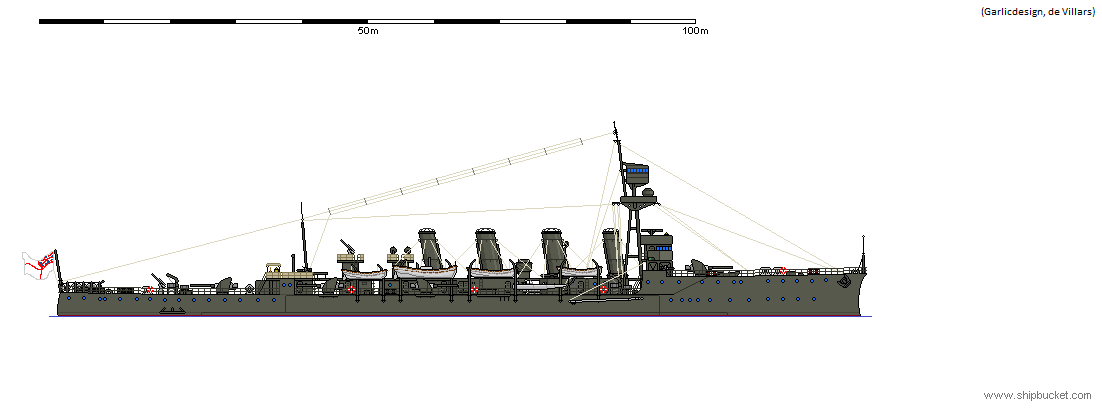
Po zakończeniu PWS w składzie floty brytyjskiej znajdowała się wciąż pewna liczba małych krążowników, budowanych w dekadzie przed wybuchem wojny do współdziałania z flotyllami niszczycieli, jako przewodniki flotylli. Te tzw. scouty, po wojnie uznano za zbędne i mimo iż były niezbyt stare, wszystkie wysłano na złom w latach 1920-1923. Oczywiście, w roli typowych lekkich krążowników nie bardzo już mogły się sprawdzić, jako że do służby weszły w międzyczasie okręty tej klasy dwa razy większe, szybsze, lepiej opancerzone i uzbrojone w 6-calówki. Niemniej widziałbym szansę na ich utrzymanie w służbie w roli jednostek eskortowych.
Tutaj „na tapetę” wziąłem ostatnie, najnowsze jednostki tej klasy – liczący 6 (pierwotnie 7, ale jeden zatonął) okrętów typ Boadicea z lat 1908-12, czasem rozdzielany na trzy podtypy (Boadicea, Blonde, Active). Jednostki te były bardzo do siebie podobne, miały zbliżone wymiary, wygląd i osiągi, a różniły się uzbrojeniem (6 lub 10 dział 102 mm), opancerzeniem pokładu (25 lub 38 mm) i kształtem stewy dziobowej.
W mojej adaptacji do nowej roli przewidziałem wymianę uzbrojenia okrętów na działa 6-calowe (152mm) L/45, wzmocnienie opancerzenia poprzez dodanie pancerza burtowego na wysokości komór amunicyjnych i siłowni, oraz zmianę sposobu opalania kotłów z mieszanego, na opalanie wyłącznie paliwem płynnym. Samej maszynowni nie przewidziałem do modernizacji, ograniczając się do jej remontu i ewentualnie wymiany zużytych elementów.  Wyrzutnie torped kal. 457 mm zostały wymienione na kal. 533 mm. Okręty otrzymały 2 zrzutnie bomb głębinowych na rufie oraz 4 miotacze na burtach. Zmodernizowano nadbudówkę i maszt dziobowy. Ponadto postanowiłem ujednolicić kształt dziobu do tego, jaki występował na podtypie Active.
Po przebudowie okręty prezentują się tak oto:


Boadicea, british escort cruiser laid down 1907 (Engine 1908), rebuilt 1920

Displacement:
    2 919 t light; 3 071 t standard; 3 350 t normal; 3 574 t full load

Dimensions: Length overall / water x beam x draught
    406,11 ft / 404,49 ft x 41,47 ft x 14,01 ft (normal load)
    123,78 m / 123,29 m x 12,64 m  x 4,27 m

Armament:
      2 - 5,98" / 152 mm guns in single mounts, 107,15lbs / 48,60kg shells, 1899 Model
      Quick firing guns in deck mounts
      on centreline ends, evenly spread
      4 - 5,98" / 152 mm guns in single mounts, 107,15lbs / 48,60kg shells, 1899 Model
      Quick firing guns in deck mounts
      on side, all amidships
      2 - 2,99" / 76,0 mm guns in single mounts, 13,39lbs / 6,07kg shells, 1913 Model
      Anti-aircraft guns in deck mounts
      on centreline, evenly spread, 1 raised mount
      4 - 1,57" / 40,0 mm guns in single mounts, 1,95lbs / 0,88kg shells, 1914 Model
      Anti-aircraft guns in deck mounts
      on side ends, evenly spread, 2 raised mounts - superfiring
    Weight of broadside 677 lbs / 307 kg
    Shells per gun, main battery: 200
    2 - 21,0" / 533 mm above water torpedoes

Armour:
   - Belts:        Width (max)    Length (avg)        Height (avg)
    Main:    2,01" / 51 mm    261,98 ft / 79,85 m    5,97 ft / 1,82 m
    Ends:    Unarmoured
    Upper:    1,50" / 38 mm    186,38 ft / 56,81 m    8,46 ft / 2,58 m
      Main Belt covers 100% of normal length
      Main belt does not fully cover magazines and engineering spaces

   - Gun armour:    Face (max)    Other gunhouse (avg)    Barbette/hoist (max)
    Main:    1,57" / 40 mm    0,98" / 25 mm              -
    2nd:    1,57" / 40 mm    0,98" / 25 mm              -

   - Armour deck: 1,50" / 38 mm, Conning tower: 4,02" / 102 mm

Machinery:
    Oil fired boilers, steam turbines,
    Direct drive, 4 shafts, 18 619 shp / 13 890 Kw = 25,00 kts
    Range 5 480nm at 10,00 kts
    Bunker at max displacement = 503 tons

Complement:
    219 - 286

Cost:
    £0,305 million / $1,220 million

Distribution of weights at normal displacement:
    Armament: 85 tons, 2,5%
    Armour: 599 tons, 17,9%
       - Belts: 236 tons, 7,0%
       - Torpedo bulkhead: 0 tons, 0,0%
       - Armament: 35 tons, 1,0%
       - Armour Deck: 309 tons, 9,2%
       - Conning Tower: 19 tons, 0,6%
    Machinery: 940 tons, 28,1%
    Hull, fittings & equipment: 1 235 tons, 36,9%
    Fuel, ammunition & stores: 431 tons, 12,9%
    Miscellaneous weights: 60 tons, 1,8%

Overall survivability and seakeeping ability:
    Survivability (Non-critical penetrating hits needed to sink ship):
      3 253 lbs / 1 475 Kg = 30,4 x 6,0 " / 152 mm shells or 0,8 torpedoes
    Stability (Unstable if below 1.00): 1,35
    Metacentric height 2,3 ft / 0,7 m
    Roll period: 11,6 seconds
    Steadiness    - As gun platform (Average = 50 %): 65 %
            - Recoil effect (Restricted arc if above 1.00): 0,20
    Seaboat quality  (Average = 1.00): 1,30

Hull form characteristics:
    Hull has rise forward of midbreak
    Block coefficient: 0,499
    Length to Beam Ratio: 9,75 : 1
    'Natural speed' for length: 20,11 kts
    Power going to wave formation at top speed: 53 %
    Trim (Max stability = 0, Max steadiness = 100): 50
    Bow angle (Positive = bow angles forward): 3,00 degrees
    Stern overhang: 0,49 ft / 0,15 m
    Freeboard (% = measuring location as a percentage of overall length):
       - Stem:        21,46 ft / 6,54 m
       - Forecastle (20%):    19,95 ft / 6,08 m
       - Mid (28%):        19,95 ft / 6,08 m (10,96 ft / 3,34 m aft of break)
       - Quarterdeck (20%):    10,96 ft / 3,34 m
       - Stern:        11,98 ft / 3,65 m
       - Average freeboard:    13,66 ft / 4,16 m
    Ship tends to be wet forward

Ship space, strength and comments:
    Space    - Hull below water (magazines/engines, low = better): 113,5%
        - Above water (accommodation/working, high = better): 108,2%
    Waterplane Area: 11 166 Square feet or 1 037 Square metres
    Displacement factor (Displacement / loading): 104%
    Structure weight / hull surface area: 69 lbs/sq ft or 336 Kg/sq metre
    Hull strength (Relative):
        - Cross-sectional: 1,08
        - Longitudinal: 1,47
        - Overall: 1,11
    Hull space for machinery, storage, compartmentation is cramped
    Room for accommodation and workspaces is adequate
    Good seaboat, rides out heavy weather easily

2 depth charge racks
4 depth charge throwers

Boadicea (1908, rebuilt 1920)
Bellona (1909, rebuilt 1920)
Blanche (1909, rebuilt 1920)
Blonde (1910, rebuilt 1921)
Active (1911, rebuilt 1921)
Fearless (1912, rebuilt 1921)
 

środa, 2 października 2024

Alternatywny Scharnhorst

Kolejne niemieckie okręty pancerne planowane do zbudowani po trójce „pancerników kieszonkowych”, jeszcze przed dojściem Hitlera do władzy, jawnie zrywały z postanowieniami traktatu wersalskiego. Jeden z projektów krążownika liniowego (schlachtkreuzer) z 1928 r. przewidywał lekko opancerzony okręt o wyporności normalnej 19200 ton (lekkiej 17500 ton), uzbrojony w 8 dział 305 mm (długości 50 kal., prawdopodobnie nowego wzoru opracowanego na podstawie pierwszowojennego), ale rozwijający aż 34 w. czyniło by go to najszybszym na świecie okrętem uzbrojonym w ciężkie działa, zdolnym do zniszczenia każdego krążownika ciężkiego i jednocześnie do ucieczki przed każdym silniejszym okrętem, nowo budowanych okrętów francuskich nie wyłączając.


Scharnhorst, german light battlecruiser laid down 1932 (Engine 1934)

Displacement:
    17 119 t light; 18 044 t standard; 19 213 t normal; 20 148 t full load

Dimensions: Length overall / water x beam x draught
    696,26 ft / 689,07 ft x 81,66 ft x 25,43 ft (normal load)
    212,22 m / 210,03 m x 24,89 m  x 7,75 m

Armament:
      8 - 12,01" / 305 mm guns (4x2 guns), 865,70lbs / 392,67kg shells, 1932 Model
      Breech loading guns in turrets (on barbettes)
      on centreline ends, evenly spread, 2 raised mounts - superfiring
      6 - 5,91" / 150 mm guns (2x3 guns), 102,98lbs / 46,71kg shells, 1925 Model
      Quick firing guns in turrets (on barbettes)
      on side, all amidships
      3 - 5,91" / 150 mm guns (1x3 guns), 102,98lbs / 46,71kg shells, 1925 Model
      Quick firing guns in a turret (on a barbette)
      on centreline aft, all raised guns - superfiring
      4 - 3,46" / 88,0 mm guns (2x2 guns), 20,79lbs / 9,43kg shells, 1931 Model
      Anti-aircraft guns in deck mounts
      on side, all amidships, all raised mounts - superfiring
    Weight of broadside 7 936 lbs / 3 600 kg
    Shells per gun, main battery: 120
    6 - 21,0" / 533 mm above water torpedoes

Armour:
   - Belts:        Width (max)    Length (avg)        Height (avg)
    Main:    3,94" / 100 mm    451,35 ft / 137,57 m    12,50 ft / 3,81 m
    Ends:    2,95" / 75 mm    180,51 ft / 55,02 m    9,25 ft / 2,82 m
      57,22 ft / 17,44 m Unarmoured ends
      Main Belt covers 101% of normal length
      Main belt does not fully cover magazines and engineering spaces

   - Torpedo Bulkhead:
        0,71" / 18 mm    451,35 ft / 137,57 m    24,44 ft / 7,45 m

   - Gun armour:    Face (max)    Other gunhouse (avg)    Barbette/hoist (max)
    Main:    5,91" / 150 mm    3,94" / 100 mm        5,91" / 150 mm
    2nd:    1,57" / 40 mm    0,79" / 20 mm        1,57" / 40 mm
    3rd:    1,57" / 40 mm    0,79" / 20 mm        1,57" / 40 mm

   - Armour deck: 0,91" / 23 mm (deck 0,79" / 20 mm, slopes 1,18" / 30 mm, Conning tower: 7,09" / 180 mm

Machinery:
    Oil fired boilers, steam turbines,
    Geared drive, 4 shafts, 153 070 shp / 114 190 Kw = 34,00 kts
    Range 10 000nm at 12,00 kts
    Bunker at max displacement = 2 104 tons

Complement:
    815 - 1 060

Cost:
    £9,313 million / $37,253 million

Distribution of weights at normal displacement:
    Armament: 992 tons, 5,2%
    Armour: 3 077 tons, 16,0%
       - Belts: 1 118 tons, 5,8%
       - Torpedo bulkhead: 289 tons, 1,5%
       - Armament: 948 tons, 4,9%
       - Armour Deck: 611 tons, 3,2%
       - Conning Tower: 110 tons, 0,6%
    Machinery: 4 404 tons, 22,9%
    Hull, fittings & equipment: 8 547 tons, 44,5%
    Fuel, ammunition & stores: 2 094 tons, 10,9%
    Miscellaneous weights: 100 tons, 0,5%

Overall survivability and seakeeping ability:
    Survivability (Non-critical penetrating hits needed to sink ship):
      15 577 lbs / 7 066 Kg = 18,0 x 12,0 " / 305 mm shells or 2,2 torpedoes
    Stability (Unstable if below 1.00): 1,21
    Metacentric height 5,3 ft / 1,6 m
    Roll period: 15,0 seconds
    Steadiness    - As gun platform (Average = 50 %): 35 %
            - Recoil effect (Restricted arc if above 1.00): 0,50
    Seaboat quality  (Average = 1.00): 0,48

Hull form characteristics:
    Hull has rise forward of midbreak
    Block coefficient: 0,470
    Length to Beam Ratio: 8,44 : 1
    'Natural speed' for length: 26,25 kts
    Power going to wave formation at top speed: 57 %
    Trim (Max stability = 0, Max steadiness = 100): 50
    Bow angle (Positive = bow angles forward): 4,00 degrees
    Stern overhang: 5,48 ft / 1,67 m
    Freeboard (% = measuring location as a percentage of overall length):
       - Stem:        24,44 ft / 7,45 m
       - Forecastle (18%):    20,44 ft / 6,23 m
       - Mid (63%):        18,96 ft / 5,78 m (10,47 ft / 3,19 m aft of break)
       - Quarterdeck (18%):    10,47 ft / 3,19 m
       - Stern:        11,45 ft / 3,49 m
       - Average freeboard:    16,77 ft / 5,11 m
    Ship tends to be wet forward

Ship space, strength and comments:
    Space    - Hull below water (magazines/engines, low = better): 150,9%
        - Above water (accommodation/working, high = better): 133,8%
    Waterplane Area: 36 503 Square feet or 3 391 Square metres
    Displacement factor (Displacement / loading): 96%
    Structure weight / hull surface area: 165 lbs/sq ft or 807 Kg/sq metre
    Hull strength (Relative):
        - Cross-sectional: 1,00
        - Longitudinal: 1,00
        - Overall: 1,00
    Hull space for machinery, storage, compartmentation is cramped
    Room for accommodation and workspaces is excellent
    Caution: Lacks seaworthiness - very limited seakeeping ability

2 catapults, 2 seaplanes

Scharnhorst (1934)
Gneisenau (1935)
 

niedziela, 22 września 2024

Monitor taki nie za duży ;)

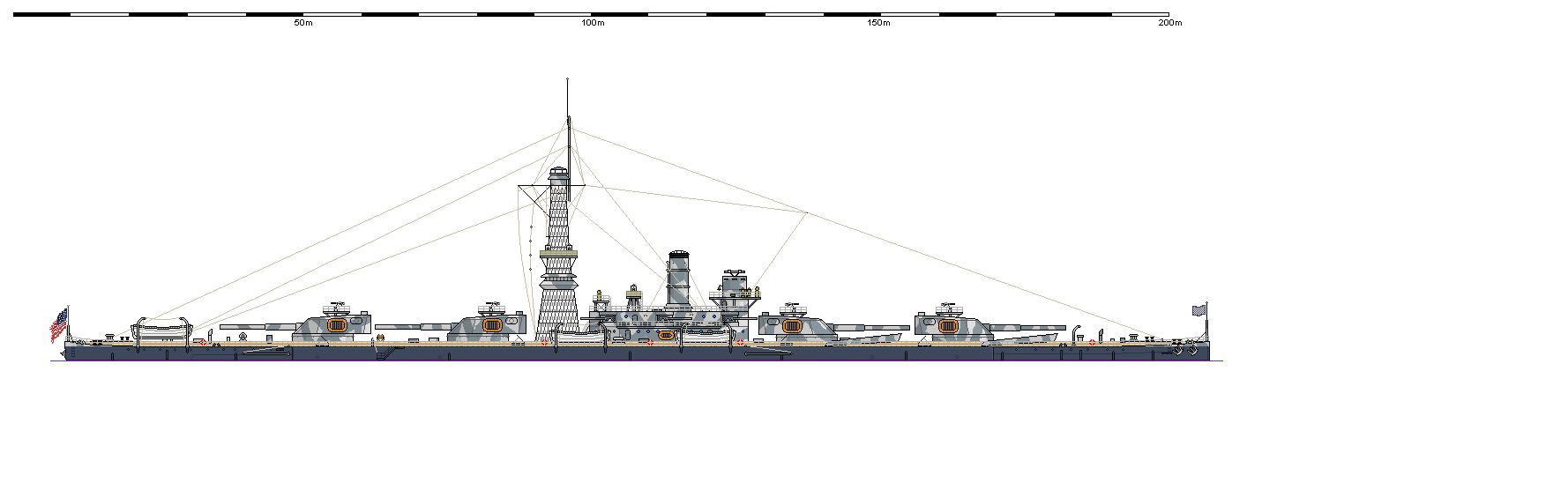
W Stanach to mieli rozmach… W czerwcu 1917 r. powstał u nich projekt monitora, który miał być uzbrojony w 8 dział kal. 406 mm L/50 (!). Geneza projektu nie jest niestety znana, można się tylko domyślać, że powstał on pod wpływem doświadczeń brytyjskich z użytkowania monitorów do ostrzału wybrzeży okupowanej Belgii, tylko został opracowany bez specjalnego oglądania się na koszty. Z danych wiadomo, że miał wypierać 26000 ton, mieć wymiary (w stopach) 650x108x14,5. Jedyny znany rysunek tego projektu przedstawia jednostkę o skrajnie prostych liniach kadłuba (współczynnik pełnotliwości kadłuba wynosi 0,9!), niskiej wolnej burcie i opadającym ku niej pokładzie, wyposażoną w cztery dwudziałowe wieże posadowione na jednym poziomie i centralną nadbudówkę z masztem kratownicowym i 6 działami kal. 127 mm w kazamatach. Miał też chyba (tak wnioskuję z rysunku) mieć opancerzone stanowisko dowodzenia, aczkolwiek o nieznanej grubości. Na dachach wież miało znajdować się kilka km-ów.
Mimo nie osiągnięcia zakładanych w projekcie grubości opancerzenia (457 albo nawet 508 mm na burcie) okręt wyszedł i tak przeciążony, ale na tak specyficznej jednostce jaką jest monitor można na to przymknąć oko. Od siebie natomiast przyspieszyłem jednostkę do 9 w., bowiem projekt przewidywał niesamowite (:D) 6 w., co uznałem jednak za grubą przesadę (tak, wiem, niektóre monitory tyle wyciągały, ale to jednak w moim odczuciu przegięcie;))    
Oto moja wizualizacja i symulacja tego nietrywialnego projektu. Jak zwykle życzę miłego odbioru :) 


Miantonomoh, United States large monitor laid down 1917 (Engine 1918)

Displacement:
    24 585 t light; 25 806 t standard; 26 080 t normal; 26 300 t full load

Dimensions: Length overall / water x beam x draught
    649,51 ft / 649,02 ft x 108,01 ft x 14,50 ft (normal load)
    197,97 m / 197,82 m x 32,92 m  x 4,42 m

Armament:
      8 - 15,98" / 406 mm guns (4x2 guns), 2 041,96lbs / 926,22kg shells, 1916 Model
      Breech loading guns in turrets (on barbettes)
      on centreline ends, evenly spread
      6 - 5,00" / 127 mm guns in single mounts, 62,50lbs / 28,35kg shells, 1910 Model
      Quick firing guns in casemate mounts
      on side, all amidships, all raised mounts - superfiring
      4 - 0,30" / 7,6 mm guns in single mounts, 0,01lbs / 0,00kg shells, 1917 Model
      Machine guns in deck mounts
      on centreline ends, evenly spread, all raised mounts - superfiring
    Weight of broadside 16 711 lbs / 7 580 kg
    Shells per gun, main battery: 75

Armour:
   - Belts:        Width (max)    Length (avg)        Height (avg)
    Main:    9,02" / 229 mm    398,20 ft / 121,37 m    12,50 ft / 3,81 m
    Ends:    Unarmoured
      Main Belt covers 94% of normal length

   - Gun armour:    Face (max)    Other gunhouse (avg)    Barbette/hoist (max)
    Main:    10,0" / 254 mm    5,98" / 152 mm        7,99" / 203 mm
    2nd:    2,01" / 51 mm          -                  -

   - Armour deck: 2,44" / 62 mm (4,00" / 102 mm over amidships), Conning tower: 5,98" / 152 mm

Machinery:
    Diesel Internal combustion motors,
    Direct drive, 2 shafts, 2 379 shp / 1 775 Kw = 9,00 kts
    Range 3 000nm at 6,00 kts
    Bunker at max displacement = 495 tons

Complement:
    1 025 - 1 333

Cost:
    £4,777 million / $19,106 million

Distribution of weights at normal displacement:
    Armament: 2 089 tons, 8,0%
    Armour: 6 606 tons, 25,3%
       - Belts: 2 038 tons, 7,8%
       - Torpedo bulkhead: 0 tons, 0,0%
       - Armament: 1 460 tons, 5,6%
       - Armour Deck: 2 994 tons, 11,5%
       - Conning Tower: 113 tons, 0,4%
    Machinery: 86 tons, 0,3%
    Hull, fittings & equipment: 15 805 tons, 60,6%
    Fuel, ammunition & stores: 1 496 tons, 5,7%
    Miscellaneous weights: 0 tons, 0,0%

Overall survivability and seakeeping ability:
    Survivability (Non-critical penetrating hits needed to sink ship):
      42 233 lbs / 19 157 Kg = 20,7 x 16,0 " / 406 mm shells or 5,2 torpedoes
    Stability (Unstable if below 1.00): 1,58
    Metacentric height 12,1 ft / 3,7 m
    Roll period: 13,0 seconds
    Steadiness    - As gun platform (Average = 50 %): 32 %
            - Recoil effect (Restricted arc if above 1.00): 0,18
    Seaboat quality  (Average = 1.00): 0,41

Hull form characteristics:
    Hull has a flush deck
    Block coefficient: 0,898
    Length to Beam Ratio: 6,01 : 1
    'Natural speed' for length: 25,48 kts
    Power going to wave formation at top speed: 10 %
    Trim (Max stability = 0, Max steadiness = 100): 50
    Bow angle (Positive = bow angles forward): 0,00 degrees
    Stern overhang: 0,49 ft / 0,15 m
    Freeboard (% = measuring location as a percentage of overall length):
       - Stem:        14,24 ft / 4,34 m
       - Forecastle (19%):    11,25 ft / 3,43 m
       - Mid (50%):        11,25 ft / 3,43 m
       - Quarterdeck (20%):    11,25 ft / 3,43 m
       - Stern:        14,24 ft / 4,34 m
       - Average freeboard:    11,77 ft / 3,59 m
    Ship tends to be wet forward

Ship space, strength and comments:
    Space    - Hull below water (magazines/engines, low = better): 60,6%
        - Above water (accommodation/working, high = better): 138,7%
    Waterplane Area: 66 311 Square feet or 6 161 Square metres
    Displacement factor (Displacement / loading): 111%
    Structure weight / hull surface area: 221 lbs/sq ft or 1 077 Kg/sq metre
    Hull strength (Relative):
        - Cross-sectional: 1,41
        - Longitudinal: 0,73
        - Overall: 0,86
    Caution: Hull subject to strain in open-sea
    Hull space for machinery, storage, compartmentation is excellent
    Room for accommodation and workspaces is excellent
    Caution: Lacks seaworthiness - very limited seakeeping ability

niedziela, 15 września 2024

Mini-Garibaldi dla Bułgarii

Dziś kolejny krążownik dla MW Bułgarii, narysowany wg koncepcji kolegi H_Babbock. Dwa pomysł na większe (do 4000 ton) krążowniki dla tej floty pojawiły się w toku dyskusji pod postem o krążowniku Krum (http://springsharp.blogspot.com/2024/08/may-krazownik-dla-bugarii.html). Jednym z nich był krążownik pancernopokładowy francuskiej budowy prezentowany 25 sierpnia, a drugim – niniejszy okręt. W założeniu jest to mini-Garibaldi, zatem ma podobną, symetryczną sylwetkę wynikającą z konfiguracji układu napędowego (maszynownia między kotłowniami). Okręt dysponuje 2 działami 203 mm i 4 – 152 mm. Ma opancerzenie dochodzące do 80 mm na burcie, 50 mm na pokładzie i rozwija 21 w. Ceną za te parametry na tak ograniczonej wyporności okazał się nieduży zasięg oraz rozmieszczenie dział artylerii głównej w stanowiskach pokładowych z pancernymi osłonami, co jest znacznie lżejszym rozwiązaniem niż wieże. Ogólnie okręt na tle jednostek tureckich dysponuje jednak sporym potencjałem i wraz z prezentowanym poprzednio Terwełem może tworzyć całkiem groźny zespół. Formalnie okręt jest krążownikiem pancernym, aczkolwiek zdaję sobie sprawę, że na tle niektórych innych okrętów tej klasy może wypadać nieco blado. Niemniej, skoro japońska Chiyoda (2400 ton, 10x120, pb 114) była krążownikiem pancernym, to i ten może :) 


 Swieti Georgi, bulgarian armoured cruiser laid down 1905 (Engine 1906)

Displacement:
    3 606 t light; 3 780 t standard; 3 987 t normal; 4 152 t full load

Dimensions: Length overall / water x beam x draught
    322,11 ft / 322,11 ft x 50,00 ft x 16,50 ft (normal load)
    98,18 m / 98,18 m x 15,24 m  x 5,03 m

Armament:
      2 - 7,99" / 203 mm guns in single mounts, 255,24lbs / 115,77kg shells, 1900 Model
      Breech loading guns in deck mounts
      on centreline ends, evenly spread
      4 - 5,98" / 152 mm guns in single mounts, 103,94lbs / 47,15kg shells, 1888 Model
      Quick firing guns in deck mounts
      on side, all amidships
      8 - 2,99" / 76,0 mm guns in single mounts, 13,39lbs / 6,07kg shells, 1893 Model
      Quick firing guns in deck mounts
      on side, all amidships, 4 raised mounts - superfiring
    Weight of broadside 1 033 lbs / 469 kg
    Shells per gun, main battery: 150
    4 - 18,0" / 457 mm submerged torpedo tubes

Armour:
   - Belts:        Width (max)    Length (avg)        Height (avg)
    Main:    3,15" / 80 mm    200,85 ft / 61,22 m    6,27 ft / 1,91 m
    Ends:    1,57" / 40 mm    100,00 ft / 30,48 m    6,27 ft / 1,91 m
      21,26 ft / 6,48 m Unarmoured ends
    Upper:    0,79" / 20 mm    200,85 ft / 61,22 m    6,99 ft / 2,13 m
      Main Belt covers 96% of normal length
      Main belt does not fully cover magazines and engineering spaces

   - Gun armour:    Face (max)    Other gunhouse (avg)    Barbette/hoist (max)
    Main:    3,94" / 100 mm    1,97" / 50 mm              -
    2nd:    2,76" / 70 mm    1,18" / 30 mm              -

   - Armour deck: 1,97" / 50 mm, Conning tower: 3,94" / 100 mm

Machinery:
    Coal fired boilers, complex reciprocating steam engines,
    Direct drive, 2 shafts, 12 036 ihp / 8 979 Kw = 21,00 kts
    Range 2 200nm at 11,00 kts
    Bunker at max displacement = 372 tons (100% coal)

Complement:
    250 - 326

Cost:
    £0,463 million / $1,850 million

Distribution of weights at normal displacement:
    Armament: 129 tons, 3,2%
    Armour: 749 tons, 18,8%
       - Belts: 259 tons, 6,5%
       - Torpedo bulkhead: 0 tons, 0,0%
       - Armament: 69 tons, 1,7%
       - Armour Deck: 400 tons, 10,0%
       - Conning Tower: 21 tons, 0,5%
    Machinery: 1 628 tons, 40,8%
    Hull, fittings & equipment: 1 099 tons, 27,6%
    Fuel, ammunition & stores: 381 tons, 9,6%
    Miscellaneous weights: 0 tons, 0,0%

Overall survivability and seakeeping ability:
    Survivability (Non-critical penetrating hits needed to sink ship):
      1 473 lbs / 668 Kg = 5,8 x 8,0 " / 203 mm shells or 0,5 torpedoes
    Stability (Unstable if below 1.00): 1,36
    Metacentric height 3,0 ft / 0,9 m
    Roll period: 12,1 seconds
    Steadiness    - As gun platform (Average = 50 %): 98 %
            - Recoil effect (Restricted arc if above 1.00): 0,20
    Seaboat quality  (Average = 1.00): 1,18

Hull form characteristics:
    Hull has a flush deck
    Block coefficient: 0,525
    Length to Beam Ratio: 6,44 : 1
    'Natural speed' for length: 17,95 kts
    Power going to wave formation at top speed: 56 %
    Trim (Max stability = 0, Max steadiness = 100): 83
    Bow angle (Positive = bow angles forward): -12,00 degrees
    Stern overhang: 0,00 ft / 0,00 m
    Freeboard (% = measuring location as a percentage of overall length):
       - Stem:        13,45 ft / 4,10 m
       - Forecastle (24%):    11,98 ft / 3,65 m
       - Mid (50%):        10,96 ft / 3,34 m
       - Quarterdeck (21%):    11,45 ft / 3,49 m
       - Stern:        11,98 ft / 3,65 m
       - Average freeboard:    11,70 ft / 3,57 m
    Ship tends to be wet forward

Ship space, strength and comments:
    Space    - Hull below water (magazines/engines, low = better): 172,5%
        - Above water (accommodation/working, high = better): 94,8%
    Waterplane Area: 10 981 Square feet or 1 020 Square metres
    Displacement factor (Displacement / loading): 76%
    Structure weight / hull surface area: 68 lbs/sq ft or 334 Kg/sq metre
    Hull strength (Relative):
        - Cross-sectional: 0,94
        - Longitudinal: 1,75
        - Overall: 1,00
    Hull space for machinery, storage, compartmentation is cramped
    Room for accommodation and workspaces is adequate
    Ship has slow, easy roll, a good, steady gun platform

wtorek, 10 września 2024

Krążownik-monitor

Dzisiaj okręt, którego koncept pojawił się w związku z możliwością wykorzystania dwóch wież przeznaczonych dla pancernika Agincourt, w związku z jego konwersją na krążownik liniowy (post z 5 marca 2023 r.). Okręt w założeniu jest syntezą krążownika i monitora, a cały pomysł wiąże się z osobą adm. Fishera, który w początkach PWS był znów I Lordem Morskim, i zapewne taki okręt bardzo by mu przypadł do gustu. Jest bowiem całkiem szybki, ma niezbyt imponujący pancerz i ciężkie działa. Dzięki małemu zanurzeniu i zwiększonemu do 30 stopni kątowi podniesienia dział może służyć do ostrzału wybrzeży (zakładam zasięg dział w takim przypadku rzędu 26 km). Natomiast dzięki relatywnie wysokim burtom i sporej prędkości można wyobrazić sobie jego pełnomorską służbę np. jako jednostki zwalczającej rajdery (mimo iż tradycyjnie program narzeka na dzielność morską). W sumie brzmi to  trochę jak próba połączenia ognia z wodą, ale właśnie dlatego ten pomysł tak mnie zaintrygował. A jak wyszło, to przedstawiam poniżej;) 


Duke of Wellington, british large cruiser-monitor laid down 1915 (Engine 1917)

Displacement:
    12 787 t light; 13 303 t standard; 13 851 t normal; 14 289 t full load

Dimensions: Length overall / water x beam x draught
    648,69 ft / 648,69 ft x 78,54 ft (Bulges 92,13 ft) x 13,32 ft (normal load)
    197,72 m / 197,72 m x 23,94 m (Bulges 28,08 m)  x 4,06 m

Armament:
      4 - 12,01" / 305 mm guns (2x2 guns), 865,70lbs / 392,67kg shells, 1910 Model
      Breech loading guns in turrets (on barbettes)
      on centreline ends, evenly spread, all raised mounts
      6 - 5,51" / 140 mm guns in single mounts, 83,72lbs / 37,97kg shells, 1915 Model
      Breech loading guns in deck mounts
      on side, all amidships
      2 - 5,51" / 140 mm guns in single mounts, 83,72lbs / 37,97kg shells, 1915 Model
      Breech loading guns in deck mounts
      on centreline ends, evenly spread, all raised mounts
      2 - 2,99" / 76,0 mm guns in single mounts, 13,39lbs / 6,07kg shells, 1915 Model
      Anti-aircraft guns in deck mounts
      on side, all amidships, all raised mounts - superfiring
    Weight of broadside 4 159 lbs / 1 887 kg
    Shells per gun, main battery: 100
    4 - 21,0" / 533 mm submerged torpedo tubes

Armour:
   - Belts:        Width (max)    Length (avg)        Height (avg)
    Main:    5,00" / 127 mm    234,65 ft / 71,52 m    9,28 ft / 2,83 m
    Ends:    2,99" / 76 mm      93,44 ft / 28,48 m    9,28 ft / 2,83 m
      320,60 ft / 97,72 m Unarmoured ends
      Main Belt covers 56% of normal length
      Main belt does not fully cover magazines and engineering spaces

   - Gun armour:    Face (max)    Other gunhouse (avg)    Barbette/hoist (max)
    Main:    12,0" / 305 mm    10,0" / 254 mm        5,98" / 152 mm
    2nd:    1,57" / 40 mm    0,79" / 20 mm              -
    3rd:    1,57" / 40 mm    0,79" / 20 mm              -

   - Armour deck: 1,14" / 29 mm (2,24" / 57 mm over amidships), Conning tower: 5,51" / 140 mm

Machinery:
    Oil fired boilers, steam turbines,
    Geared drive, 4 shafts, 63 999 shp / 47 743 Kw = 27,50 kts
    Range 5 500nm at 10,00 kts
    Bunker at max displacement = 987 tons

Complement:
    637 - 829

Cost:
    £1,764 million / $7,056 million

Distribution of weights at normal displacement:
    Armament: 520 tons, 3,8%
    Armour: 2 290 tons, 16,5%
       - Belts: 622 tons, 4,5%
       - Torpedo bulkhead: 0 tons, 0,0%
       - Armament: 805 tons, 5,8%
       - Armour Deck: 794 tons, 5,7%
       - Conning Tower: 68 tons, 0,5%
    Machinery: 2 346 tons, 16,9%
    Hull, fittings & equipment: 7 632 tons, 55,1%
    Fuel, ammunition & stores: 1 063 tons, 7,7%
    Miscellaneous weights: 0 tons, 0,0%

Overall survivability and seakeeping ability:
    Survivability (Non-critical penetrating hits needed to sink ship):
      23 663 lbs / 10 733 Kg = 27,3 x 12,0 " / 305 mm shells or 2,9 torpedoes
    Stability (Unstable if below 1.00): 1,33
    Metacentric height 5,8 ft / 1,8 m
    Roll period: 16,1 seconds
    Steadiness    - As gun platform (Average = 50 %): 48 %
            - Recoil effect (Restricted arc if above 1.00): 0,25
    Seaboat quality  (Average = 1.00): 0,94

Hull form characteristics:
    Hull has rise forward of midbreak
    Block coefficient: 0,609
    Length to Beam Ratio: 7,04 : 1
    'Natural speed' for length: 25,47 kts
    Power going to wave formation at top speed: 49 %
    Trim (Max stability = 0, Max steadiness = 100): 50
    Bow angle (Positive = bow angles forward): 0,00 degrees
    Stern overhang: 0,00 ft / 0,00 m
    Freeboard (% = measuring location as a percentage of overall length):
       - Stem:        28,94 ft / 8,82 m
       - Forecastle (27%):    22,93 ft / 6,99 m
       - Mid (65%):        21,46 ft / 6,54 m (13,45 ft / 4,10 m aft of break)
       - Quarterdeck (22%):    13,98 ft / 4,26 m
       - Stern:        15,45 ft / 4,71 m
       - Average freeboard:    20,29 ft / 6,18 m

Ship space, strength and comments:
    Space    - Hull below water (magazines/engines, low = better): 86,0%
        - Above water (accommodation/working, high = better): 224,4%
    Waterplane Area: 37 578 Square feet or 3 491 Square metres
    Displacement factor (Displacement / loading): 124%
    Structure weight / hull surface area: 149 lbs/sq ft or 726 Kg/sq metre
    Hull strength (Relative):
        - Cross-sectional: 1,00
        - Longitudinal: 1,00
        - Overall: 1,00
    Hull space for machinery, storage, compartmentation is adequate
    Room for accommodation and workspaces is excellent
    Poor seaboat, wet and uncomfortable, reduced performance in heavy weather

niedziela, 1 września 2024

Syjamskie pancerniki bateryjne

 Po dłuższej przerwie proponuję powrót do tematu floty Syjamu w XIX w.;) Tym razem narysowałem i zasymulowałem mały pancernik bateryjny (korwetę pancerną) z lat 60-tych XIX w. Okręt ma konstrukcję drewnianą z burtowym pancerzem żelaznym o grubości 102 mmm. Napęd zapewnia maszyna parowa pojedynczego rozprężania o mocy 2200 KM, oraz ożaglowanie barku. Uzbrojenie pochodzi głównie z recyklingu – są to odprzodowe działa gwintowane kal. 160 mm, rozmieszczone na pokładzie bateryjnym. Stanowią one konwersję gladkolufowych 32-funtówek, których Brytyjczycy mieli znaczne ilości, jako że było to standardowe działo w Royal Navy od czasu ujednolicenia w niej wagomiaru artylerii, co nastąpiło na podstawie decyzji z 1826 r. Uzupełnia je pojedyncza pościgowa 20-funtówka Armstronga na dziobie (odtylcowa, gwintowana, kal. 95 mm).  Ogólnie okręt może sprawiać jednostki zrobionej nieco po taniości, ale trzeba zwrócić uwagę, że w latach 60-tych budowa pancerników o konstrukcji drewnianej, jak i wykorzystanie dział gładkolufowych poddanych gwintowaniu (a czasem nawet i bez tego) było w wielu flotach standardem. Często wręcz budowano pancerniki poprzez konwersję starych drewnianych okrętów parowo-żaglowych, zatem można zaryzykować, że przedstawione korwety spełniają międzynarodowe standardy dla tego typu jednostek.  

Dla porządku, poniżej przedstawiam aktualny wykaz okrętów alternatywnej floty Syjamu, zaprezentowanych dotąd na blogu:

Pancerniki typu Maha Chakri:
2805 ton, 13 w., 14x160
Maha Chakri (1864)
Naresuan (1864)

Pancerniki OW typu Thongduang: http://springsharp.blogspot.com/2021/12/syjamski-pow.html
4070 ton, 15.5 w., 4x240  
Thongduang (1892)
Mongkut (1893)

Pancerniki OW typu Sri Ayuthia: http://springsharp.blogspot.com/2022/02/syjamskie-pow-typu-sri-ayuthia.html
4978 ton, 20 w., 8x203
Sri Ayuthia (1937)
Dhonburi (1938)

Monitor typu Phuket: http://springsharp.blogspot.com/2022/05/syjamski-monitor-phuket.html
1518 ton, 10.5 w., 2x240
Phuket (1869)

Krążowniki typu Udon Thani: http://springsharp.blogspot.com/2022/10/syjamski-krazownik-nieopancerzony.html
1707 ton, 15.5 w., 6x150
Udon Thani (1879)
Surat Thani (1880)

Krążowniki typu Chakri: http://springsharp.blogspot.com/2022/09/syjamskie-krazowniki-typu-chakri.html
1844 tony, 17 w., 2x210
Chakri (1882)
Taksin (1883)

Krążownik typu Chulalongkorn: http://springsharp.blogspot.com/2021/09/krazownik-wilhelma-ii.html
2794 tony, 19.5 w., 8x120
Chulalongkorn  (1895)

Krążowniki typu Ayutthaya: http://springsharp.blogspot.com/2022/09/syjamskie-krazowniki-z-dziaami-kal-170.html
4496 ton, 26.3 w., 4x170
Ayutthaya (1908)
Sukhothai (1909)

Krążowniki typu Taksin: https://springsharp.blogspot.com/2024/04/alternatywne-krazowniki-typu-taksin.html
4540 ton, 30,5 w., 10x140,
Taksin (1938)
Naresuan (1939)

Stawiacz min typu Korat: https://springsharp.blogspot.com/2023/03/syjamski-stawiacz-min.html
2597 ton, 23 w., 4x120, 400 min
Korat (1909)

Niszczyciele typu Chlam: http://springsharp.blogspot.com/2022/07/kanonierko-niszczyciel.html
550 ton, 26 w., 2x120, 3wt450
Chlam (1901)
Plaloma (1901)
Pla duk (1902)
Dinrn (1902)

Kanonierki typu Hun Phayon: http://springsharp.blogspot.com/2022/02/kanonierki-dla-syjamu.html  
586 ton, 13.5 w., 1x254
Hun Phayon (1873)
Chao Kam Nai Wen (1873)
Khamot (1873)
Kwai Thanu (1874)
Krahang (1874)
Krasue (1875)
Kuman Thong (1875) 


Maha Chakri, siamese armoured corvette laid down 1863 (Engine 1864)

Displacement:
    2 437 t light; 2 564 t standard; 2 805 t normal; 2 998 t full load

Dimensions: Length overall / water x beam x draught
    212,83 ft / 208,83 ft x 43,70 ft x 19,85 ft (normal load)
    64,87 m / 63,65 m x 13,32 m  x 6,05 m

Armament:
      14 - 6,30" / 160 mm guns in single mounts, 74,36lbs / 33,73kg shells, 1863 Model
      Muzzle loading guns in broadside mounts
      on side, evenly spread
      14 guns on gundeck (upper belt level) - Limited use in all but light seas
      1 - 3,74" / 95,0 mm guns in single mounts, 15,57lbs / 7,06kg shells, 1863 Model
      Breech loading gun in deck mount
      on centreline forward
    Weight of broadside 1 057 lbs / 479 kg
    Shells per gun, main battery: 120

Armour:
   - Belts:        Width (max)    Length (avg)        Height (avg)
    Main:    4,02" / 102 mm      82,09 ft / 25,02 m    5,48 ft / 1,67 m
    Ends:    3,50" / 89 mm    103,51 ft / 31,55 m    5,48 ft / 1,67 m
      23,23 ft / 7,08 m Unarmoured ends
      Main Belt covers 60% of normal length
      Main belt does not fully cover magazines and engineering spaces

   - Gun armour:    Face (max)    Other gunhouse (avg)    Barbette/hoist (max)
    Main:    4,02" / 102 mm          -                  -

   - Armour deck: 0,51" / 13 mm, Conning tower: 5,00" / 127 mm

Machinery:
    Coal fired boilers, simple reciprocating steam engines,
    Direct drive, 1 shaft, 2 232 ihp / 1 665 Kw = 13,00 kts
    Range 2 000nm at 8,00 kts
    Bunker at max displacement = 434 tons (100% coal)

Complement:
    192 - 250

Cost:
    £0,284 million / $1,135 million

Distribution of weights at normal displacement:
    Armament: 132 tons, 4,7%
    Armour: 458 tons, 16,3%
       - Belts: 170 tons, 6,0%
       - Torpedo bulkhead: 0 tons, 0,0%
       - Armament: 209 tons, 7,4%
       - Armour Deck: 58 tons, 2,1%
       - Conning Tower: 21 tons, 0,8%
    Machinery: 626 tons, 22,3%
    Hull, fittings & equipment: 1 126 tons, 40,2%
    Fuel, ammunition & stores: 368 tons, 13,1%
    Miscellaneous weights: 95 tons, 3,4%

Overall survivability and seakeeping ability:
    Survivability (Non-critical penetrating hits needed to sink ship):
      1 602 lbs / 727 Kg = 21,5 x 6,3 " / 160 mm shells or 0,4 torpedoes
    Stability (Unstable if below 1.00): 1,43
    Metacentric height 2,7 ft / 0,8 m
    Roll period: 11,2 seconds
    Steadiness    - As gun platform (Average = 50 %): 100 %
            - Recoil effect (Restricted arc if above 1.00): 0,32
    Seaboat quality  (Average = 1.00): 2,00

Hull form characteristics:
    Hull has a flush deck
    Block coefficient: 0,542
    Length to Beam Ratio: 4,78 : 1
    'Natural speed' for length: 14,45 kts
    Power going to wave formation at top speed: 48 %
    Trim (Max stability = 0, Max steadiness = 100): 50
    Bow angle (Positive = bow angles forward): -19,00 degrees
    Stern overhang: 4,00 ft / 1,22 m
    Freeboard (% = measuring location as a percentage of overall length):
       - Stem:        12,96 ft / 3,95 m
       - Forecastle (20%):    15,94 ft / 4,86 m
       - Mid (50%):        14,99 ft / 4,57 m
       - Quarterdeck (16%):    15,45 ft / 4,71 m
       - Stern:        16,47 ft / 5,02 m
       - Average freeboard:    15,32 ft / 4,67 m
    Ship tends to be wet forward

Ship space, strength and comments:
    Space    - Hull below water (magazines/engines, low = better): 111,7%
        - Above water (accommodation/working, high = better): 93,2%
    Waterplane Area: 6 122 Square feet or 569 Square metres
    Displacement factor (Displacement / loading): 98%
    Structure weight / hull surface area: 102 lbs/sq ft or 496 Kg/sq metre
    Hull strength (Relative):
        - Cross-sectional: 0,84
        - Longitudinal: 5,53
        - Overall: 1,01
    Hull space for machinery, storage, compartmentation is cramped
    Room for accommodation and workspaces is adequate
    Ship has slow, easy roll, a good, steady gun platform
    Excellent seaboat, comfortable, can fire her guns in the heaviest weather

Maha Chakri (1864)
Naresuan (1864)