środa, 12 października 2016

"Świnka morska" pod polską banderą ;)


Zdobyty w Duali pancernik obrony wybrzeża Odin został odholowany do Monrowii, gdzie poddano go prowizorycznej naprawie zespołu napędowego. Ze zdezelowanych maszyn udało się uzyskać tyle mocy, że okręt jest w stanie poruszać się z prędkością 12 w. Chwilowo żadnych innych prac na jednostce nie prowadzono. Formalnie okręt wcielono do floty pod niezmienioną (a jedynie spolszczoną) nazwą, jako pływającą baterię mającą wzmocnić obronę wybrzeża Nowej Kurlandii lub Togo – w zależności od bieżących potrzeb. Kiedy niebezpieczeństwo ze strony niemieckiej floty minie, zamierzałem okręt zredukować do roli hulka, albo jakiejś jednostki pomocniczej. Ale że pod poprzednim postem dyskusja rozwinęła się tak pięknie (co mam nadzieję, będziemy tu kontynuować;)) to okręt zostanie wysłany do Wielkiej Brytanii albo Francji celem przebudowy i współdziałania z flotą brytyjską w akcjach u wybrzeży Flandrii.


 Odyn, polish floating battery laid down 1893 (Engine 1894)

Displacement:
    3 376 t light; 3 498 t standard; 3 691 t normal; 3 845 t full load

Dimensions: Length overall / water x beam x draught
    259,19 ft / 259,19 ft x 49,87 ft x 18,41 ft (normal load)
    79,00 m / 79,00 m x 15,20 m  x 5,61 m

Armament:
      2 - 9,45" / 240 mm guns in single mounts, 409,14lbs / 185,58kg shells, 1888 Model
      Breech loading guns in turrets (on barbettes)
      on side, all forward
      Main guns limited to end-on fire
      1 - 9,45" / 240 mm guns in single mounts, 409,14lbs / 185,58kg shells, 1888 Model
      Breech loading gun in a turret (on a barbette)
      on centreline aft
      2 - 3,46" / 88,0 mm guns in single mounts, 20,79lbs / 9,43kg shells, 1890 Model
      Quick firing guns in casemate mounts
      on side, all forward, all raised mounts - superfiring
      8 - 3,46" / 88,0 mm guns in single mounts, 20,79lbs / 9,43kg shells, 1890 Model
      Quick firing guns in deck mounts with hoists
      on side, evenly spread, all raised mounts
    Weight of broadside 1 435 lbs / 651 kg
    Shells per gun, main battery: 56
    3 - 17,7" / 450 mm submerged torpedo tubes

Armour:
   - Belts:        Width (max)    Length (avg)        Height (avg)
    Main:    8,66" / 220 mm    133,73 ft / 40,76 m    8,33 ft / 2,54 m
    Ends:    Unarmoured
      Main Belt covers 79% of normal length

   - Gun armour:    Face (max)    Other gunhouse (avg)    Barbette/hoist (max)
    Main:    1,18" / 30 mm    1,18" / 30 mm        7,87" / 200 mm
    2nd:    1,18" / 30 mm    1,18" / 30 mm        7,87" / 200 mm
    3rd:    1,18" / 30 mm          -                  -
    4th:    1,18" / 30 mm          -                  -

   - Armour deck: 2,76" / 70 mm, Conning tower: 4,72" / 120 mm

Machinery:
    Coal fired boilers, complex reciprocating steam engines,
    Direct drive, 2 shafts, 1 464 ihp / 1 092 Kw = 12,00 kts
    Range 2 200nm at 10,00 kts
    Bunker at max displacement = 347 tons (100% coal)

Complement:
    236 - 307

Cost:
    £0,304 million / $1,217 million

Distribution of weights at normal displacement:
    Armament: 179 tons, 4,9%
    Armour: 1 183 tons, 32,1%
       - Belts: 460 tons, 12,5%
       - Torpedo bulkhead: 0 tons, 0,0%
       - Armament: 242 tons, 6,6%
       - Armour Deck: 457 tons, 12,4%
       - Conning Tower: 24 tons, 0,7%
    Machinery: 252 tons, 6,8%
    Hull, fittings & equipment: 1 761 tons, 47,7%
    Fuel, ammunition & stores: 314 tons, 8,5%
    Miscellaneous weights: 0 tons, 0,0%

Overall survivability and seakeeping ability:
    Survivability (Non-critical penetrating hits needed to sink ship):
      6 176 lbs / 2 801 Kg = 14,6 x 9,4 " / 240 mm shells or 1,7 torpedoes
    Stability (Unstable if below 1.00): 1,01
    Metacentric height 1,8 ft / 0,5 m
    Roll period: 15,7 seconds
    Steadiness    - As gun platform (Average = 50 %): 100 %
            - Recoil effect (Restricted arc if above 1.00): 1,16
    Seaboat quality  (Average = 1.00): 2,00

Hull form characteristics:
    Hull has low forecastle, rise forward of midbreak
    Block coefficient: 0,543
    Length to Beam Ratio: 5,20 : 1
    'Natural speed' for length: 16,10 kts
    Power going to wave formation at top speed: 36 %
    Trim (Max stability = 0, Max steadiness = 100): 50
    Bow angle (Positive = bow angles forward): -20,00 degrees
    Stern overhang: 0,00 ft / 0,00 m
    Freeboard (% = measuring location as a percentage of overall length):
       - Stem:        13,98 ft / 4,26 m
       - Forecastle (20%):    13,98 ft / 4,26 m (17,95 ft / 5,47 m aft of break)
       - Mid (74%):        17,95 ft / 5,47 m (9,48 ft / 2,89 m aft of break)
       - Quarterdeck (13%):    9,48 ft / 2,89 m
       - Stern:        9,48 ft / 2,89 m
       - Average freeboard:    14,91 ft / 4,54 m
    Ship tends to be wet forward

Ship space, strength and comments:
    Space    - Hull below water (magazines/engines, low = better): 63,7%
        - Above water (accommodation/working, high = better): 117,1%
    Waterplane Area: 8 961 Square feet or 833 Square metres
    Displacement factor (Displacement / loading): 118%
    Structure weight / hull surface area: 124 lbs/sq ft or 605 Kg/sq metre
    Hull strength (Relative):
        - Cross-sectional: 1,02
        - Longitudinal: 5,57
        - Overall: 1,21
    Hull space for machinery, storage, compartmentation is excellent
    Room for accommodation and workspaces is adequate
    Ship has slow, easy roll, a good, steady gun platform
    Excellent seaboat, comfortable, can fire her guns in the heaviest weather
 

niedziela, 9 października 2016

Działania w Afryce zachodniej we wrześniu 1914 r.


Dociągnęliśmy z opisem działań na Bałtyku do zimy 1914 r., czas zatem zająć się operacjami w koloniach. Na pierwszy ogień idzie Afryka Zachodnia :) 
Siły morskie Niemiec w Kamerunie były co najwyżej symboliczne. W dodatku jeden z dwóch stacjonujących tu pancerników obrony wybrzeża – Odin był akurat unieruchomiony awarią układu napędowego i nie mógł wziąć udziału w walce. Aby zabezpieczyć się przed atakiem na Dualę, Niemcy zatopili u wejścia do estuarium Wouri kilka statków, a ponadto postawili miny, na których zatonęła francuska kanonierka La Surprise. Bez zneutralizowania tych min niemożliwe okazało się  przeprowadzenie lądowania. Do trałowania ad hoc postanowiono przystosować 3 polskie i 2 francuskie torpedowce. Akcja tych okręcików, przeprowadzona 17 września wywabiła z portu niemiecki pancernik obrony wybrzeża Agir i stary krążownik Irene. Agir zdołał ciężko uszkodzić pociskiem kal. 240 mm torpedowiec Hardy, szybko jednak ściągnął na siebie ogień ubezpieczających trałowce polskich pancerników obrony wybrzeża Władysław Jagiełło i Kazimierz Jagiellończyk. Ich w sumie 8 dział kal. 254 mm szybko obróciło niemiecką jednostkę w niesterowny i płonący wrak, który wkrótce przewrócił się na burte i zatonął.  Widząc co się dzieje, dowódca Irene nie zastanawiając się długo postanowił czmychnąć z powrotem do portu. Mimo to jego okręt otrzymał 2 trafienia pociskami kal. 254 mm i kilka mniejszymi, które rozbiły kilka dział i podziurawiły przewody parowe. To w zasadzie zredukowało wartość bojową okrętu do zera.  Po tej klęsce, wobec podjęcia stałej blokady przez sprzymierzonych, Niemcy zaprzestali jakichkolwiek akcji na morzu. Miny zostały już bez przeszkód wytrałowane i 20 września obydwa polskie pancerniki w towarzystwie brytyjskich krążowników Cumberland i Challenger oraz francuskiego Bruix weszły na wody estuarium Wouri i zażądały kapitulacji garnizonu Duali. Żądanie zostało odrzucone, wobec czego port został zbombardowany. W wyniku ostrzału zatopiony został krążownik Irene i kanonierki Bussard i Eber, a uszkodzenia odniósł pancernik obrony wybrzeża Odin. Niemcy nie podjęli większego oporu i wycofali się w głąb kolonii, dzięki czemu siły lądowe sprzymierzonych (1.000 żołnierzy francuskich wojsk kolonialnych i 1.000 polskich)  wyładowały się na ląd bez przeszkód, jak również bez strat opanowały miasto. Na tym operacje morskie na wodach Kamerunu zakończyły się. Wątpliwej wartości zdobyczą wojsk polskich okazał się pancernik obrony wybrzeża Odin, którego przez zaniechanie Niemcy nie zatopili.  

czwartek, 6 października 2016

Pomocnicze stawiacze min


Oto wspominany już przeze mnie pomocniczy stawiacz min, przeznaczony do służby w koloniach. Zadaniem tych okrętów ma być oczywiście stawianie defensywnych zagród minowych w rejonie naszych baz i baterii artylerii nadbrzeżnej w koloniach. Takie pozycje minowo-artyleryjskie, jak sądzę, powinny znakomicie utrudnić działania wrogiej floty przeciw naszym posiadłościom zamorskim. 
Typ liczy sobie 2 jednostki, z których jedna ma działać z rejonie Madagaskaru, a druga - w naszych zachodnioafrykańskich posiadłościach. Okręty mogą zabrać 205 min, które stanowią ich główny oręż. By jednak nie były zupełnie bezbronne w obliczu przeciwnika (którym będzie zapewne nie szukający konfrontacji rajder), jednostki otrzymały po 2 działa szybkostrzelne kal.  102 mm, rozstawione tak jak to już praktykowaliśmy na krążownikach pomocniczych, czyli poburtowo. Są to działa proweniencji amerykańskiej, model opracowany ok. 1892 r. o długości lufy L/40, przywiezione przez warsztatowiec Mikołaj Kopernik. Uzupełnieniem są 37 mm działka McCleana, na razie w pierwotnej wersji L/70. 


Orestes, polish auxiliary minelayer laid down 1913, mobilized 1914

Displacement:
    2 151 t light; 2 205 t standard; 2 410 t normal; 2 574 t full load

Dimensions: Length overall / water x beam x draught
    252,59 ft / 237,63 ft x 36,25 ft x 14,83 ft (normal load)
    76,99 m / 72,43 m x 11,05 m  x 4,52 m

Armament:
      2 - 4,02" / 102 mm guns in single mounts, 32,38lbs / 14,69kg shells, 1892 Model
      Quick firing guns in deck mounts with hoists
      on side, all forward
      2 - 1,46" / 37,0 mm guns in single mounts, 1,55lbs / 0,70kg shells, 1914 Model
      Quick firing guns in deck mounts
      on side, all amidships, all raised mounts - superfiring
      1 - 1,46" / 37,0 mm guns in single mounts, 1,55lbs / 0,70kg shells, 1914 Model
      Quick firing gun in deck mount
      on centreline forward
    Weight of broadside 69 lbs / 31 kg
    Shells per gun, main battery: 150

Armour:
   - Gun armour:    Face (max)    Other gunhouse (avg)    Barbette/hoist (max)
    Main:    1,18" / 30 mm    1,18" / 30 mm              -
    2nd:    0,59" / 15 mm          -                  -
    3rd:    0,59" / 15 mm          -                  -

Machinery:
    Coal fired boilers, complex reciprocating steam engines,
    Direct drive, 1 shaft, 722 ihp / 538 Kw = 10,50 kts
    Range 9 500nm at 7,00 kts
    Bunker at max displacement = 368 tons (100% coal)

Complement:
    171 - 223

Cost:
    £0,097 million / $0,389 million

Distribution of weights at normal displacement:
    Armament: 9 tons, 0,4%
    Armour: 8 tons, 0,4%
       - Belts: 0 tons, 0,0%
       - Torpedo bulkhead: 0 tons, 0,0%
       - Armament: 8 tons, 0,4%
       - Armour Deck: 0 tons, 0,0%
       - Conning Tower: 0 tons, 0,0%
    Machinery: 48 tons, 2,0%
    Hull, fittings & equipment: 1 932 tons, 80,2%
    Fuel, ammunition & stores: 259 tons, 10,7%
    Miscellaneous weights: 154 tons, 6,4%

Overall survivability and seakeeping ability:
    Survivability (Non-critical penetrating hits needed to sink ship):
      13 288 lbs / 6 027 Kg = 410,4 x 4,0 " / 102 mm shells or 6,4 torpedoes
    Stability (Unstable if below 1.00): 1,01
    Metacentric height 1,1 ft / 0,3 m
    Roll period: 14,5 seconds
    Steadiness    - As gun platform (Average = 50 %): 84 %
            - Recoil effect (Restricted arc if above 1.00): 0,11
    Seaboat quality  (Average = 1.00): 2,00

Hull form characteristics:
    Hull has raised forecastle
    Block coefficient: 0,660
    Length to Beam Ratio: 6,55 : 1
    'Natural speed' for length: 15,42 kts
    Power going to wave formation at top speed: 32 %
    Trim (Max stability = 0, Max steadiness = 100): 42
    Bow angle (Positive = bow angles forward): 0,00 degrees
    Stern overhang: 14,96 ft / 4,56 m
    Freeboard (% = measuring location as a percentage of overall length):
       - Stem:        22,44 ft / 6,84 m
       - Forecastle (17%):    18,44 ft / 5,62 m (13,48 ft / 4,11 m aft of break)
       - Mid (50%):        11,98 ft / 3,65 m
       - Quarterdeck (18%):    12,50 ft / 3,81 m
       - Stern:        13,48 ft / 4,11 m
       - Average freeboard:    13,84 ft / 4,22 m

Ship space, strength and comments:
    Space    - Hull below water (magazines/engines, low = better): 18,0%
        - Above water (accommodation/working, high = better): 91,5%
    Waterplane Area: 6 578 Square feet or 611 Square metres
    Displacement factor (Displacement / loading): 737%
    Structure weight / hull surface area: 168 lbs/sq ft or 819 Kg/sq metre
    Hull strength (Relative):
        - Cross-sectional: 3,07
        - Longitudinal: 11,33
        - Overall: 3,50
    Hull space for machinery, storage, compartmentation is excellent
    Room for accommodation and workspaces is adequate
    Ship has slow, easy roll, a good, steady gun platform
    Excellent seaboat, comfortable, can fire her guns in the heaviest weather

205 mines

Orestes (1913, mobilized 1914)
Meleager (1913, mobilized 1914)


poniedziałek, 3 października 2016

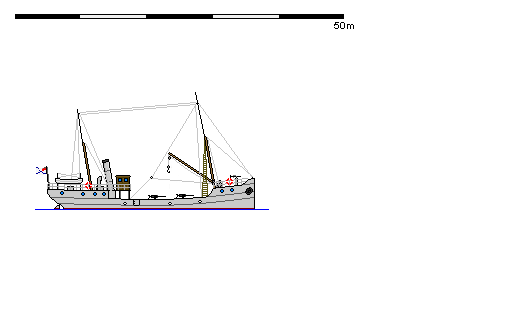
Patrolowce/trałowce pomocnicze typu DP-9


Kolejne okręty które nikogo pewnie nie zainteresują ;) czyli patrolowce pomocnicze na bazie małych frachtowców. Okręty są przeznaczone do służby w koloniach, a dokładnie na Madagaskarze, gdzie też została dokonana ich konwersja. Uzbrojeniem są dwa stare działka 6-funtowe. Przewiduję, że w razie potrzeby te jednostki będą mogły pełnić funkcję pomocniczych trałowców, na wypadek jakby jakiś niemiecki rajder zechciał nam utrudnić minami żeglugę. To wszystko jest, jak sądzę, dostatecznym uzasadnieniem dla ich zmobilizowania :)   


DP-9, polish auxiliary patrol boat laid down 1902, mobilized 1914

Displacement:
    239 t light; 246 t standard; 267 t normal; 284 t full load

Dimensions: Length overall / water x beam x draught
    103,41 ft / 95,44 ft x 18,96 ft x 8,76 ft (normal load)
    31,52 m / 29,09 m x 5,78 m  x 2,67 m

Armament:
      2 - 2,24" / 57,0 mm guns in single mounts, 5,23lbs / 2,37kg shells, 1885 Model
      Quick firing guns in deck mounts
      on centreline, all amidships
      1 - 0,30" / 7,6 mm guns in single mounts, 0,01lbs / 0,00kg shells, 1913 Model
      Machine gun in deck mount
      on centreline forward
    Weight of broadside 10 lbs / 5 kg
    Shells per gun, main battery: 300

Machinery:
    Coal fired boilers, simple reciprocating steam engines,
    Direct drive, 1 shaft, 131 ihp / 98 Kw = 9,00 kts
    Range 3 000nm at 7,00 kts
    Bunker at max displacement = 38 tons (100% coal)

Complement:
    32 - 42

Cost:
    £0,013 million / $0,051 million

Distribution of weights at normal displacement:
    Armament: 1 tons, 0,5%
    Machinery: 23 tons, 8,5%
    Hull, fittings & equipment: 215 tons, 80,5%
    Fuel, ammunition & stores: 28 tons, 10,5%
    Miscellaneous weights: 0 tons, 0,0%

Overall survivability and seakeeping ability:
    Survivability (Non-critical penetrating hits needed to sink ship):
      629 lbs / 285 Kg = 111,3 x 2,2 " / 57 mm shells or 1,0 torpedoes
    Stability (Unstable if below 1.00): 0,97
    Metacentric height 0,4 ft / 0,1 m
    Roll period: 12,7 seconds
    Steadiness    - As gun platform (Average = 50 %): 100 %
            - Recoil effect (Restricted arc if above 1.00): 0,06
    Seaboat quality  (Average = 1.00): 2,00

Hull form characteristics:
    Hull has raised forecastle, raised quarterdeck
    Block coefficient: 0,590
    Length to Beam Ratio: 5,03 : 1
    'Natural speed' for length: 9,77 kts
    Power going to wave formation at top speed: 48 %
    Trim (Max stability = 0, Max steadiness = 100): 50
    Bow angle (Positive = bow angles forward): 0,00 degrees
    Stern overhang: 7,97 ft / 2,43 m
    Freeboard (% = measuring location as a percentage of overall length):
       - Stem:        15,45 ft / 4,71 m
       - Forecastle (20%):    10,43 ft / 3,18 m (6,00 ft / 1,83 m aft of break)
       - Mid (50%):        4,99 ft / 1,52 m
       - Quarterdeck (30%):    9,48 ft / 2,89 m (5,48 ft / 1,67 m before break)
       - Stern:        9,48 ft / 2,89 m
       - Average freeboard:    8,05 ft / 2,46 m

Ship space, strength and comments:
    Space    - Hull below water (magazines/engines, low = better): 33,3%
        - Above water (accommodation/working, high = better): 41,1%
    Waterplane Area: 1 281 Square feet or 119 Square metres
    Displacement factor (Displacement / loading): 478%
    Structure weight / hull surface area: 84 lbs/sq ft or 411 Kg/sq metre
    Hull strength (Relative):
        - Cross-sectional: 3,01
        - Longitudinal: 27,14
        - Overall: 3,75
    Hull space for machinery, storage, compartmentation is excellent
    Room for accommodation and workspaces is extremely poor
    Ship has slow, easy roll, a good, steady gun platform
    Excellent seaboat, comfortable, can fire her guns in the heaviest weather

DP-9 (1902, mobilized 1914)
DP-10 (1902, mobilized 1914)
DP-11 (1903, mobilized 1914)
DP-12 (1903, mobilized 1914)

sobota, 1 października 2016

Rzeczne kutry uzbrojone


Czas na kolejne jednostki dla flotylli rzecznej. Są to 14-tonowe kutry uzbrojone, o napędzie silnikiem spalinowym, wyposażone w 1 działko kal. 37 mm Mc Cleana. Od poprzedniego typu przeznaczonego na rzeki krajowe (typ Osa z 1906 r. – post z 24.04.2015 r.) nowe kutry są szybsze o niemal 3 w., a posiadając niewielkie zanurzenie rzędu 0,5 m mają możliwość pływania po niemal wszystkich wodach śródlądowych nawet przy niskim ich stanie.   


RKU-1, polish river cutter laid down 1914

Displacement:
    13 t light; 14 t standard; 14 t normal; 14 t full load

Dimensions: Length overall / water x beam x draught
    55,15 ft / 55,15 ft x 11,68 ft x 1,80 ft (normal load)
    16,81 m / 16,81 m x 3,56 m  x 0,55 m

Armament:
      1 - 1,46" / 37,0 mm guns in single mounts, 1,55lbs / 0,70kg shells, 1914 Model
      Quick firing gun in deck mount
      on centreline forward
    Weight of broadside 2 lbs / 1 kg
    Shells per gun, main battery: 800

Armour:
   - Gun armour:    Face (max)    Other gunhouse (avg)    Barbette/hoist (max)
    Main:    0,91" / 23 mm          -                  -

Machinery:
    Petrol Internal combustion motors,
    Direct drive, 1 shaft, 653 shp / 487 Kw = 19,00 kts
    Range 230nm at 9,00 kts
    Bunker at max displacement = 1 tons
      Caution: Delicate, lightweight machinery

Complement:
    6

Cost:
    £0,002 million / $0,009 million

Distribution of weights at normal displacement:
    Armament: 0 tons, 1,4%
    Armour: 1 tons, 4,1%
       - Belts: 0 tons, 0,0%
       - Torpedo bulkhead: 0 tons, 0,0%
       - Armament: 1 tons, 4,1%
       - Armour Deck: 0 tons, 0,0%
       - Conning Tower: 0 tons, 0,0%
    Machinery: 8 tons, 56,2%
    Hull, fittings & equipment: 4 tons, 28,7%
    Fuel, ammunition & stores: 1 tons, 9,6%
    Miscellaneous weights: 0 tons, 0,0%

Overall survivability and seakeeping ability:
    Survivability (Non-critical penetrating hits needed to sink ship):
      4 lbs / 2 Kg = 2,6 x 1,5 " / 37 mm shells or 0,0 torpedoes
    Stability (Unstable if below 1.00): 2,17
    Metacentric height 0,7 ft / 0,2 m
    Roll period: 6,0 seconds
    Steadiness    - As gun platform (Average = 50 %): 5 %
            - Recoil effect (Restricted arc if above 1.00): 0,01
    Seaboat quality  (Average = 1.00): 0,01

Hull form characteristics:
    Hull has a flush deck
    Block coefficient: 0,422
    Length to Beam Ratio: 4,72 : 1
    'Natural speed' for length: 7,43 kts
    Power going to wave formation at top speed: 85 %
    Trim (Max stability = 0, Max steadiness = 100): 50
    Bow angle (Positive = bow angles forward): 0,00 degrees
    Stern overhang: 0,00 ft / 0,00 m
    Freeboard (% = measuring location as a percentage of overall length):
       - Stem:        2,99 ft / 0,91 m
       - Forecastle (20%):    2,99 ft / 0,91 m
       - Mid (50%):        2,49 ft / 0,76 m
       - Quarterdeck (15%):    2,00 ft / 0,61 m
       - Stern:        2,00 ft / 0,61 m
       - Average freeboard:    2,51 ft / 0,76 m
    Ship tends to be wet forward

Ship space, strength and comments:
    Space    - Hull below water (magazines/engines, low = better): 196,1%
        - Above water (accommodation/working, high = better): 59,9%
    Waterplane Area: 381 Square feet or 35 Square metres
    Displacement factor (Displacement / loading): 27%
    Structure weight / hull surface area: 8 lbs/sq ft or 40 Kg/sq metre
    Hull strength (Relative):
        - Cross-sectional: 0,45
        - Longitudinal: 1,37
        - Overall: 0,50
    Caution: Hull subject to strain in open-sea
    Hull space for machinery, storage, compartmentation is cramped
    Room for accommodation and workspaces is cramped
    Ship has quick, lively roll, not a steady gun platform
    Caution: Lacks seaworthiness - very limited seakeeping ability

RKU-1 (1914)
RKU-2 (1914)
RKU-3 (1914)
RKU-4 (1914)
RKU-5 (1914)
RKU-6 (1915)
RKU-7 (1915)

niedziela, 25 września 2016

Rzeczna bateria pływająca


Dziś nietypowe jednostki dla flotylli rzecznych. Są to barki rzeczne zaadaptowane na prędce do pełnienia roli pływających baterii artyleryjskich. Celem samodzielnego poruszania się otrzymały one silniki diesla. Zamontowane na nich działa kal. 152 mm są wprawdzie archaiczne, ale cóż zrobić – takie leżały jeszcze w magazynie, więc z nich skorzystałem. Pochodzą one z wycofanych okrętów – kanonierek typu Pegaz (z lat 1876-78), korwet typu Strzybóg (z lat 1877-78), taranowca Zawisza Czarny z 1872 r. i krążownika Admirał Dickmann z 1881 r. (w sumie naliczyłem 63 szt. w magazynach). Armaty mają długość lufy L/23, oryginalnie jako ładunku miotającego używały czarnego prochu,  który 38-kg pociskom nadawał prędkość wylotową 435 m/s przy szybkostrzelności do 2 strz./min. Dokładny ich zasięg nie jest mi znany, ale przez analogię do innych dział rosyjskich z tego czasu (107 mm L/20 z 1867 r. i 203 mm L/22 z 1867 r.) szacuję go na ok. 2-3 km.  Do zastosowań na morzu działa te nie nadają się już w ogóle, ale na wodach śródlądowych, do rażenia wrogiej piechoty pociskami odłamkowymi mogą być jeszcze przydatne.  Sądzę że przy pewnych modyfikacjach, w tym nowszych ładunkach miotających, wspomniane parametry dało by się jeszcze nieco poprawić. Seria okrętów jest relatywnie krótka (liczy 5 sztuk), by ryzyko i koszty na wypadek niepowodzenia koncepcji nie były dotkliwe. Jeśli okręty w takiej konfiguracji  się nie sprawdzą, to po prostu kolejnych podobnych nie będzie.  


BP-1, polish river floating battery laid down 1914

Displacement:
    171 t light; 181 t standard; 182 t normal; 183 t full load

Dimensions: Length overall / water x beam x draught
    129,24 ft / 126,74 ft x 20,44 ft x 3,12 ft (normal load)
    39,39 m / 38,63 m x 6,23 m  x 0,95 m

Armament:
      2 - 5,98" / 152 mm guns in single mounts, 70,18lbs / 31,83kg shells, 1867 Model
      Breech loading guns in deck mounts with hoists
      on centreline, evenly spread
      Main guns limited to end-on fire
      1 - 1,46" / 37,0 mm guns in single mounts, 1,55lbs / 0,70kg shells, 1914 Model
      Quick firing gun in deck mount
      on centreline forward
    Weight of broadside 142 lbs / 64 kg
    Shells per gun, main battery: 75

Armour:
   - Gun armour:    Face (max)    Other gunhouse (avg)    Barbette/hoist (max)
    Main:    1,18" / 30 mm    1,18" / 30 mm              -

Machinery:
    Diesel Internal combustion motors,
    Direct drive, 1 shaft, 75 shp / 56 Kw = 8,00 kts
    Range 200nm at 6,00 kts
    Bunker at max displacement = 2 tons

Complement:
    24 - 32

Cost:
    £0,027 million / $0,108 million

Distribution of weights at normal displacement:
    Armament: 18 tons, 9,7%
    Armour: 12 tons, 6,5%
       - Belts: 0 tons, 0,0%
       - Torpedo bulkhead: 0 tons, 0,0%
       - Armament: 12 tons, 6,5%
       - Armour Deck: 0 tons, 0,0%
       - Conning Tower: 0 tons, 0,0%
    Machinery: 3 tons, 1,6%
    Hull, fittings & equipment: 139 tons, 76,2%
    Fuel, ammunition & stores: 11 tons, 6,0%
    Miscellaneous weights: 0 tons, 0,0%

Overall survivability and seakeeping ability:
    Survivability (Non-critical penetrating hits needed to sink ship):
      432 lbs / 196 Kg = 4,0 x 6,0 " / 152 mm shells or 0,5 torpedoes
    Stability (Unstable if below 1.00): 1,01
    Metacentric height 0,5 ft / 0,1 m
    Roll period: 12,5 seconds
    Steadiness    - As gun platform (Average = 50 %): 69 %
            - Recoil effect (Restricted arc if above 1.00): 1,56
    Seaboat quality  (Average = 1.00): 1,50

Hull form characteristics:
    Hull has a flush deck
    Block coefficient: 0,790
    Length to Beam Ratio: 6,20 : 1
    'Natural speed' for length: 11,26 kts
    Power going to wave formation at top speed: 29 %
    Trim (Max stability = 0, Max steadiness = 100): 46
    Bow angle (Positive = bow angles forward): 15,00 degrees
    Stern overhang: 0,49 ft / 0,15 m
    Freeboard (% = measuring location as a percentage of overall length):
       - Stem:        7,48 ft / 2,28 m
       - Forecastle (20%):    7,48 ft / 2,28 m
       - Mid (50%):        7,48 ft / 2,28 m
       - Quarterdeck (15%):    7,48 ft / 2,28 m
       - Stern:        7,48 ft / 2,28 m
       - Average freeboard:    7,48 ft / 2,28 m
    Ship tends to be wet forward

Ship space, strength and comments:
    Space    - Hull below water (magazines/engines, low = better): 76,9%
        - Above water (accommodation/working, high = better): 134,0%
    Waterplane Area: 2 257 Square feet or 210 Square metres
    Displacement factor (Displacement / loading): 114%
    Structure weight / hull surface area: 44 lbs/sq ft or 215 Kg/sq metre
    Hull strength (Relative):
        - Cross-sectional: 0,85
        - Longitudinal: 4,15
        - Overall: 1,00
    Hull space for machinery, storage, compartmentation is excellent
    Room for accommodation and workspaces is excellent
    Good seaboat, rides out heavy weather easily

BP-1 (1914)
BP-2 (1914)
BP-3 (1914)
BP-4 (1914)
BP-5 (1914)
BP-5 (1914)