niedziela, 28 lipca 2024

Bardzo szybki krążownik:)

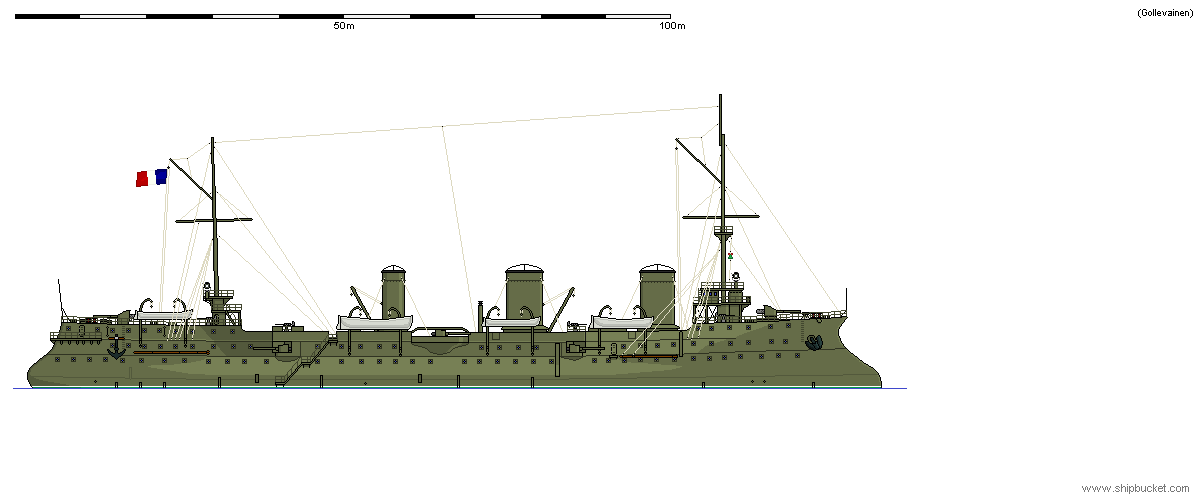
U schyłku XIX w. we Francji, w ramach realizacji idei Jeune Ecole, rozpoczęto przymiarki do budowy dużych krążowników pancernopokładowych przeznaczonych do działań na liniach komunikacyjnych. Bezpośrednim impulsem były ponoć amerykańskie krążowniki typu Columbia, o takim właśnie przeznaczeniu. Jeden z pierwszych takich projektów (o ile w ogóle nie pierwszy) określany jako „croiseur tres rapide” („bardzo szybki krążownik”) pochodził z 1894 r. i przewidywał sporych rozmiarów (8500 ton) jednostkę, stosunkowo lekko uzbrojoną i opancerzoną, ale za to o dobrej dzielności morskiej, dużym zasięgu i oczywiście dużej prędkości. Ostatecznie, pomysł ten wyewoluował w krążowniki Guichen z 1897 r. i Chateaurenault z 1898 r. Poniżej prezentuję moją symulację pierwotnego projektu, wspartą wizualizacją pochodzącą z forum shipbucket.com. 


Maille-Breze, french protected cruiser laid down 1894 (Engine 1896)

Displacement:
    7 486 t light; 7 758 t standard; 8 712 t normal; 9 476 t full load

Dimensions: Length overall / water x beam x draught
    427,00 ft / 424,02 ft x 51,05 ft x 25,00 ft (normal load)
    130,15 m / 129,24 m x 15,56 m  x 7,62 m

Armament:
      2 - 6,46" / 164 mm guns in single mounts, 134,59lbs / 61,05kg shells, 1893 Model
      Quick firing guns in deck mounts
      on centreline ends, evenly spread
      6 - 5,43" / 138 mm guns in single mounts, 80,19lbs / 36,37kg shells, 1893 Model
      Quick firing guns in deck mounts
      on side, all amidships
      8 - 1,85" / 47,0 mm guns in single mounts, 2,93lbs / 1,33kg shells, 1885 Model
      Quick firing guns in deck mounts
      on side, evenly spread, 4 raised mounts
    Weight of broadside 774 lbs / 351 kg
    Shells per gun, main battery: 200
    2 - 17,7" / 450 mm submerged torpedo tubes

Armour:
   - Gun armour:    Face (max)    Other gunhouse (avg)    Barbette/hoist (max)
    Main:    1,57" / 40 mm    0,98" / 25 mm              -
    2nd:    1,57" / 40 mm    0,98" / 25 mm              -

   - Armour deck: 2,05" / 52 mm (deck 1,57" / 40 mm, slopes 2,95" / 75 mm), Conning tower: 3,94" / 100 mm

Machinery:
    Coal fired boilers, complex reciprocating steam engines,
    Direct drive, 3 shafts, 21 143 ihp / 15 773 Kw = 22,10 kts
    Range 7 000nm at 10,00 kts
    Bunker at max displacement = 1 718 tons (100% coal)

Complement:
    450 - 586

Cost:
    £0,837 million / $3,346 million

Distribution of weights at normal displacement:
    Armament: 97 tons, 1,1%
    Armour: 659 tons, 7,6%
       - Belts: 0 tons, 0,0%
       - Torpedo bulkhead: 0 tons, 0,0%
       - Armament: 44 tons, 0,5%
       - Armour Deck: 579 tons, 6,7%
       - Conning Tower: 36 tons, 0,4%
    Machinery: 3 524 tons, 40,4%
    Hull, fittings & equipment: 3 207 tons, 36,8%
    Fuel, ammunition & stores: 1 226 tons, 14,1%
    Miscellaneous weights: 0 tons, 0,0%

Overall survivability and seakeeping ability:
    Survivability (Non-critical penetrating hits needed to sink ship):
      5 597 lbs / 2 539 Kg = 41,6 x 6,5 " / 164 mm shells or 0,8 torpedoes
    Stability (Unstable if below 1.00): 1,15
    Metacentric height 2,4 ft / 0,7 m
    Roll period: 13,9 seconds
    Steadiness    - As gun platform (Average = 50 %): 100 %
            - Recoil effect (Restricted arc if above 1.00): 0,35
    Seaboat quality  (Average = 1.00): 2,00

Hull form characteristics:
    Hull has a flush deck
    Block coefficient: 0,564
    Length to Beam Ratio: 8,31 : 1
    'Natural speed' for length: 20,59 kts
    Power going to wave formation at top speed: 51 %
    Trim (Max stability = 0, Max steadiness = 100): 50
    Bow angle (Positive = bow angles forward): -25,00 degrees
    Stern overhang: 2,99 ft / 0,91 m
    Freeboard (% = measuring location as a percentage of overall length):
       - Stem:        35,89 ft / 10,94 m
       - Forecastle (12%):    33,40 ft / 10,18 m
       - Mid (50%):        27,92 ft / 8,51 m
       - Quarterdeck (6%):    31,92 ft / 9,73 m
       - Stern:        32,91 ft / 10,03 m
       - Average freeboard:    30,86 ft / 9,41 m

Ship space, strength and comments:
    Space    - Hull below water (magazines/engines, low = better): 144,7%
        - Above water (accommodation/working, high = better): 196,0%
    Waterplane Area: 15 299 Square feet or 1 421 Square metres
    Displacement factor (Displacement / loading): 103%
    Structure weight / hull surface area: 77 lbs/sq ft or 377 Kg/sq metre
    Hull strength (Relative):
        - Cross-sectional: 0,76
        - Longitudinal: 10,72
        - Overall: 1,00
    Hull space for machinery, storage, compartmentation is cramped
    Room for accommodation and workspaces is excellent
    Ship has slow, easy roll, a good, steady gun platform
    Excellent seaboat, comfortable, can fire her guns in the heaviest weather

sobota, 20 lipca 2024

Krążownik dla Persji

W 1881 r. koncern Armstronga opracował projekt powiększonego krążownika Tsukushi. Okręt miał być nieco większy, lepiej uzbrojony i o lepszej dzielności morskiej. Nieść miał dodatkowe 2 działa kal. 120 mm i mieć podwyższoną dziobówkę przed dziobowym działem kal. 254 mm. Ograniczało to nieco kąty ostrzału (brak możliwości strzelania w kierunku dziobu) ale za to miało poprawić dzielność morską.
Otwartą kwestią jest flota, dla której okręt miałby powstać. Możliwe, że adresat nie został określony, a projekt powstał w celach spekulacyjnych (czasem tak było, że nawet zaczynano budować okręt bez zamówienia, a klienta szukano i znajdowano już w trakcie budowy). Ja proponuję go dla kraju, którego na blogu jeszcze nie było, czyli… Persji.


Darayavaus, persian protected cruiser laid down 1881 (Engine 1882)

Displacement:
    1 722 t light; 1 794 t standard; 1 973 t normal; 2 117 t full load

Dimensions: Length overall / water x beam x draught
    234,15 ft / 232,64 ft x 37,01 ft x 16,11 ft (normal load)
    71,37 m / 70,91 m x 11,28 m  x 4,91 m

Armament:
      2 - 10,00" / 254 mm guns in single mounts, 417,50lbs / 189,37kg shells, 1879 Model
      Breech loading guns in casemate mounts
      on centreline ends, evenly spread
      1 gun in hull casemate - Limited use in any sea
      6 - 4,72" / 120 mm guns in single mounts, 44,02lbs / 19,97kg shells, 1879 Model
      Breech loading guns in casemate mounts
      on side, all amidships
      6 guns in hull casemates - Limited use in any sea
      4 - 1,85" / 47,0 mm guns in single mounts, 2,65lbs / 1,20kg shells, 1879 Model
      Quick firing guns in deck mounts
      on side ends, evenly spread
      2 - 0,98" / 25,0 mm guns in single mounts, 0,41lbs / 0,19kg shells, 1880 Model
      Quick firing guns in deck mounts
      on centreline ends, evenly spread
    Weight of broadside 1 111 lbs / 504 kg
    Shells per gun, main battery: 50
    2 - 14,0" / 356 mm submerged torpedo tubes

Armour:
   - Gun armour:    Face (max)    Other gunhouse (avg)    Barbette/hoist (max)
    Main:    1,50" / 38 mm          -                  -
    2nd:    0,98" / 25 mm          -                  -

   - Armour deck: 0,98" / 25 mm (deck 0,75" / 19 mm, slopes 1,50" / 38 mm), Conning tower: 1,50" / 38 mm

Machinery:
    Coal fired boilers, simple reciprocating steam engines,
    Direct drive, 2 shafts, 4 262 ihp / 3 179 Kw = 17,20 kts
    Range 3 700nm at 8,00 kts
    Bunker at max displacement = 323 tons (100% coal)

Complement:
    147 - 192

Cost:
    £0,270 million / $1,080 million

Distribution of weights at normal displacement:
    Armament: 139 tons, 7,0%
    Armour: 144 tons, 7,3%
       - Belts: 0 tons, 0,0%
       - Torpedo bulkhead: 0 tons, 0,0%
       - Armament: 35 tons, 1,8%
       - Armour Deck: 104 tons, 5,3%
       - Conning Tower: 5 tons, 0,3%
    Machinery: 665 tons, 33,7%
    Hull, fittings & equipment: 740 tons, 37,5%
    Fuel, ammunition & stores: 252 tons, 12,7%
    Miscellaneous weights: 34 tons, 1,7%

Overall survivability and seakeeping ability:
    Survivability (Non-critical penetrating hits needed to sink ship):
      730 lbs / 331 Kg = 1,7 x 10,0 " / 254 mm shells or 0,3 torpedoes
    Stability (Unstable if below 1.00): 1,49
    Metacentric height 2,2 ft / 0,7 m
    Roll period: 10,4 seconds
    Steadiness    - As gun platform (Average = 50 %): 100 %
            - Recoil effect (Restricted arc if above 1.00): 0,58
    Seaboat quality  (Average = 1.00): 2,00

Hull form characteristics:
    Hull has rise forward of midbreak
    Block coefficient: 0,498
    Length to Beam Ratio: 6,29 : 1
    'Natural speed' for length: 15,25 kts
    Power going to wave formation at top speed: 54 %
    Trim (Max stability = 0, Max steadiness = 100): 50
    Bow angle (Positive = bow angles forward): -13,00 degrees
    Stern overhang: 1,51 ft / 0,46 m
    Freeboard (% = measuring location as a percentage of overall length):
       - Stem:        17,45 ft / 5,32 m
       - Forecastle (27%):    15,94 ft / 4,86 m
       - Mid (75%):        13,45 ft / 4,10 m (6,99 ft / 2,13 m aft of break)
       - Quarterdeck (12%):    7,48 ft / 2,28 m
       - Stern:        7,48 ft / 2,28 m
       - Average freeboard:    13,33 ft / 4,06 m

Ship space, strength and comments:
    Space    - Hull below water (magazines/engines, low = better): 172,4%
        - Above water (accommodation/working, high = better): 96,7%
    Waterplane Area: 5 726 Square feet or 532 Square metres
    Displacement factor (Displacement / loading): 66%
    Structure weight / hull surface area: 72 lbs/sq ft or 350 Kg/sq metre
    Hull strength (Relative):
        - Cross-sectional: 0,84
        - Longitudinal: 4,71
        - Overall: 1,00
    Hull space for machinery, storage, compartmentation is cramped
    Room for accommodation and workspaces is adequate
    Ship has slow, easy roll, a good, steady gun platform
    Excellent seaboat, comfortable, can fire her guns in the heaviest weather
 

poniedziałek, 15 lipca 2024

Modernizacja monitorów typu Canonicus

W nawiązaniu do posta na temat modernizacji monitorów typu Passaic (25.02.2024 r.) dziś proponuję przebudowę jednostek typu Canonicus. Ma ona zasadniczo analogiczny charakter, czyli obejmuje: montaż nadbudówki w osi symetrii kadłuba przed i za wieżą działową, montaż omasztowania brygu z ożaglowaniem, wymianę uzbrojenia z dział gładkolufowych Dahlgrena na 10-calowe (300-funtowe) działa gwintowane odprzodowe Parrotta, montaż kartaczownic Gatlinga, wymianę starych maszyn parowych i kotłów na nowe dające zwiększoną do 1300 KM moc oraz montaż nowego opancerzonego stanowiska dowodzenia na nadbudówce oraz składanych nadburć. Jako że okręty są nieco większe niż poprzedni typ, to tutaj dodatkowo pokusiłem się jeszcze o dodanie dwóch dział Parrotta kal. 107 mm, do zwalczania celów na które niepraktycznym było by angażować ciężkie 10-calówki. Podobnie jak w przypadku przebudowy typu Passaic nie uzyskano tu może nowej jakości, ale z pewnością okręty dużo bardziej przystające do  realiów ówczesnego pola walki.


Canonicus, United States monitor laid down 1862 (Engine 1874)

Displacement:
    1 959 t light; 2 027 t standard; 2 114 t normal; 2 184 t full load

Dimensions: Length overall / water x beam x draught
    225,00 ft / 225,00 ft x 43,34 ft x 12,99 ft (normal load)
    68,58 m / 68,58 m x 13,21 m  x 3,96 m

Armament:
      2 - 10,00" / 254 mm guns (1x2 guns), 297,50lbs / 134,94kg shells, 1863 Model
      Muzzle loading guns in Coles/Ericsson turret
      on centreline amidships
      2 - 4,21" / 107 mm guns in single mounts, 22,24lbs / 10,09kg shells, 1863 Model
      Muzzle loading guns in deck mounts
      on centreline ends, evenly spread, all raised mounts
      3 - 0,98" / 25,0 mm guns in single mounts, 0,28lbs / 0,13kg shells, 1862 Model
      Quick firing guns in deck mounts
      on centreline, evenly spread
    Weight of broadside 640 lbs / 290 kg
    Shells per gun, main battery: 70

Armour:
   - Belts:        Width (max)    Length (avg)        Height (avg)
    Main:    5,00" / 127 mm    110,01 ft / 33,53 m    6,00 ft / 1,83 m
    Ends:    2,99" / 76 mm    100,00 ft / 30,48 m    6,00 ft / 1,83 m
      14,99 ft / 4,57 m Unarmoured ends
      Main Belt covers 75% of normal length
      Main belt does not fully cover magazines and engineering spaces

   - Gun armour:    Face (max)    Other gunhouse (avg)    Barbette/hoist (max)
    Main:    10,0" / 254 mm    5,98" / 152 mm              -

   - Armour deck: 1,50" / 38 mm, Conning tower: 5,51" / 140 mm

Machinery:
    Coal fired boilers, simple reciprocating steam engines,
    Direct drive, 1 shaft, 1 271 ihp / 948 Kw = 12,00 kts
    Range 1 100nm at 8,00 kts
    Bunker at max displacement = 157 tons (100% coal)

Complement:
    155 - 202

Cost:
    £0,176 million / $0,705 million

Distribution of weights at normal displacement:
    Armament: 80 tons, 3,8%
    Armour: 621 tons, 29,4%
       - Belts: 227 tons, 10,7%
       - Torpedo bulkhead: 0 tons, 0,0%
       - Armament: 185 tons, 8,7%
       - Armour Deck: 190 tons, 9,0%
       - Conning Tower: 20 tons, 0,9%
    Machinery: 288 tons, 13,6%
    Hull, fittings & equipment: 891 tons, 42,2%
    Fuel, ammunition & stores: 155 tons, 7,3%
    Miscellaneous weights: 78 tons, 3,7%

Overall survivability and seakeeping ability:
    Survivability (Non-critical penetrating hits needed to sink ship):
      1 165 lbs / 528 Kg = 4,0 x 10,0 " / 254 mm shells or 0,5 torpedoes
    Stability (Unstable if below 1.00): 1,16
    Metacentric height 1,9 ft / 0,6 m
    Roll period: 13,2 seconds
    Steadiness    - As gun platform (Average = 50 %): 63 %
            - Recoil effect (Restricted arc if above 1.00): 0,27
    Seaboat quality  (Average = 1.00): 1,27

Hull form characteristics:
    Hull has a flush deck
    Block coefficient: 0,584
    Length to Beam Ratio: 5,19 : 1
    'Natural speed' for length: 15,00 kts
    Power going to wave formation at top speed: 40 %
    Trim (Max stability = 0, Max steadiness = 100): 50
    Bow angle (Positive = bow angles forward): 0,00 degrees
    Stern overhang: 0,00 ft / 0,00 m
    Freeboard (% = measuring location as a percentage of overall length):
       - Stem:        7,51 ft / 2,29 m
       - Forecastle (20%):    7,51 ft / 2,29 m
       - Mid (50%):        7,51 ft / 2,29 m
       - Quarterdeck (25%):    7,51 ft / 2,29 m
       - Stern:        7,51 ft / 2,29 m
       - Average freeboard:    7,51 ft / 2,29 m
    Ship tends to be wet forward

Ship space, strength and comments:
    Space    - Hull below water (magazines/engines, low = better): 76,6%
        - Above water (accommodation/working, high = better): 63,3%
    Waterplane Area: 6 854 Square feet or 637 Square metres
    Displacement factor (Displacement / loading): 110%
    Structure weight / hull surface area: 96 lbs/sq ft or 466 Kg/sq metre
    Hull strength (Relative):
        - Cross-sectional: 0,74
        - Longitudinal: 1,48
        - Overall: 0,80
    Caution: Hull subject to strain in open-sea
    Hull space for machinery, storage, compartmentation is excellent
    Room for accommodation and workspaces is cramped
    Good seaboat, rides out heavy weather easily

Canonicus (1863, rebuilt 1874)
Manhattan (1863, rebuilt 1874)
Saugus (1863, rebuilt 1874)
Tecumseh (1863, rebuilt 1874)
Mahopac (1864, rebuilt 1875)
Ajax (1864, rebuilt 1875)
Wyandotte (1864, rebuilt 1875)
 

wtorek, 9 lipca 2024

Przebudowa korwet typu Bismarck dla Turcji

Flota turecka u schyłku XIX w. cierpiała na dotkliwy brak nowoczesnych okrętów. Próbowano sobie z tym radzić, modernizując posiadane stare jednostki, głównie pancerniki i pancerniki obrony wybrzeża. Nadających się do przebudowy jednostek krążowniczych jednak wcale nie posiadali. Tymczasem w latach 80-tych i na początku lat 90-tych Niemcy zaczęli wycofywać ze służby bądź przesuwać do zadań szkolnych całkiem niestare (z lat 1877-1879) korwety typu Bismarck. Były to okręty żelazne, nieopancerzone, z pełnym ożaglowaniem i uzbrojeniem w baterii burtowej. Były już więc koncepcyjnie przestarzałe, ale można by się pokusić o ich modernizację, co nasunęło mi pomysł sprzedaży 2 z nich, po uprzedniej głębokiej przebudowie, do Turcji.
W ramach tej przebudowy zlikwidowano w całości istniejące omasztowanie i ożaglowanie, instalując w zamian 2 maszty z marsami działkami szybkostrzelnymi. Zlikwidowano też konstrukcję galionu, jako zbędne obciążenie, uzyskując  w ten sposób niemal pionową stewę dziobową. Usunięto całe uzbrojenie  artyleryjskie w bateriach burtowych, montując w zamian na pokładzie 2 szybkostrzelne działa kal. 150 mm L/30 i 8 dział szybkostrzelnych kal. 105 mm L/35, co uzupełnia 9 działek kal. 37 mm. Na pokładzie bateryjnym zainstalowano 6 wyrzutni torped kal. 350 mm. Wymieniono wszystkie kotły na nowe wodnorurkowe, a istniejącą maszynę parową na nowoczesną maszynę potrójnego rozprężania, co pozwoliło w sumie podnieść prędkość z 12,5 w. do 18 w. oraz zasięg z 1940 Mm do 3500 Mm. Ponad maszynownią i kotłownią, na długości 28 m zainstalowano pokład pancerny o grubości 40 mm ze skosami o grubości 88 mm.
Po dokonanych zmianach, okręty wyglądają tak:


Muin-i Rahmet, turkish protected cruiser laid down 1875 (Engine 1891)

Displacement:
    2 543 t light; 2 650 t standard; 2 956 t normal; 3 201 t full load

Dimensions: Length overall / water x beam x draught
    257,92 ft / 243,64 ft x 45,01 ft x 18,64 ft (normal load)
    78,61 m / 74,26 m x 13,72 m  x 5,68 m

Armament:
      2 - 5,91" / 150 mm guns in single mounts, 99,89lbs / 45,31kg shells, 1888 Model
      Quick firing guns in deck mounts
      on centreline, all amidships
      8 - 4,13" / 105 mm guns in single mounts, 35,32lbs / 16,02kg shells, 1891 Model
      Quick firing guns in deck mounts
      on side, evenly spread
      5 - 1,46" / 37,0 mm guns in single mounts, 1,55lbs / 0,70kg shells, 1891 Model
      Quick firing guns in deck mounts
      on centreline, evenly spread, 3 raised mounts
      2 - 1,46" / 37,0 mm guns in single mounts, 1,55lbs / 0,70kg shells, 1891 Model
      Quick firing guns in casemate mounts
      on side, all forward
      2 guns in hull casemates - Limited use in heavy seas
      2 - 1,46" / 37,0 mm guns in single mounts, 1,55lbs / 0,70kg shells, 1891 Model
      Quick firing guns in deck mounts
      on side, all amidships
    Weight of broadside 496 lbs / 225 kg
    Shells per gun, main battery: 150
    6 - 13,8" / 350 mm above water torpedoes

Armour:
   - Gun armour:    Face (max)    Other gunhouse (avg)    Barbette/hoist (max)
    Main:    1,18" / 30 mm    0,79" / 20 mm              -
    2nd:    1,18" / 30 mm    0,79" / 20 mm              -

   - Armour deck: 0,79" / 20 mm (deck 1,57" / 40 mm, slopes 3,46" / 88 mm over machinery), Conning tower: 3,94" / 100 mm

Machinery:
    Coal fired boilers, complex reciprocating steam engines,
    Direct drive, 1 shaft, 6 114 ihp / 4 561 Kw = 18,00 kts
    Range 3 450nm at 10,00 kts
    Bunker at max displacement = 551 tons (100% coal)

Complement:
    199 - 260

Cost:
    £0,297 million / $1,187 million

Distribution of weights at normal displacement:
    Armament: 62 tons, 2,1%
    Armour: 153 tons, 5,2%
       - Belts: 0 tons, 0,0%
       - Torpedo bulkhead: 0 tons, 0,0%
       - Armament: 32 tons, 1,1%
       - Armour Deck: 103 tons, 3,5%
       - Conning Tower: 17 tons, 0,6%
    Machinery: 1 112 tons, 37,6%
    Hull, fittings & equipment: 1 217 tons, 41,2%
    Fuel, ammunition & stores: 413 tons, 14,0%
    Miscellaneous weights: 0 tons, 0,0%

Overall survivability and seakeeping ability:
    Survivability (Non-critical penetrating hits needed to sink ship):
      1 590 lbs / 721 Kg = 19,9 x 5,9 " / 150 mm shells or 0,4 torpedoes
    Stability (Unstable if below 1.00): 1,27
    Metacentric height 2,3 ft / 0,7 m
    Roll period: 12,4 seconds
    Steadiness    - As gun platform (Average = 50 %): 100 %
            - Recoil effect (Restricted arc if above 1.00): 0,28
    Seaboat quality  (Average = 1.00): 2,00

Hull form characteristics:
    Hull has raised forecastle
    Block coefficient: 0,506
    Length to Beam Ratio: 5,41 : 1
    'Natural speed' for length: 15,61 kts
    Power going to wave formation at top speed: 58 %
    Trim (Max stability = 0, Max steadiness = 100): 50
    Bow angle (Positive = bow angles forward): 2,00 degrees
    Stern overhang: 13,45 ft / 4,10 m
    Freeboard (% = measuring location as a percentage of overall length):
       - Stem:        23,95 ft / 7,30 m
       - Forecastle (15%):    22,93 ft / 6,99 m (20,44 ft / 6,23 m aft of break)
       - Mid (50%):        19,46 ft / 5,93 m
       - Quarterdeck (20%):    19,95 ft / 6,08 m
       - Stern:        21,46 ft / 6,54 m
       - Average freeboard:    20,55 ft / 6,26 m

Ship space, strength and comments:
    Space    - Hull below water (magazines/engines, low = better): 138,2%
        - Above water (accommodation/working, high = better): 112,5%
    Waterplane Area: 7 072 Square feet or 657 Square metres
    Displacement factor (Displacement / loading): 103%
    Structure weight / hull surface area: 80 lbs/sq ft or 391 Kg/sq metre
    Hull strength (Relative):
        - Cross-sectional: 0,78
        - Longitudinal: 9,34
        - Overall: 1,00
    Hull space for machinery, storage, compartmentation is cramped
    Room for accommodation and workspaces is adequate
    Ship has slow, easy roll, a good, steady gun platform
    Excellent seaboat, comfortable, can fire her guns in the heaviest weather

Muin-i Rahmet (1877, rebuilt 1891)
Mirat-i Zafer (1877, rebuilt 1892)
 

czwartek, 4 lipca 2024

Przebudowa pancerników typu Bretagne

Pod jednym z postów swego czasu rozwinęła się dyskusja na temat modernizacji francuskich pancerników typu Bretagne. Mimo pewnych głosów sceptycznych, zainspirował mnie ten temat, więc postanowiłem się nim zająć i oto efekt. W mojej wizji przebudowy okręt został zmodyfikowany naprawdę gruntownie. Wnętrze kadłuba pomiędzy dziobowymi i rufowymi wieżami artylerii głównej Zostało całkowicie przemodelowane, łącznie z usunięciem tamtejszej wieży działowej, maszynowni, kotłowni i nadbudówek. Zabudowano całkiem nowy napęd o mocy ok. 86000 KM, z kotłami opalanymi paliwem płynnym. Powyżej zlokalizowano nowe nadbudówki, w tym wieżową nadbudówkę dziobową i nowym opancerzonym stanowiskiem dowodzenia, pojedynczy komin, oraz wyposażenie lotnicze – katapultę z wodnosamolotem i dźwigiem (obsługującym także łodzie).  Korzystając z otwartego przy okazji przebudowy dostępu do dużej części kadłuba wzmocniono pancerz poziomy, który osiągnął grubość 150 mm na śródokręciu. Będąc przy temacie pancerza – uznałem, że burtowy jest zbyt cienki (zaledwie 250 mm) i również wymaga wzmocnienia, wobec czego zastąpiono go nowym, z płyt o grubości 300 mm. Do wież artylerii głównej  znajdujących się w superpozycji zamontowano nowe czołowe płyty pancerne o grubości analogicznej jak w wieżach poniżej, bowiem dotychczas miały zaledwie 250 mm, co uznałem za wartość zdecydowanie niewystarczającą. Kadłub przedłużono poprzez zbudowanie całkowicie nowej, wydłużonej sekcji dziobowej, z wychyloną do przodu dziobnicą. Po bokach zmontowano bąble które mają za zadanie nieco polepszyć stateczność jednostki i poprawić ochronę przeciwtorpedową, gdyż istniejąca gródź przeciwtorpedowa była bardzo cienka. W kwestii kadłuba warto też wspomnieć że zlikwidowano wszystkie kazamaty wraz z działami 138 mm, zlikwidowano uskoki kadłuba w rejonie skrajnych kazamat, a także usunięto podwodne wyrzutnie torped (gdyż w tej alternatywnie najprawdopodobniej nie było przebudów okrętów z I połowy lat 30-tych, kiedy to faktycznie je zlikwidowano). Modernizacjom uległo oczywiście uzbrojenie. Cała artyleria średnia została zastąpiona prze uniwersalne działa kal. 130 mm w podwójnych wieżach na śródokręciu. W roli artylerii plot zamontowano ponadto podwójne działka kal. 37 mm i km-y Hotchkissa kal 13,2 mm. W kwestii artylerii głównej dokonano dalszego powiększenia kąta podniesienia dział, celem poprawy ich zasięgu. Z tego co wiem, w rzeczywistości kąt podniesienia zwiększony do 23 stopni miał tylko Bretagne, co zapewniało mu zasięg 26,6 km, a pozostałe okręt musiały się zadowolić kątem 18 stopni i zasięgiem 21 km. Tu zakładam minimum ujednolicenie kąta podniesienia do 23 stopni na wszystkich okrętach, a jeśli się da – to może nawet zwiększenie tej wartości.


Bretagne, french battleship laid down 1912 (Engine 1937)

Displacement:
    24 578 t light; 25 742 t standard; 26 926 t normal; 27 874 t full load

Dimensions: Length overall / water x beam x draught
    604,85 ft / 594,39 ft x 88,25 ft (Bulges 95,54 ft) x 29,17 ft (normal load)
    184,36 m / 181,17 m x 26,90 m (Bulges 29,12 m)  x 8,89 m

Armament:
      4 - 13,39" / 340 mm guns (2x2 guns), 1 199,24lbs / 543,97kg shells, 1912 Model
      Breech loading guns in turrets (on barbettes)
      on centreline ends, evenly spread
      4 - 13,39" / 340 mm guns (2x2 guns), 1 199,24lbs / 543,97kg shells, 1912 Model
      Breech loading guns in turrets (on barbettes)
      on centreline ends, evenly spread, all raised mounts
      16 - 5,12" / 130 mm guns (8x2 guns), 67,03lbs / 30,40kg shells, 1932 Model
      Dual purpose guns in turrets (on barbettes)
      on side, all amidships, 4 raised mounts - superfiring
      12 - 1,46" / 37,0 mm guns (6x2 guns), 1,55lbs / 0,70kg shells, 1933 Model
      Anti-aircraft guns in deck mounts
      on side, all amidships, 2 raised mounts - superfiring
      12 - 0,52" / 13,2 mm guns (6x2 guns), 0,07lbs / 0,03kg shells, 1929 Model
      Machine guns in deck mounts
      on side, evenly spread, 2 raised mounts
    Weight of broadside 10 686 lbs / 4 847 kg
    Shells per gun, main battery: 100

Armour:
   - Belts:        Width (max)    Length (avg)        Height (avg)
    Main:    11,8" / 300 mm    324,80 ft / 99,00 m    13,29 ft / 4,05 m
    Ends:    5,31" / 135 mm    219,82 ft / 67,00 m    13,29 ft / 4,05 m
      49,77 ft / 15,17 m Unarmoured ends
    Upper:    6,30" / 160 mm    251,61 ft / 76,69 m    7,97 ft / 2,43 m
      Main Belt covers 84% of normal length
      Main belt does not fully cover magazines and engineering spaces

   - Torpedo Bulkhead and Bulges:
        0,31" / 8 mm    324,80 ft / 99,00 m    29,17 ft / 8,89 m

   - Gun armour:    Face (max)    Other gunhouse (avg)    Barbette/hoist (max)
    Main:    13,4" / 340 mm    6,06" / 154 mm        9,76" / 248 mm
    2nd:    13,4" / 340 mm    6,06" / 154 mm        10,6" / 270 mm
    3rd:    0,98" / 25 mm    0,98" / 25 mm        3,94" / 100 mm

   - Armour deck: 4,13" / 105 mm (5,91" / 150 mm over amidships, 2,95" / 75 mm over ends), Conning tower: 11,81" / 300 mm

Machinery:
    Oil fired boilers, steam turbines,
    Geared drive, 4 shafts, 86 388 shp / 64 445 Kw = 27,00 kts
    Range 6 000nm at 14,00 kts
    Bunker at max displacement = 2 131 tons

Complement:
    1 050 - 1 366

Cost:
    £2,317 million / $9,270 million

Distribution of weights at normal displacement:
    Armament: 1 336 tons, 5,0%
    Armour: 9 023 tons, 33,5%
       - Belts: 3 487 tons, 12,9%
       - Torpedo bulkhead: 110 tons, 0,4%
       - Armament: 2 347 tons, 8,7%
       - Armour Deck: 2 850 tons, 10,6%
       - Conning Tower: 229 tons, 0,8%
    Machinery: 2 394 tons, 8,9%
    Hull, fittings & equipment: 11 775 tons, 43,7%
    Fuel, ammunition & stores: 2 348 tons, 8,7%
    Miscellaneous weights: 50 tons, 0,2%

Overall survivability and seakeeping ability:
    Survivability (Non-critical penetrating hits needed to sink ship):
      37 540 lbs / 17 028 Kg = 31,3 x 13,4 " / 340 mm shells or 5,4 torpedoes
    Stability (Unstable if below 1.00): 1,05
    Metacentric height 4,5 ft / 1,4 m
    Roll period: 18,8 seconds
    Steadiness    - As gun platform (Average = 50 %): 48 %
            - Recoil effect (Restricted arc if above 1.00): 0,59
    Seaboat quality  (Average = 1.00): 0,92

Hull form characteristics:
    Hull has rise forward of midbreak
    Block coefficient: 0,569
    Length to Beam Ratio: 6,22 : 1
    'Natural speed' for length: 24,38 kts
    Power going to wave formation at top speed: 56 %
    Trim (Max stability = 0, Max steadiness = 100): 50
    Bow angle (Positive = bow angles forward): 19,00 degrees
    Stern overhang: 0,49 ft / 0,15 m
    Freeboard (% = measuring location as a percentage of overall length):
       - Stem:        28,94 ft / 8,82 m
       - Forecastle (24%):    22,44 ft / 6,84 m
       - Mid (72%):        22,44 ft / 6,84 m (14,47 ft / 4,41 m aft of break)
       - Quarterdeck (16%):    14,47 ft / 4,41 m
       - Stern:        14,47 ft / 4,41 m
       - Average freeboard:    20,86 ft / 6,36 m

Ship space, strength and comments:
    Space    - Hull below water (magazines/engines, low = better): 86,6%
        - Above water (accommodation/working, high = better): 141,0%
    Waterplane Area: 37 268 Square feet or 3 462 Square metres
    Displacement factor (Displacement / loading): 110%
    Structure weight / hull surface area: 213 lbs/sq ft or 1 040 Kg/sq metre
    Hull strength (Relative):
        - Cross-sectional: 1,05
        - Longitudinal: 1,91
        - Overall: 1,12
    Hull space for machinery, storage, compartmentation is adequate
    Room for accommodation and workspaces is excellent
    Poor seaboat, wet and uncomfortable, reduced performance in heavy weather

1 catapult, 1 seaplane

Bretagne (1913, rebuilt 1937)
Provence (1913, rebuilt 1938)
Lorraine (1913, rebuilt 1939)
 

sobota, 29 czerwca 2024

Pancerniki 18-działowe

Dziś projekt pancernika z jedną z największych liczbą dział w historii – 18-działowy projekt stoczni Ansaldo z 1908 r. dla Rosji (choć są też informacje, że był również oferowany Argentynie). Autorem ponoć był sam Cuniberti. Okręt charakteryzuje się nadzwyczaj niecodziennym układem uzbrojenia. Trójdziałowe wieże to jeszcze nic. Najlepsze jest ich rozmieszczenie. Cztery wieże umieszczono bowiem na burtach – jedna para na dziobie, druga na śródokręciu, a pozostałe 2 – w superpozycji na rufie. Przekazów na temat motywacji takiego układu brak, ale być może chodziło o to, że okręt nie miał walczyć w składzie długiej linii bojowej, gdzie najważniejsza jest salwa burtowa, ale pojedynczo lub w składzie nielicznego zespołu, gdzie ważniejsze jest równomierne pokrycie ogniem wszystkich sektorów wokół okrętu.
Mimo iż dość lekko opancerzony i mający standardową prędkość, zamiast projektowych 23 000 ton, okręt liczy sobie 24000 ton. Zatem, jak wiele projektów z tamtego czasu, zwłaszcza wielodziałowych, okazał się nieco niedoszacowany co do wyporności, ale nie aż tak jakby mogło się wydawać na pierwszy rzut oka. Zdaje się to sugerować, że wbrew pozorom, był on jakoś tam policzony, a nie był tylko zbiorem pobożnych życzeń. Nie miał przy tym, rzecz jasna, specjalnych szans na realizację, niemniej jest bardzo ciekawy i niecodzienny i to mi wystarczyło, by się nim zająć. Efekt - poniżej ;) 


Swiatosław, russian battleship laid down 1908 (Engine 1910)

Displacement:
    21 611 t light; 23 228 t standard; 23 995 t normal; 24 609 t full load

Dimensions: Length overall / water x beam x draught
    581,62 ft / 577,69 ft x 91,99 ft x 26,74 ft (normal load)
    177,28 m / 176,08 m x 28,04 m  x 8,15 m

Armament:
      12 - 12,01" / 305 mm guns (4x3 guns), 865,70lbs / 392,67kg shells, 1907 Model
      Breech loading guns in turrets (on barbettes)
      on side, evenly spread, 2 raised mounts
      Aft Main mounts separated by engine room
      6 - 12,01" / 305 mm guns (2x3 guns), 865,70lbs / 392,67kg shells, 1907 Model
      Breech loading guns in turrets (on barbettes)
      on centreline, all aft, 1 raised mount - superfiring
      16 - 4,72" / 120 mm guns in single mounts, 52,72lbs / 23,91kg shells, 1905 Model
      Quick firing guns in casemate mounts
      on side, evenly spread
      16 guns in hull casemates - Limited use in all but light seas
      4 - 1,85" / 47,0 mm guns in single mounts, 2,84lbs / 1,29kg shells, 1883 Model
      Quick firing guns in deck mounts
      on centreline ends, evenly spread, all raised mounts - superfiring
      8 - 0,30" / 7,6 mm guns in single mounts, 0,01lbs / 0,00kg shells, 1905 Model
      Machine guns in deck mounts
      on side, all amidships, all raised mounts - superfiring
    Weight of broadside 16 438 lbs / 7 456 kg
    Shells per gun, main battery: 120
    4 - 18,0" / 457 mm submerged torpedo tubes

Armour:
   - Belts:        Width (max)    Length (avg)        Height (avg)
    Main:    7,99" / 203 mm    371,56 ft / 113,25 m    11,68 ft / 3,56 m
    Ends:    5,98" / 152 mm    195,18 ft / 59,49 m    11,68 ft / 3,56 m
      10,96 ft / 3,34 m Unarmoured ends
    Upper:    4,02" / 102 mm    208,73 ft / 63,62 m    7,51 ft / 2,29 m
      Main Belt covers 99% of normal length
      Main belt does not fully cover magazines and engineering spaces

   - Torpedo Bulkhead:
        2,01" / 51 mm    371,56 ft / 113,25 m    25,69 ft / 7,83 m

   - Gun armour:    Face (max)    Other gunhouse (avg)    Barbette/hoist (max)
    Main:    12,0" / 305 mm    7,99" / 203 mm        7,99" / 203 mm
    2nd:    12,0" / 305 mm    7,99" / 203 mm        7,99" / 203 mm
    3rd:    2,99" / 76 mm          -                  -

   - Armour deck: 1,93" / 49 mm (2,48" / 63 mm over amidships, 0,98" / 25 mm over ends), Conning tower: 10,00" / 254 mm

Machinery:
    Coal and oil fired boilers, steam turbines,
    Direct drive, 4 shafts, 30 695 shp / 22 899 Kw = 21,00 kts
    Range 4 000nm at 10,00 kts
    Bunker at max displacement = 1 380 tons (50% coal)

Complement:
    963 - 1 253

Cost:
    £2,668 million / $10,674 million

Distribution of weights at normal displacement:
    Armament: 2 055 tons, 8,6%
    Armour: 7 444 tons, 31,0%
       - Belts: 2 353 tons, 9,8%
       - Torpedo bulkhead: 709 tons, 3,0%
       - Armament: 2 828 tons, 11,8%
       - Armour Deck: 1 376 tons, 5,7%
       - Conning Tower: 179 tons, 0,7%
    Machinery: 1 329 tons, 5,5%
    Hull, fittings & equipment: 10 783 tons, 44,9%
    Fuel, ammunition & stores: 2 384 tons, 9,9%
    Miscellaneous weights: 0 tons, 0,0%

Overall survivability and seakeeping ability:
    Survivability (Non-critical penetrating hits needed to sink ship):
      24 511 lbs / 11 118 Kg = 28,3 x 12,0 " / 305 mm shells or 4,2 torpedoes
    Stability (Unstable if below 1.00): 1,02
    Metacentric height 4,6 ft / 1,4 m
    Roll period: 18,1 seconds
    Steadiness    - As gun platform (Average = 50 %): 62 %
            - Recoil effect (Restricted arc if above 1.00): 0,87
    Seaboat quality  (Average = 1.00): 1,24

Hull form characteristics:
    Hull has raised forecastle
    Block coefficient: 0,591
    Length to Beam Ratio: 6,28 : 1
    'Natural speed' for length: 24,04 kts
    Power going to wave formation at top speed: 44 %
    Trim (Max stability = 0, Max steadiness = 100): 50
    Bow angle (Positive = bow angles forward): 3,00 degrees
    Stern overhang: 2,49 ft / 0,76 m
    Freeboard (% = measuring location as a percentage of overall length):
       - Stem:        27,43 ft / 8,36 m
       - Forecastle (21%):    25,92 ft / 7,90 m (17,45 ft / 5,32 m aft of break)
       - Mid (50%):        15,45 ft / 4,71 m
       - Quarterdeck (15%):    15,45 ft / 4,71 m
       - Stern:        15,94 ft / 4,86 m
       - Average freeboard:    18,09 ft / 5,51 m

Ship space, strength and comments:
    Space    - Hull below water (magazines/engines, low = better): 109,2%
        - Above water (accommodation/working, high = better): 121,3%
    Waterplane Area: 38 543 Square feet or 3 581 Square metres
    Displacement factor (Displacement / loading): 90%
    Structure weight / hull surface area: 206 lbs/sq ft or 1 007 Kg/sq metre
    Hull strength (Relative):
        - Cross-sectional: 0,96
        - Longitudinal: 1,48
        - Overall: 1,00
    Hull space for machinery, storage, compartmentation is adequate
    Room for accommodation and workspaces is excellent
    Good seaboat, rides out heavy weather easily

Swiatosław (1910)
Siełafaił (1911)
Gawriił (1912)
Rafaił (1913)

poniedziałek, 24 czerwca 2024

Monitory fińskie

Zanim powstała para fińskich POW Vainamoinen i Ilmarinen, pojawiło się całkiem sporo propozycji przybrzeżnych okrętów artyleryjskich dla tej floty. Pierwszą była propozycja dowódcy floty, kmdr Von Bonsdorffa z 1921 r., przewidująca budowę 4 „monitorów przybrzeżnych” o wyporności 3500 ton, wymiarach 84x18,3 m, prędkości 12 w. i uzbrojeniu… 6x305 (!). Bliższych szczegółów jednostki niestety brak, nie zachował się też żaden jej szkic, stąd charakterystyki i wygląd jednostki są moją fantazją. Oczywiście, wyporność była absolutnie niewystarczająca dla tak ciężkiego uzbrojenia. Zatem symulacja sprowadzała się do wyzwania polegającego na umieszczeniu tego uzbrojenia w jak najmniejszej wyporności. Z pewnym trudem okręt udało się „zmieścić” na 4300 ton. Niecodzienna jest sylwetka jednostki, która cechuje się nadzwyczaj niską wolną burtą niczym amerykańskie monitory z czasów wojny secesyjnej, ale wyposażona jest w całkiem współczesne wieże działowe.
Co ciekawe, projekt został odrzucony nie ze względu na nierealność pod względem technicznym, ale przez uwarunkowania finansowe…


Viipuri, finnish coastal monitor laid down 1922

Displacement:
    3 974 t light; 4 240 t standard; 4 299 t normal; 4 347 t full load

Dimensions: Length overall / water x beam x draught
    276,08 ft / 275,59 ft x 60,04 ft x 14,76 ft (normal load)
    84,15 m / 84,00 m x 18,30 m  x 4,50 m

Armament:
      6 - 12,01" / 305 mm guns (2x3 guns), 865,70lbs / 392,67kg shells, 1908 Model
      Breech loading guns in turrets (on barbettes)
      on centreline ends, evenly spread
      4 - 4,13" / 105 mm guns in single mounts, 35,32lbs / 16,02kg shells, 1910 Model
      Quick firing guns in deck mounts
      on side, all amidships, all raised mounts - superfiring
      2 - 1,57" / 40,0 mm guns in single mounts, 1,95lbs / 0,88kg shells, 1914 Model
      Anti-aircraft guns in deck mounts
      on side, all amidships, all raised mounts - superfiring
    Weight of broadside 5 339 lbs / 2 422 kg
    Shells per gun, main battery: 60

Armour:
   - Belts:        Width (max)    Length (avg)        Height (avg)
    Main:    5,91" / 150 mm    165,52 ft / 50,45 m    7,68 ft / 2,34 m
    Ends:    Unarmoured
      Main Belt covers 92% of normal length
      Main belt does not fully cover magazines and engineering spaces

   - Gun armour:    Face (max)    Other gunhouse (avg)    Barbette/hoist (max)
    Main:    5,91" / 150 mm    3,94" / 100 mm        5,91" / 150 mm

   - Armour deck: 1,57" / 40 mm, Conning tower: 5,91" / 150 mm

Machinery:
    Diesel Internal combustion motors,
    Direct drive, 2 shafts, 1 669 shp / 1 245 Kw = 12,00 kts
    Range 2 000nm at 8,00 kts
    Bunker at max displacement = 108 tons

Complement:
    265 - 345

Cost:
    £1,929 million / $7,715 million

Distribution of weights at normal displacement:
    Armament: 667 tons, 15,5%
    Armour: 1 056 tons, 24,6%
       - Belts: 350 tons, 8,2%
       - Torpedo bulkhead: 0 tons, 0,0%
       - Armament: 314 tons, 7,3%
       - Armour Deck: 358 tons, 8,3%
       - Conning Tower: 34 tons, 0,8%
    Machinery: 53 tons, 1,2%
    Hull, fittings & equipment: 2 197 tons, 51,1%
    Fuel, ammunition & stores: 325 tons, 7,6%
    Miscellaneous weights: 0 tons, 0,0%

Overall survivability and seakeeping ability:
    Survivability (Non-critical penetrating hits needed to sink ship):
      2 469 lbs / 1 120 Kg = 2,9 x 12,0 " / 305 mm shells or 0,9 torpedoes
    Stability (Unstable if below 1.00): 1,22
    Metacentric height 3,3 ft / 1,0 m
    Roll period: 13,8 seconds
    Steadiness    - As gun platform (Average = 50 %): 31 %
            - Recoil effect (Restricted arc if above 1.00): 0,35
    Seaboat quality  (Average = 1.00): 0,39

Hull form characteristics:
    Hull has a flush deck
    Block coefficient: 0,616
    Length to Beam Ratio: 4,59 : 1
    'Natural speed' for length: 16,60 kts
    Power going to wave formation at top speed: 37 %
    Trim (Max stability = 0, Max steadiness = 100): 50
    Bow angle (Positive = bow angles forward): 0,00 degrees
    Stern overhang: 0,49 ft / 0,15 m
    Freeboard (% = measuring location as a percentage of overall length):
       - Stem:        6,50 ft / 1,98 m
       - Forecastle (28%):    4,99 ft / 1,52 m
       - Mid (50%):        4,99 ft / 1,52 m
       - Quarterdeck (24%):    4,99 ft / 1,52 m
       - Stern:        4,99 ft / 1,52 m
       - Average freeboard:    5,15 ft / 1,57 m
    Ship tends to be wet forward

Ship space, strength and comments:
    Space    - Hull below water (magazines/engines, low = better): 116,2%
        - Above water (accommodation/working, high = better): 44,0%
    Waterplane Area: 12 284 Square feet or 1 141 Square metres
    Displacement factor (Displacement / loading): 66%
    Structure weight / hull surface area: 153 lbs/sq ft or 746 Kg/sq metre
    Hull strength (Relative):
        - Cross-sectional: 0,97
        - Longitudinal: 1,49
        - Overall: 1,01
    Hull space for machinery, storage, compartmentation is cramped
    Room for accommodation and workspaces is extremely poor
    Caution: Lacks seaworthiness - very limited seakeeping ability

Viipuri (1922)
Rauma (1922)
Vantaa (1923)
Savonlinna (1923)