niedziela, 15 listopada 2020

Chińskie krążowniki typu Qin

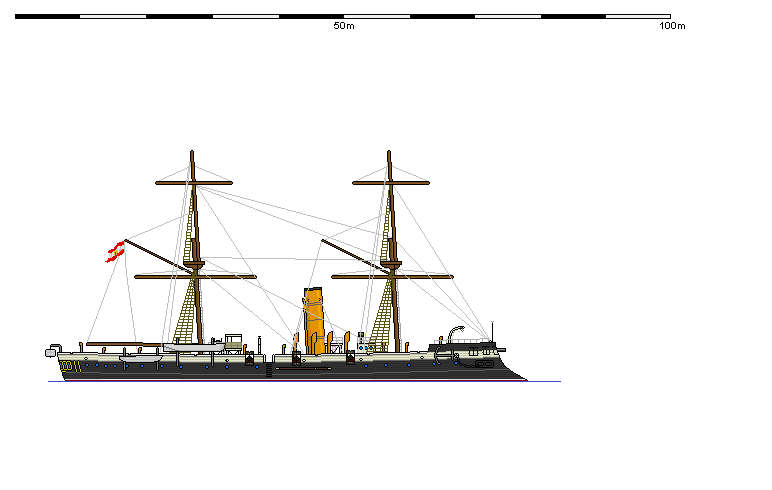
 Dziś coś mocno nietypowego. Poniższe okręty to chińska odpowiedź na japońskie krążowniki pancernopokładowe typu Matsushima. Kraj pochodzenia, patrząc na sylwetkę, jest jak sądzę oczywisty. Koncept jest o tyle do jednostek japońskich podobny, że okręty te również posiadają pojedyncze ciężkie działo (tutaj jest to nowoczesna, długolufowa francuska armata 340 mm model 1887 w której stosowano ładunki miotające na proch bezdymny). Poza nim, okręt posiada liczne działa szybkostrzelne kal. 138 mm L/45 model 1888 stanowiące we flocie chińskiej nową jakość, w zasadzie pozbawionej dotąd artylerii szybkostrzelnej. Okręty z pewnością są kontrowersyjne, ale zaryzykuję, że posiadając takie jednostki, Chińczycy pod Jalu nie dali by się Japończykom pobić, ergo – wynik wojny byłby zupełnie inny. 


Qin, chinese protected cruiser laid down 1890 (Engine 1892)

Displacement:
    5 722 t light; 5 965 t standard; 6 520 t normal; 6 965 t full load

Dimensions: Length overall / water x beam x draught
    373,36 ft / 373,36 ft x 54,66 ft x 19,62 ft (normal load)
    113,80 m / 113,80 m x 16,66 m  x 5,98 m

Armament:
      1 - 13,39" / 340 mm guns in single mounts, 1 145,27lbs / 519,49kg shells, 1887 Model
      Breech loading gun in a turret (on a barbette)
      on centreline amidships
      2 - 5,43" / 138 mm guns in single mounts, 77,78lbs / 35,28kg shells, 1888 Model
      Quick firing guns in turrets (on barbettes)
      on centreline ends, evenly spread
      12 - 5,43" / 138 mm guns in single mounts, 77,78lbs / 35,28kg shells, 1888 Model
      Quick firing guns in casemate mounts
      on side, all amidships
      12 guns in hull casemates - Limited use in heavy seas
      12 - 2,24" / 57,0 mm guns in single mounts, 5,06lbs / 2,30kg shells, 1883 Model
      Breech loading guns in deck mounts
      on centreline ends, evenly spread, all raised mounts - superfiring
    Weight of broadside 2 295 lbs / 1 041 kg
    Shells per gun, main battery: 80
    3 - 14,0" / 356 mm submerged torpedo tubes

Armour:
   - Gun armour:    Face (max)    Other gunhouse (avg)    Barbette/hoist (max)
    Main:    12,0" / 305 mm    4,02" / 102 mm        5,98" / 152 mm
    2nd:    2,99" / 76 mm    2,01" / 51 mm        2,99" / 76 mm
    3rd:    2,99" / 76 mm          -                  -
    4th:    0,51" / 13 mm          -                  -

   - Armour deck: 2,01" / 51 mm, Conning tower: 5,98" / 152 mm

Machinery:
    Coal fired boilers, complex reciprocating steam engines,
    Direct drive, 2 shafts, 11 592 ihp / 8 648 Kw = 19,50 kts
    Range 4 500nm at 10,00 kts
    Bunker at max displacement = 1 000 tons (100% coal)

Complement:
    362 - 471

Cost:
    £0,731 million / $2,924 million

Distribution of weights at normal displacement:
    Armament: 287 tons, 4,4%
    Armour: 915 tons, 14,0%
       - Belts: 0 tons, 0,0%
       - Torpedo bulkhead: 0 tons, 0,0%
       - Armament: 331 tons, 5,1%
       - Armour Deck: 539 tons, 8,3%
       - Conning Tower: 45 tons, 0,7%
    Machinery: 2 070 tons, 31,7%
    Hull, fittings & equipment: 2 451 tons, 37,6%
    Fuel, ammunition & stores: 798 tons, 12,2%
    Miscellaneous weights: 0 tons, 0,0%

Overall survivability and seakeeping ability:
    Survivability (Non-critical penetrating hits needed to sink ship):
      3 911 lbs / 1 774 Kg = 3,3 x 13,4 " / 340 mm shells or 0,8 torpedoes
    Stability (Unstable if below 1.00): 1,31
    Metacentric height 3,3 ft / 1,0 m
    Roll period: 12,7 seconds
    Steadiness    - As gun platform (Average = 50 %): 91 %
            - Recoil effect (Restricted arc if above 1.00): 0,64
    Seaboat quality  (Average = 1.00): 1,82

Hull form characteristics:
    Hull has a flush deck
    Block coefficient: 0,570
    Length to Beam Ratio: 6,83 : 1
    'Natural speed' for length: 19,32 kts
    Power going to wave formation at top speed: 50 %
    Trim (Max stability = 0, Max steadiness = 100): 50
    Bow angle (Positive = bow angles forward): -60,00 degrees
    Stern overhang: 0,00 ft / 0,00 m
    Freeboard (% = measuring location as a percentage of overall length):
       - Stem:        21,46 ft / 6,54 m
       - Forecastle (16%):    20,44 ft / 6,23 m
       - Mid (50%):        16,47 ft / 5,02 m
       - Quarterdeck (13%):    15,45 ft / 4,71 m
       - Stern:        14,96 ft / 4,56 m
       - Average freeboard:    17,49 ft / 5,33 m

Ship space, strength and comments:
    Space    - Hull below water (magazines/engines, low = better): 141,0%
        - Above water (accommodation/working, high = better): 131,0%
    Waterplane Area: 14 512 Square feet or 1 348 Square metres
    Displacement factor (Displacement / loading): 89%
    Structure weight / hull surface area: 106 lbs/sq ft or 519 Kg/sq metre
    Hull strength (Relative):
        - Cross-sectional: 0,90
        - Longitudinal: 2,45
        - Overall: 1,00
    Hull space for machinery, storage, compartmentation is cramped
    Room for accommodation and workspaces is excellent
    Ship has slow, easy roll, a good, steady gun platform
    Excellent seaboat, comfortable, can fire her guns in the heaviest weather

Qin (1892)
Xia (1893)
Tang (1894)

wtorek, 10 listopada 2020

Krążownik liniowy Frunze

 W latach 1914-1915 rosyjska MW wcieliła do służby cztery stosunkowo szybkie, ale słabo opancerzone drednoty typu Gangut. W 1919 r. jeden z nich, Frunze (ex-Połtawa) uległ pożarowi, co powtórzyło się jeszcze w 1922 r. W efekcie jednostka została znacznie uszkodzona – praktycznie był to pusty kadłub, bez wież artylerii głównej i całego wyposażenia. Około końca lat 20-tych pojawiają się pomysły wykorzystania kadłuba do zbudowania na jego bazie nowoczesnego krążownika liniowego, z wykorzystaniem starych wież i dział 305 mm – dwóch skrajnych na starych miejscach, zaś trzeciej w superpozycji za wieżą dziobową. Wykorzystanie uratowanych z okrętu starych dział było koniecznością, wobec niemożności wyprodukowania przez ówczesny przemysł radziecki nowych ciężkich dział, jak również pozyskania ich z zagranicy. W 1933 r. sporządzono dwa warianty przebudowy kadłuba Frunze na krążownik liniowy, różniące się głownie sylwetką – jeden miał dwa kominy, drugi miał jeden, pochylony. Poniżej prezentuję wariant jednokominowy. W ramach przebudowy na okręcie zamontowano nową siłownię turbinową z  kotłami opalanymi wyłącznie paliwem płynnym, zlikwidowano barbety dwóch środkowych wież, zamiast których zainstalowano jedną podwyższoną, położoną za wieżą dziobową, dzięki czemu wieża na niej posadowiona znalazła się w superpozycji. Wzmocniono opancerzenie poziome do uśrednionej wartości sumarycznej wynoszącej 105 mm, oraz opancerzenie wież poprzez dodanie płyt pancernych o grubości 100 mm na ich czołach, które tym samym osiągnęły 303 mm grubości. Okręt otrzymał całkowicie nowe nadbudówki na śródokręciu, w tym nowe stanowisko dowodzenia. Zlikwidowano połowę kazamat kadłubowych, położoną najbliżej dziobu i rufy, a mieszczące się w nich działa kal. 120 mm przeniesiono do nowych kazamat w nadbudówce na śródokręciu. Przebudowano dziób jednostki, podnosząc nieco pokład dziobowy. Wreszcie okręt otrzymał wyposażenie lotnicze w postaci katapulty i wodnosamolotu, a utracił podwodne wyrzutnie torped.
Przebudowa dała w sumie całkiem nowy okręt, dość ładny i ciekawy jak sądzę. Nie grzeszy wprawdzie dzielnością morską, ale na wody Bałtyku czy Morza Czarnego powinna ona wystarczyć.


Frunze, soviet battlecruiser laid down 1909 (Engine 1935)

Displacement:
    21 545 t light; 22 613 t standard; 23 451 t normal; 24 120 t full load

Dimensions: Length overall / water x beam x draught
    605,89 ft / 594,49 ft x 88,25 ft x 27,49 ft (normal load)
    184,67 m / 181,20 m x 26,90 m  x 8,38 m

Armament:
      9 - 12,01" / 305 mm guns (3x3 guns), 865,70lbs / 392,67kg shells, 1907 Model
      Breech loading guns in turrets (on barbettes)
      on centreline ends, majority forward, 1 raised mount - superfiring
      16 - 4,72" / 120 mm guns in single mounts, 52,72lbs / 23,91kg shells, 1905 Model
      Quick firing guns in casemate mounts
      on side, all amidships
      8 guns in hull casemates - Limited use in heavy seas
      8 - 2,99" / 76,0 mm guns in single mounts, 13,39lbs / 6,07kg shells, 1935 Model
      Anti-aircraft guns in deck mounts
      on side, all amidships, all raised mounts - superfiring
      8 - 1,77" / 45,0 mm guns in single mounts, 2,78lbs / 1,26kg shells, 1932 Model
      Anti-aircraft guns in deck mounts
      on side, all amidships, all raised mounts - superfiring
    Weight of broadside 8 764 lbs / 3 975 kg
    Shells per gun, main battery: 120

Armour:
   - Belts:        Width (max)    Length (avg)        Height (avg)
    Main:    8,86" / 225 mm    382,22 ft / 116,50 m    16,73 ft / 5,10 m
    Ends:    4,92" / 125 mm    211,29 ft / 64,40 m    16,73 ft / 5,10 m
      0,98 ft / 0,30 m Unarmoured ends
    Upper:    4,92" / 125 mm    501,38 ft / 152,82 m    7,55 ft / 2,30 m
      Main Belt covers 99% of normal length

   - Torpedo Bulkhead:
        2,01" / 51 mm    440,49 ft / 134,26 m    24,84 ft / 7,57 m

   - Gun armour:    Face (max)    Other gunhouse (avg)    Barbette/hoist (max)
    Main:    11,9" / 303 mm    7,99" / 203 mm        5,98" / 152 mm
    2nd:    4,92" / 125 mm          -                  -

   - Armour deck: 4,13" / 105 mm, Conning tower: 11,02" / 280 mm

Machinery:
    Oil fired boilers, steam turbines,
    Geared drive, 4 shafts, 90 839 shp / 67 766 Kw = 28,00 kts
    Range 4 380nm at 14,00 kts
    Bunker at max displacement = 1 507 tons

Complement:
    946 - 1 231

Cost:
    £2,036 million / $8,142 million

Distribution of weights at normal displacement:
    Armament: 1 096 tons, 4,7%
    Armour: 9 225 tons, 39,3%
       - Belts: 3 873 tons, 16,5%
       - Torpedo bulkhead: 813 tons, 3,5%
       - Armament: 1 494 tons, 6,4%
       - Armour Deck: 2 851 tons, 12,2%
       - Conning Tower: 195 tons, 0,8%
    Machinery: 2 581 tons, 11,0%
    Hull, fittings & equipment: 8 594 tons, 36,6%
    Fuel, ammunition & stores: 1 906 tons, 8,1%
    Miscellaneous weights: 50 tons, 0,2%

Overall survivability and seakeeping ability:
    Survivability (Non-critical penetrating hits needed to sink ship):
      34 055 lbs / 15 447 Kg = 39,3 x 12,0 " / 305 mm shells or 5,6 torpedoes
    Stability (Unstable if below 1.00): 1,20
    Metacentric height 5,8 ft / 1,8 m
    Roll period: 15,3 seconds
    Steadiness    - As gun platform (Average = 50 %): 40 %
            - Recoil effect (Restricted arc if above 1.00): 0,44
    Seaboat quality  (Average = 1.00): 0,77

Hull form characteristics:
    Hull has a flush deck
    Block coefficient: 0,569
    Length to Beam Ratio: 6,74 : 1
    'Natural speed' for length: 24,38 kts
    Power going to wave formation at top speed: 57 %
    Trim (Max stability = 0, Max steadiness = 100): 42
    Bow angle (Positive = bow angles forward): 25,00 degrees
    Stern overhang: 0,00 ft / 0,00 m
    Freeboard (% = measuring location as a percentage of overall length):
       - Stem:        24,44 ft / 7,45 m
       - Forecastle (18%):    19,95 ft / 6,08 m
       - Mid (50%):        19,95 ft / 6,08 m
       - Quarterdeck (16%):    19,95 ft / 6,08 m
       - Stern:        20,44 ft / 6,23 m
       - Average freeboard:    20,30 ft / 6,19 m
    Ship tends to be wet forward

Ship space, strength and comments:
    Space    - Hull below water (magazines/engines, low = better): 93,1%
        - Above water (accommodation/working, high = better): 149,7%
    Waterplane Area: 37 274 Square feet or 3 463 Square metres
    Displacement factor (Displacement / loading): 101%
    Structure weight / hull surface area: 162 lbs/sq ft or 789 Kg/sq metre
    Hull strength (Relative):
        - Cross-sectional: 0,96
        - Longitudinal: 1,56
        - Overall: 1,00
    Hull space for machinery, storage, compartmentation is adequate
    Room for accommodation and workspaces is excellent
    Poor seaboat, wet and uncomfortable, reduced performance in heavy weather

1 catapult, 1 plane


środa, 4 listopada 2020

Taranowiec austro-węgierski

 Po bitwie pod Lissą w 1866 r., gdzie austriacki pancernik Erzherzog Ferdinand Max skutecznie staranował i zatopił włoski pancernik Re d’Italia na całym świecie zapanowała moda na taran jako podstawowe narzędzie walki na morzu. W tarany wyposażano wiele okrętów różnych klas, nie wyłączając pancerników, a i budowano jednostki specjalnie przeznaczone do walki w ten sposób. Okręt, który poniżej prezentuję, stanowi propozycję taranowca dla floty austro-węgierskiej w okresie bezpośrednio po bitwie pod Lissą. Jest to stosunkowo niedużych rozmiarów jednostka parowo-żaglowa, oprócz tarana wyposażona w nowoczesną artylerię odtylcową produkcji Kruppa (której tak brakowało w wojnie 1866 r.) oraz zgodnie z realiami epoki - dwumasztowe ożaglowanie. Taranowiec rozwija ponad 15 w. i jak sądzę mógłby być ciekawą propozycją dla floty austro-węgierskiej działającej na wodach Morza Adriatyckiego, cechującego się skomplikowaną i urozmaiconą linią brzegową, mogącą sprzyjać niespodziewanym i nieszablonowym akcjom tego rodzaju jednostek.


Condor, austro-hungarian ram laid down 1868 (Engine 1869)

Displacement:
    1 602 t light; 1 651 t standard; 1 750 t normal; 1 829 t full load

Dimensions: Length overall / water x beam x draught
    235,14 ft / 231,14 ft x 37,04 ft x 13,94 ft (normal load)
    71,67 m / 70,45 m x 11,29 m  x 4,25 m

Armament:
      1 - 8,27" / 210 mm guns in single mounts, 189,32lbs / 85,87kg shells, 1868 Model
      Breech loading gun in casemate mount
      on centreline forward
      6 - 4,72" / 120 mm guns in single mounts, 32,16lbs / 14,59kg shells, 1864 Model
      Breech loading guns in deck mounts
      on side, all amidships
    Weight of broadside 382 lbs / 173 kg
    Shells per gun, main battery: 60

Armour:
   - Gun armour:    Face (max)    Other gunhouse (avg)    Barbette/hoist (max)
    Main:    3,94" / 100 mm          -                  -

Machinery:
    Coal fired boilers, simple reciprocating steam engines,
    Direct drive, 1 shaft, 2 818 ihp / 2 102 Kw = 15,30 kts
    Range 1 500nm at 7,50 kts
    Bunker at max displacement = 178 tons (100% coal)

Complement:
    216

Cost:
    £0,191 million / $0,762 million

Distribution of weights at normal displacement:
    Armament: 48 tons, 2,7%
    Armour: 20 tons, 1,2%
       - Belts: 0 tons, 0,0%
       - Torpedo bulkhead: 0 tons, 0,0%
       - Armament: 20 tons, 1,2%
       - Armour Deck: 0 tons, 0,0%
       - Conning Tower: 0 tons, 0,0%
    Machinery: 674 tons, 38,5%
    Hull, fittings & equipment: 796 tons, 45,5%
    Fuel, ammunition & stores: 148 tons, 8,4%
    Miscellaneous weights: 64 tons, 3,7%

Overall survivability and seakeeping ability:
    Survivability (Non-critical penetrating hits needed to sink ship):
      675 lbs / 306 Kg = 3,6 x 8,3 " / 210 mm shells or 0,3 torpedoes
    Stability (Unstable if below 1.00): 1,26
    Metacentric height 1,7 ft / 0,5 m
    Roll period: 11,9 seconds
    Steadiness    - As gun platform (Average = 50 %): 100 %
            - Recoil effect (Restricted arc if above 1.00): 0,33
    Seaboat quality  (Average = 1.00): 2,00

Hull form characteristics:
    Hull has raised forecastle
    Block coefficient: 0,513
    Length to Beam Ratio: 6,24 : 1
    'Natural speed' for length: 15,20 kts
    Power going to wave formation at top speed: 48 %
    Trim (Max stability = 0, Max steadiness = 100): 50
    Bow angle (Positive = bow angles forward): -40,00 degrees
    Stern overhang: 4,00 ft / 1,22 m
    Freeboard (% = measuring location as a percentage of overall length):
       - Stem:        19,46 ft / 5,93 m
       - Forecastle (21%):    18,44 ft / 5,62 m (14,96 ft / 4,56 m aft of break)
       - Mid (50%):        13,48 ft / 4,11 m
       - Quarterdeck (30%):    13,48 ft / 4,11 m
       - Stern:        14,47 ft / 4,41 m
       - Average freeboard:    14,98 ft / 4,57 m

Ship space, strength and comments:
    Space    - Hull below water (magazines/engines, low = better): 148,4%
        - Above water (accommodation/working, high = better): 110,0%
    Waterplane Area: 5 562 Square feet or 517 Square metres
    Displacement factor (Displacement / loading): 93%
    Structure weight / hull surface area: 75 lbs/sq ft or 365 Kg/sq metre
    Hull strength (Relative):
        - Cross-sectional: 0,84
        - Longitudinal: 4,85
        - Overall: 1,00
    Hull space for machinery, storage, compartmentation is cramped
    Room for accommodation and workspaces is adequate
    Ship has slow, easy roll, a good, steady gun platform
    Excellent seaboat, comfortable, can fire her guns in the heaviest weather

Condor (1869)
Cormoran (1869)
Adler (1870)
Habicht (1870)
 

piątek, 30 października 2020

Monitory niemieckie

 W 1916 r. Niemcy wycofali ze służby predrednoty typów Kaiser Friedrich III i Wittelsbach. Tym samym do wykorzystania stało się dostępnych sporo dział kal. 240 mm i 150 mm, co można by wykorzystać budując poniższą jednostkę (lub jednostki). Jest to okręt do wsparcia ogniowego wojsk lądowych, czyli stosując terminologię anglosaską – monitor. W sumie – nieco wzorowany na brytyjskich jednostkach tej klasy, z którymi Niemcy mieli do czynienia od 1915 r., co mogło by im dać asumpt do zbudowania własnego odpowiednika. Z tym, że w niemieckich realiach okręty służyłyby na Bałtyku, gdzie mogłyby pomagać w działaniach wojsk lądowych w pasie nadmorskim,   uczestniczyć w forsowaniu cieśniny Irbeńskiej, w działaniach na wodach Zatoki Ryskiej i wokół wysp moonsundzkich (np. wspierać desant na nie). Okręty mają skrajnie uproszczoną konstrukcję, kadłub o maksymalnie prostych liniach i pełnych kształtach, oraz są napędzane maszyną parową potrójnego rozprężania z kotłami opalanymi węglem. W skład uzbrojenia wchodzą 2 działa kal. 240 mm w oryginalnej wieży przeniesionej wprost z pancernika i posadowionej na nowej barbecie, uzupełnione 2 działami kal. 150 mm do obrony przed wrogimi niszczycielami i 2 plotkami. Ochronę stanowi pancerz grubości 100 mm oraz 35 mm pokład.


Sparr, german monitor laid down 1916

Displacement:
    1 978 t light; 2 075 t standard; 2 131 t normal; 2 176 t full load

Dimensions: Length overall / water x beam x draught
    279,92 ft / 278,41 ft x 48,85 ft x 8,33 ft (normal load)
    85,32 m / 84,86 m x 14,89 m  x 2,54 m

Armament:
      2 - 9,45" / 240 mm guns (1x2 guns), 421,80lbs / 191,33kg shells, 1894 Model
      Breech loading guns in a turret (on a barbette)
      on centreline forward
      2 - 5,91" / 150 mm guns in single mounts, 102,98lbs / 46,71kg shells, 1897 Model
      Quick firing guns in deck mounts
      on centreline, all aft, 1 raised mount
      2 - 3,46" / 88,0 mm guns in single mounts, 20,79lbs / 9,43kg shells, 1915 Model
      Anti-aircraft guns in deck mounts
      on centreline ends, evenly spread, all raised mounts
    Weight of broadside 1 091 lbs / 495 kg
    Shells per gun, main battery: 85

Armour:
   - Belts:        Width (max)    Length (avg)        Height (avg)
    Main:    3,94" / 100 mm      84,58 ft / 25,78 m    7,94 ft / 2,42 m
    Ends:    Unarmoured
      Main Belt covers 47% of normal length
      Main belt does not fully cover magazines and engineering spaces

   - Gun armour:    Face (max)    Other gunhouse (avg)    Barbette/hoist (max)
    Main:    9,84" / 250 mm    9,84" / 250 mm        3,94" / 100 mm

   - Armour deck: 1,38" / 35 mm, Conning tower: 3,94" / 100 mm

Machinery:
    Coal fired boilers, complex reciprocating steam engines,
    Direct drive, 2 shafts, 1 161 ihp / 866 Kw = 12,00 kts
    Range 2 200nm at 7,00 kts
    Bunker at max displacement = 101 tons (100% coal)

Complement:
    156 - 203

Cost:
    £0,318 million / $1,273 million

Distribution of weights at normal displacement:
    Armament: 136 tons, 6,4%
    Armour: 615 tons, 28,9%
       - Belts: 149 tons, 7,0%
       - Torpedo bulkhead: 0 tons, 0,0%
       - Armament: 185 tons, 8,7%
       - Armour Deck: 268 tons, 12,6%
       - Conning Tower: 14 tons, 0,7%
    Machinery: 76 tons, 3,6%
    Hull, fittings & equipment: 1 151 tons, 54,0%
    Fuel, ammunition & stores: 152 tons, 7,1%
    Miscellaneous weights: 0 tons, 0,0%

Overall survivability and seakeeping ability:
    Survivability (Non-critical penetrating hits needed to sink ship):
      5 052 lbs / 2 292 Kg = 12,0 x 9,4 " / 240 mm shells or 1,7 torpedoes
    Stability (Unstable if below 1.00): 1,26
    Metacentric height 2,6 ft / 0,8 m
    Roll period: 12,8 seconds
    Steadiness    - As gun platform (Average = 50 %): 66 %
            - Recoil effect (Restricted arc if above 1.00): 0,43
    Seaboat quality  (Average = 1.00): 1,32

Hull form characteristics:
    Hull has a flush deck
    Block coefficient: 0,658
    Length to Beam Ratio: 5,70 : 1
    'Natural speed' for length: 16,69 kts
    Power going to wave formation at top speed: 32 %
    Trim (Max stability = 0, Max steadiness = 100): 50
    Bow angle (Positive = bow angles forward): 0,00 degrees
    Stern overhang: 1,51 ft / 0,46 m
    Freeboard (% = measuring location as a percentage of overall length):
       - Stem:        12,47 ft / 3,80 m
       - Forecastle (26%):    10,96 ft / 3,34 m
       - Mid (50%):        10,43 ft / 3,18 m
       - Quarterdeck (14%):    11,48 ft / 3,50 m
       - Stern:        10,01 ft / 3,05 m
       - Average freeboard:    11,02 ft / 3,36 m
    Ship tends to be wet forward

Ship space, strength and comments:
    Space    - Hull below water (magazines/engines, low = better): 59,8%
        - Above water (accommodation/working, high = better): 139,1%
    Waterplane Area: 10 496 Square feet or 975 Square metres
    Displacement factor (Displacement / loading): 115%
    Structure weight / hull surface area: 87 lbs/sq ft or 426 Kg/sq metre
    Hull strength (Relative):
        - Cross-sectional: 0,93
        - Longitudinal: 1,95
        - Overall: 1,00
    Hull space for machinery, storage, compartmentation is excellent
    Room for accommodation and workspaces is excellent
    Good seaboat, rides out heavy weather easily

Sparr (1916)
Glasenapp (1916)
Natzmer (1916)
Kleist (1916)
 

czwartek, 22 października 2020

Torpedowe pancerniki obrony wybrzeża

 Sporo swego czasu rozmyślałem nad różnymi pancernikami torpedowymi i wpadł mi do głowy taki szalony pomysł – torpedowy pancernik obrony wybrzeża. Oczywiście dla Norwegii. Okręty (bo przewiduję parę) dość mocno przypominają swoje pierwowzory – pancerniki typów Harald Haarfagre i Norge, posiadają bardzo podobne uzbrojenie artyleryjskie i pancerz, ale są nieco większe. Wzrost gabarytów przeznaczono na wzmocnienie uzbrojenia torpedowego, które składa się z 8 nawodnych i 5 podwodnych wyrzutni kal. 457 mm. Nie wiem czy to właściwa koncepcja, ale jest szansa, że w ciasnych norweskich fiordach takie okręty mogły by się sprawdzić (w końcu lata później, Blucher został zatopiony m.in. przez torpedy, choć wystrzeliwane z lądu). W każdym razie myślę, że te okręty nie były by gorsze niż ich poprzednicy. 


Harald Hardrade, norwegian torpedo coast defence battleship laid down 1902 (Engine 1903)

Displacement:
    3 827 t light; 3 970 t standard; 4 281 t normal; 4 529 t full load

Dimensions: Length overall / water x beam x draught
    318,60 ft / 318,60 ft x 50,89 ft x 17,98 ft (normal load)
    97,11 m / 97,11 m x 15,51 m  x 5,48 m

Armament:
      2 - 8,27" / 210 mm guns in single mounts, 282,57lbs / 128,17kg shells, 1902 Model
      Breech loading guns in turrets (on barbettes)
      on centreline ends, evenly spread
      6 - 5,91" / 150 mm guns in single mounts, 102,98lbs / 46,71kg shells, 1902 Model
      Quick firing guns in casemate mounts
      on side, all amidships
      10 - 2,99" / 76,0 mm guns in single mounts, 13,39lbs / 6,07kg shells, 1902 Model
      Quick firing guns in deck mounts
      on side, all amidships, 6 raised mounts - superfiring
      2 - 2,24" / 57,0 mm guns in single mounts, 5,65lbs / 2,56kg shells, 1902 Model
      Quick firing guns in deck mounts
      on centreline ends, evenly spread, all raised mounts
    Weight of broadside 1 328 lbs / 602 kg
    Shells per gun, main battery: 70
    8 - 18,0" / 457 mm above water torpedoes, 5 - 18,0" / 457 mm submerged torpedo tubes

Armour:
   - Belts:        Width (max)    Length (avg)        Height (avg)
    Main:    5,98" / 152 mm    190,88 ft / 58,18 m    8,33 ft / 2,54 m
    Ends:    Unarmoured
      Main Belt covers 92% of normal length
      Main belt does not fully cover magazines and engineering spaces

   - Gun armour:    Face (max)    Other gunhouse (avg)    Barbette/hoist (max)
    Main:    7,99" / 203 mm    5,98" / 152 mm        7,99" / 203 mm
    2nd:    4,72" / 120 mm          -                  -
    3rd:    1,85" / 47 mm    1,50" / 38 mm              -

   - Armour deck: 1,85" / 47 mm, Conning tower: 5,98" / 152 mm

Machinery:
    Coal fired boilers, complex reciprocating steam engines,
    Direct drive, 2 shafts, 5 859 ihp / 4 371 Kw = 17,30 kts
    Range 3 900nm at 10,00 kts
    Bunker at max displacement = 558 tons (100% coal)

Complement:
    263 - 343

Cost:
    £0,396 million / $1,583 million

Distribution of weights at normal displacement:
    Armament: 166 tons, 3,9%
    Armour: 1 197 tons, 28,0%
       - Belts: 423 tons, 9,9%
       - Torpedo bulkhead: 0 tons, 0,0%
       - Armament: 365 tons, 8,5%
       - Armour Deck: 375 tons, 8,7%
       - Conning Tower: 34 tons, 0,8%
    Machinery: 875 tons, 20,4%
    Hull, fittings & equipment: 1 590 tons, 37,1%
    Fuel, ammunition & stores: 453 tons, 10,6%
    Miscellaneous weights: 0 tons, 0,0%

Overall survivability and seakeeping ability:
    Survivability (Non-critical penetrating hits needed to sink ship):
      4 654 lbs / 2 111 Kg = 16,5 x 8,3 " / 210 mm shells or 1,0 torpedoes
    Stability (Unstable if below 1.00): 1,14
    Metacentric height 2,3 ft / 0,7 m
    Roll period: 14,1 seconds
    Steadiness    - As gun platform (Average = 50 %): 100 %
            - Recoil effect (Restricted arc if above 1.00): 0,75
    Seaboat quality  (Average = 1.00): 2,00

Hull form characteristics:
    Hull has a flush deck
    Block coefficient: 0,514
    Length to Beam Ratio: 6,26 : 1
    'Natural speed' for length: 17,85 kts
    Power going to wave formation at top speed: 47 %
    Trim (Max stability = 0, Max steadiness = 100): 50
    Bow angle (Positive = bow angles forward): -4,00 degrees
    Stern overhang: 0,00 ft / 0,00 m
    Freeboard (% = measuring location as a percentage of overall length):
       - Stem:        20,44 ft / 6,23 m
       - Forecastle (20%):    18,96 ft / 5,78 m
       - Mid (50%):        17,95 ft / 5,47 m
       - Quarterdeck (20%):    18,44 ft / 5,62 m
       - Stern:        18,96 ft / 5,78 m
       - Average freeboard:    18,65 ft / 5,68 m

Ship space, strength and comments:
    Space    - Hull below water (magazines/engines, low = better): 107,0%
        - Above water (accommodation/working, high = better): 108,9%
    Waterplane Area: 10 941 Square feet or 1 016 Square metres
    Displacement factor (Displacement / loading): 100%
    Structure weight / hull surface area: 85 lbs/sq ft or 413 Kg/sq metre
    Hull strength (Relative):
        - Cross-sectional: 0,86
        - Longitudinal: 3,98
        - Overall: 1,00
    Hull space for machinery, storage, compartmentation is adequate
    Room for accommodation and workspaces is adequate
    Ship has slow, easy roll, a good, steady gun platform
    Excellent seaboat, comfortable, can fire her guns in the heaviest weather

Harald Hardrade (1903)
Harald Grafell (1903)

sobota, 17 października 2020

Francuski stawiacz min z 1892 r.

Wracamy do nieco dawniejszych i mniejszych okrętów :) Dzisiaj propozycja nowatorskiego jak sądzę na koniec XIX w. okrętu, a mianowicie stawiacz min dla francuskiej Marynarki Wojennej z 1892 r. Jeżeli czegoś nie przegapiłem, to może być to pierwszy na świecie okręt od początku przeznaczony do tej roli. Jednostka jest w typie małego krążownika pancernopokładowego o sylwetce charakterystycznej dla francuskiej szkoły budownictwa okrętowego. Uzbrojenie stanowią 1 działo kal. 100 mm, 5 dział kal. 65 mm oraz 78 min, zlokalizowanych w rufowej części na pokładzie i w nadbudówce. Okręt posiada lekkie opancerzenie w postaci pokładu pancernego ze skosami, oraz jest napędzany maszyną parową potrójnego rozprężania. I to by było chyba wszystko co o nim można powiedzieć – obawiam się, że nie jest to wybitnie kontrowersyjna jednostka ;)


Flibustier, french minelayer laid down 1892

Displacement:
    1 276 t light; 1 312 t standard; 1 432 t normal; 1 527 t full load

Dimensions: Length overall / water x beam x draught
    266,04 ft / 263,55 ft x 35,93 ft x 10,56 ft (normal load)
    81,09 m / 80,33 m x 10,95 m  x 3,22 m

Armament:
      1 - 3,94" / 100 mm guns in single mounts, 30,51lbs / 13,84kg shells, 1891 Model
      Quick firing gun in a deck mount with hoist
      on centreline forward
      4 - 2,56" / 65,0 mm guns in single mounts, 8,13lbs / 3,69kg shells, 1888 Model
      Quick firing guns in deck mounts
      on side, all amidships
      1 - 2,56" / 65,0 mm guns in single mounts, 8,13lbs / 3,69kg shells, 1888 Model
      Quick firing gun in deck mount
      on centreline aft, 1 raised gun
      2 - 1,85" / 47,0 mm guns in single mounts, 2,93lbs / 1,33kg shells, 1885 Model
      Quick firing guns in deck mounts
      on centreline, all amidships, all raised mounts - superfiring
    Weight of broadside 77 lbs / 35 kg
    Shells per gun, main battery: 150

Armour:
   - Gun armour:    Face (max)    Other gunhouse (avg)    Barbette/hoist (max)
    Main:    1,57" / 40 mm    1,18" / 30 mm              -

   - Armour deck: 0,79" / 20 mm, Conning tower: 1,18" / 30 mm

Machinery:
    Coal fired boilers, complex reciprocating steam engines,
    Direct drive, 2 shafts, 3 652 ihp / 2 724 Kw = 18,00 kts
    Range 3 000nm at 9,00 kts
    Bunker at max displacement = 215 tons (100% coal)

Complement:
    116 - 151

Cost:
    £0,140 million / $0,561 million

Distribution of weights at normal displacement:
    Armament: 10 tons, 0,7%
    Armour: 99 tons, 6,9%
       - Belts: 0 tons, 0,0%
       - Torpedo bulkhead: 0 tons, 0,0%
       - Armament: 4 tons, 0,3%
       - Armour Deck: 92 tons, 6,4%
       - Conning Tower: 3 tons, 0,2%
    Machinery: 625 tons, 43,7%
    Hull, fittings & equipment: 503 tons, 35,1%
    Fuel, ammunition & stores: 156 tons, 10,9%
    Miscellaneous weights: 39 tons, 2,7%

Overall survivability and seakeeping ability:
    Survivability (Non-critical penetrating hits needed to sink ship):
      951 lbs / 431 Kg = 31,2 x 3,9 " / 100 mm shells or 0,4 torpedoes
    Stability (Unstable if below 1.00): 1,49
    Metacentric height 2,1 ft / 0,6 m
    Roll period: 10,3 seconds
    Steadiness    - As gun platform (Average = 50 %): 90 %
            - Recoil effect (Restricted arc if above 1.00): 0,08
    Seaboat quality  (Average = 1.00): 1,81

Hull form characteristics:
    Hull has rise forward of midbreak
    Block coefficient: 0,501
    Length to Beam Ratio: 7,34 : 1
    'Natural speed' for length: 16,23 kts
    Power going to wave formation at top speed: 50 %
    Trim (Max stability = 0, Max steadiness = 100): 50
    Bow angle (Positive = bow angles forward): -14,00 degrees
    Stern overhang: 2,49 ft / 0,76 m
    Freeboard (% = measuring location as a percentage of overall length):
       - Stem:        17,45 ft / 5,32 m
       - Forecastle (12%):    14,99 ft / 4,57 m
       - Mid (26%):        14,47 ft / 4,41 m (10,47 ft / 3,19 m aft of break)
       - Quarterdeck (25%):    10,47 ft / 3,19 m
       - Stern:        10,96 ft / 3,34 m
       - Average freeboard:    11,78 ft / 3,59 m
    Ship tends to be wet forward

Ship space, strength and comments:
    Space    - Hull below water (magazines/engines, low = better): 149,5%
        - Above water (accommodation/working, high = better): 118,1%
    Waterplane Area: 6 314 Square feet or 587 Square metres
    Displacement factor (Displacement / loading): 94%
    Structure weight / hull surface area: 51 lbs/sq ft or 250 Kg/sq metre
    Hull strength (Relative):
        - Cross-sectional: 0,93
        - Longitudinal: 1,94
        - Overall: 1,00
    Hull space for machinery, storage, compartmentation is cramped
    Room for accommodation and workspaces is adequate
    Ship has slow, easy roll, a good, steady gun platform
    Excellent seaboat, comfortable, can fire her guns in the heaviest weather

78 mines

Flibustier (1892)
Argonaute (1893)
Spartiate (1894)

wtorek, 13 października 2020

Krążownik z działami kal. 508 mm

 Co by było, gdyby Fisher nie wyleciał z admiralicji w 1915 r.? Na pewno było by ciekawie ;) Na ogół jako kulminację jego idei budowy okrętów wojennych wskazuje się hipotetyczny wielki krążownik liniowy Incomparable, o długości rzędu 305 m (prawdopodobnie między pionami), wypierający 46000 ton, uzbrojony w 6 dział 508 mm, osiągający 35 w. prędkości i 24000 Mm zasięgu, na burcie opancerzony blachami o grubości 254-279 mm. Okazuje się jednak, że najprawdopodobniej okrętu w takim akurat kształcie Fisher wcale nie zamierzał budować (abstrahując od faktu, że takie charakterystyki na wyporności 46000 ton to mrzonka). Zwłaszcza, że trudno było by o pochylnie do jego zbudowania i doki do późniejszych remontów. Ewentualna budowa wiązała by się więc zapewne z gigantycznymi inwestycjami w infrastrukturę. Postanowiłem więc zasymulować okręt, który by się mieścił w ramach tego co faktycznie dało się zbudować, i oczywiście miał działa 508 mm. Za wyznacznik możliwości budowy  przyjąłem gabaryty Hooda z lekkim naddatkiem, czyli okręt o długości całkowitej nieco ponad 270 m. Zdecydowałem się też nie eskalować wyporności zanadto, żeby zachować choć pozory realizmu, i ograniczyłem ją do niespełna 38000 ton. W tym ramach powstał okręt będący przeskalowaną wersją wielkich lekkich krążowników, swoisty uber-Courageous, uzbrojony w 4 działa 508 mm i 14 dział 140 mm, rozwijający 31 w. i posiadający opancerzenie: pb 203, pp 64, pag 254, psd 254.
Myślę, że lordowi Fisherowi taki okręt by się spodobał ;) 


Magnificent, british large battlecruiser laid down 1916 (Engine 1918)

Displacement:
    34 132 t light; 35 668 t standard; 37 787 t normal; 39 482 t full load

Dimensions: Length overall / water x beam x draught
    901,32 ft / 898,33 ft x 94,39 ft x 26,08 ft (normal load)
    274,72 m / 273,81 m x 28,77 m  x 7,95 m

Armament:
      4 - 20,00" / 508 mm guns (2x2 guns), 4 000,00lbs / 1 814,37kg shells, 1918 Model
      Breech loading guns in turrets (on barbettes)
      on centreline ends, evenly spread
      12 - 5,51" / 140 mm guns in single mounts, 83,72lbs / 37,97kg shells, 1913 Model
      Quick firing guns in deck mounts
      on side, all amidships
      2 - 5,51" / 140 mm guns in single mounts, 83,72lbs / 37,97kg shells, 1913 Model
      Quick firing guns in deck mounts
      on centreline, all amidships, all raised mounts - superfiring
      4 - 4,02" / 102 mm guns in single mounts, 32,38lbs / 14,69kg shells, 1913 Model
      Anti-aircraft guns in deck mounts
      on side, all amidships, all raised mounts - superfiring
      4 - 1,85" / 47,0 mm guns in single mounts, 3,17lbs / 1,44kg shells, 1914 Model
      Quick firing guns in deck mounts
      on side, all amidships, all raised mounts - superfiring
    Weight of broadside 17 314 lbs / 7 854 kg
    Shells per gun, main battery: 80
    4 - 21,0" / 533 mm submerged torpedo tubes

Armour:
   - Belts:        Width (max)    Length (avg)        Height (avg)
    Main:    7,99" / 203 mm    450,95 ft / 137,45 m    14,99 ft / 4,57 m
    Ends:    2,99" / 76 mm    212,99 ft / 64,92 m    14,99 ft / 4,57 m
      234,38 ft / 71,44 m Unarmoured ends
    Upper:    4,72" / 120 mm    299,28 ft / 91,22 m    9,48 ft / 2,89 m
      Main Belt covers 77% of normal length
      Main belt does not fully cover magazines and engineering spaces

   - Torpedo Bulkhead:
        1,85" / 47 mm    450,95 ft / 137,45 m    22,70 ft / 6,92 m

   - Gun armour:    Face (max)    Other gunhouse (avg)    Barbette/hoist (max)
    Main:    10,0" / 254 mm    5,51" / 140 mm        10,0" / 254 mm
    2nd:    2,01" / 51 mm    1,50" / 38 mm              -
    3rd:    2,01" / 51 mm    1,50" / 38 mm              -

   - Armour deck: 2,52" / 64 mm, Conning tower: 10,00" / 254 mm

Machinery:
    Oil fired boilers, steam turbines,
    Geared drive, 4 shafts, 155 275 shp / 115 835 Kw = 31,10 kts
    Range 6 700nm at 14,00 kts
    Bunker at max displacement = 3 814 tons

Complement:
    1 354 - 1 761

Cost:
    £6,213 million / $24,852 million

Distribution of weights at normal displacement:
    Armament: 2 164 tons, 5,7%
    Armour: 8 762 tons, 23,2%
       - Belts: 3 365 tons, 8,9%
       - Torpedo bulkhead: 701 tons, 1,9%
       - Armament: 1 569 tons, 4,2%
       - Armour Deck: 2 885 tons, 7,6%
       - Conning Tower: 243 tons, 0,6%
    Machinery: 5 602 tons, 14,8%
    Hull, fittings & equipment: 17 604 tons, 46,6%
    Fuel, ammunition & stores: 3 655 tons, 9,7%
    Miscellaneous weights: 0 tons, 0,0%

Overall survivability and seakeeping ability:
    Survivability (Non-critical penetrating hits needed to sink ship):
      47 142 lbs / 21 383 Kg = 11,8 x 20,0 " / 508 mm shells or 5,3 torpedoes
    Stability (Unstable if below 1.00): 1,22
    Metacentric height 6,6 ft / 2,0 m
    Roll period: 15,5 seconds
    Steadiness    - As gun platform (Average = 50 %): 62 %
            - Recoil effect (Restricted arc if above 1.00): 0,78
    Seaboat quality  (Average = 1.00): 1,23

Hull form characteristics:
    Hull has rise forward of midbreak
    Block coefficient: 0,598
    Length to Beam Ratio: 9,52 : 1
    'Natural speed' for length: 29,97 kts
    Power going to wave formation at top speed: 47 %
    Trim (Max stability = 0, Max steadiness = 100): 50
    Bow angle (Positive = bow angles forward): 2,50 degrees
    Stern overhang: 1,51 ft / 0,46 m
    Freeboard (% = measuring location as a percentage of overall length):
       - Stem:        33,92 ft / 10,34 m
       - Forecastle (29%):    25,43 ft / 7,75 m
       - Mid (67%):        25,43 ft / 7,75 m (16,96 ft / 5,17 m aft of break)
       - Quarterdeck (21%):    16,96 ft / 5,17 m
       - Stern:        19,95 ft / 6,08 m
       - Average freeboard:    23,92 ft / 7,29 m

Ship space, strength and comments:
    Space    - Hull below water (magazines/engines, low = better): 117,3%
        - Above water (accommodation/working, high = better): 203,2%
    Waterplane Area: 61 900 Square feet or 5 751 Square metres
    Displacement factor (Displacement / loading): 101%
    Structure weight / hull surface area: 202 lbs/sq ft or 985 Kg/sq metre
    Hull strength (Relative):
        - Cross-sectional: 1,06
        - Longitudinal: 0,99
        - Overall: 1,00
    Hull space for machinery, storage, compartmentation is cramped
    Room for accommodation and workspaces is excellent
    Good seaboat, rides out heavy weather easily