czwartek, 4 września 2014

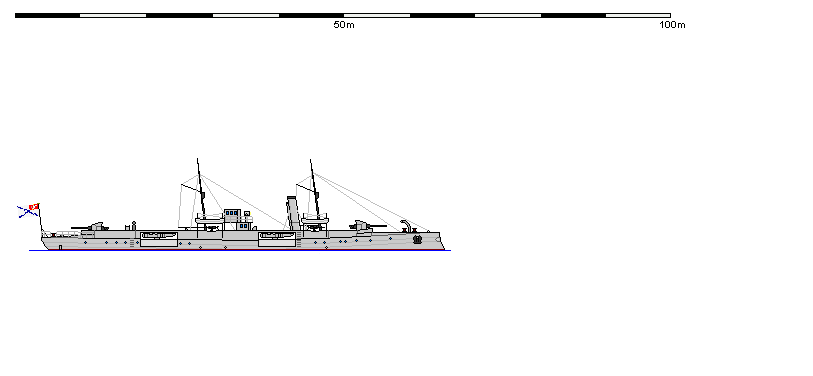
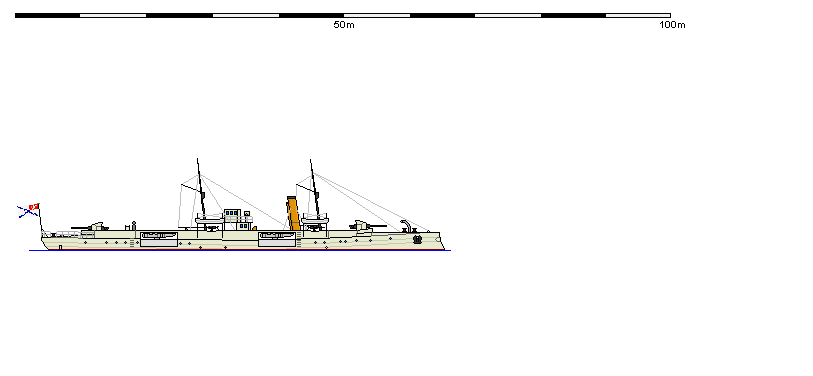
Nowa kanonierka pancerna

Oto nowy okręt, kanonierka pancerna wzorowana na rosyjskiej Chrabryj, a jednocześnie rozwinięcie okrętu Hydra z 1888 r.: http://springsharp.blogspot.com/2014/03/kanonierka-pancerna.html
Wielkością, siłą ognia i opancerzeniem przewyższa nie tylko wszystkie dotychczasowe kanonierki, ale i wiele z naszych małych krążowników (mających po 1200-1500 ton), które z tego powodu chyba trzeba będzie rychło przeklasyfikować na kanonierki...


Gorgona, polish gunboat laid down 1899

Displacement:
    1 500 t light; 1 562 t standard; 1 680 t normal; 1 774 t full load

Dimensions: Length overall / water x beam x draught
    240,62 ft / 240,62 ft x 38,48 ft x 11,91 ft (normal load)
    73,34 m / 73,34 m x 11,73 m  x 3,63 m

Armament:
      2 - 7,99" / 203 mm guns in single mounts, 255,24lbs / 115,77kg shells, 1892 Model
      Breech loading guns in deck mounts with hoists
      on side, all forward
      1 - 5,98" / 152 mm guns in single mounts, 107,15lbs / 48,60kg shells, 1891 Model
      Quick firing gun in a deck mount with hoist
      on centreline aft
      3 - 2,24" / 57,0 mm guns in single mounts, 5,23lbs / 2,37kg shells, 1885 Model
      Quick firing guns in deck mounts
      on centreline ends, majority forward, 2 raised mounts - superfiring
      2 - 2,24" / 57,0 mm guns in single mounts, 5,23lbs / 2,37kg shells, 1885 Model
      Quick firing guns in deck mounts
      on side, all amidships
    Weight of broadside 644 lbs / 292 kg
    Shells per gun, main battery: 75
    1 - 18,0" / 457 mm above water torpedoes

Armour:
   - Belts:        Width (max)    Length (avg)        Height (avg)
    Main:    5,91" / 150 mm      83,86 ft / 25,56 m    6,76 ft / 2,06 m
    Ends:    Unarmoured
      Main Belt covers 54% of normal length
      Main belt does not fully cover magazines and engineering spaces

   - Gun armour:    Face (max)    Other gunhouse (avg)    Barbette/hoist (max)
    Main:    2,99" / 76 mm    1,57" / 40 mm              -
    2nd:    2,99" / 76 mm    1,57" / 40 mm              -

   - Armour deck: 1,46" / 37 mm, Conning tower: 6,30" / 160 mm

Machinery:
    Coal fired boilers, complex reciprocating steam engines,
    Direct drive, 2 shafts, 2 102 ihp / 1 568 Kw = 15,00 kts
    Range 2 700nm at 9,50 kts
    Bunker at max displacement = 213 tons (100% coal)

Complement:
    130 - 170

Cost:
    £0,166 million / $0,665 million

Distribution of weights at normal displacement:
    Armament: 80 tons, 4,8%
    Armour: 403 tons, 24,0%
       - Belts: 174 tons, 10,3%
       - Torpedo bulkhead: 0 tons, 0,0%
       - Armament: 38 tons, 2,3%
       - Armour Deck: 171 tons, 10,2%
       - Conning Tower: 19 tons, 1,1%
    Machinery: 329 tons, 19,6%
    Hull, fittings & equipment: 687 tons, 40,9%
    Fuel, ammunition & stores: 180 tons, 10,7%
    Miscellaneous weights: 1 tons, 0,1%

Overall survivability and seakeeping ability:
    Survivability (Non-critical penetrating hits needed to sink ship):
      2 079 lbs / 943 Kg = 8,1 x 8,0 " / 203 mm shells or 0,7 torpedoes
    Stability (Unstable if below 1.00): 1,18
    Metacentric height 1,6 ft / 0,5 m
    Roll period: 12,7 seconds
    Steadiness    - As gun platform (Average = 50 %): 100 %
            - Recoil effect (Restricted arc if above 1.00): 0,87
    Seaboat quality  (Average = 1.00): 2,00

Hull form characteristics:
    Hull has rise forward of midbreak, low quarterdeck
    Block coefficient: 0,533
    Length to Beam Ratio: 6,25 : 1
    'Natural speed' for length: 15,51 kts
    Power going to wave formation at top speed: 46 %
    Trim (Max stability = 0, Max steadiness = 100): 50
    Bow angle (Positive = bow angles forward): -14,00 degrees
    Stern overhang: 0,00 ft / 0,00 m
    Freeboard (% = measuring location as a percentage of overall length):
       - Stem:        16,47 ft / 5,02 m
       - Forecastle (19%):    15,94 ft / 4,86 m
       - Mid (28%):        15,45 ft / 4,71 m (10,96 ft / 3,34 m aft of break)
       - Quarterdeck (15%):    7,97 ft / 2,43 m (10,96 ft / 3,34 m before break)
       - Stern:        7,97 ft / 2,43 m
       - Average freeboard:    11,94 ft / 3,64 m
    Ship tends to be wet forward

Ship space, strength and comments:
    Space    - Hull below water (magazines/engines, low = better): 99,1%
        - Above water (accommodation/working, high = better): 102,6%
    Waterplane Area: 6 361 Square feet or 591 Square metres
    Displacement factor (Displacement / loading): 98%
    Structure weight / hull surface area: 70 lbs/sq ft or 343 Kg/sq metre
    Hull strength (Relative):
        - Cross-sectional: 0,88
        - Longitudinal: 3,04
        - Overall: 1,00
    Hull space for machinery, storage, compartmentation is adequate
    Room for accommodation and workspaces is adequate
    Ship has slow, easy roll, a good, steady gun platform
    Excellent seaboat, comfortable, can fire her guns in the heaviest weather

Gorgona (1899)
Syrena (1900)
Argos (1901)
Tytan (1902)

poniedziałek, 1 września 2014

Nowe zaopatrzeniowce


Kolejna jednostka dla naszej floty:) W tym przypadku jest to zaopatrzeniowiec z dodatkowa możliwością pełnienia funkcji krążownika pomocniczego. Zadaniem okrętu jest zaopatrywanie zespołów okrętów na odległych akwenach w amunicję, żywność i inne materiały, za wyjątkiem paliwa, bo od tego będzie węglowiec (węglowce?). Zadanie drugorzędne to transport materiałów wojennych przede wszystkim do kolonii. Typ liczy sobie trzy jednostki: Nowa Kurlandia, Madagaskar i Hajnan. Nazwy oczywiście pochodzą od naszych kolonii, przy czym Nowa Kurlandia to po prostu Liberia (przecież kolonia nie może się tak nazywać, stąd wymyśliłem własną nazwę..). W związku z wprowadzeniem aż trzech nowych transportowców wycofany zostaje ze służby stary transportowiec Kurlandia z 1874 r.
Autorem rysunku i pomysłodawcą jednostki jest JKS:)


Nowa Kurlandia, polish supply ship/auxiliary cruiser laid down 1898 (Engine 1899)

Displacement:
    2 539 t light; 2 621 t standard; 3 101 t normal; 3 486 t full load

Dimensions: Length overall / water x beam x draught
    252,59 ft / 245,60 ft x 40,16 ft x 16,04 ft (normal load)
    76,99 m / 74,86 m x 12,24 m  x 4,89 m

Armament:
      2 - 4,72" / 120 mm guns in single mounts, 52,72lbs / 23,92kg shells, 1891 Model
      Quick firing guns in deck mounts with hoists
      on centreline ends, evenly spread
      2 - 4,72" / 120 mm guns in single mounts, 52,72lbs / 23,92kg shells, 1891 Model
      Quick firing guns in deck mounts with hoists
      on side, all amidships
      2 - 1,85" / 47,0 mm guns in single mounts, 3,17lbs / 1,44kg shells, 1884 Model
      Quick firing guns in deck mounts
      on centreline, all amidships, all raised mounts - superfiring
    Weight of broadside 217 lbs / 99 kg
    Shells per gun, main battery: 150
    1 - 18,0" / 457 mm above water torpedoes

Armour:
   - Gun armour:    Face (max)    Other gunhouse (avg)    Barbette/hoist (max)
    Main:    0,59" / 15 mm    0,59" / 15 mm              -
    2nd:    0,59" / 15 mm    0,59" / 15 mm              -

Machinery:
    Coal fired boilers, complex reciprocating steam engines,
    Direct drive, 1 shaft, 3 187 ihp / 2 377 Kw = 15,00 kts
    Range 9 000nm at 9,00 kts
    Bunker at max displacement = 864 tons (100% coal)

Complement:
    207 - 270

Cost:
    £0,182 million / $0,730 million

Distribution of weights at normal displacement:
    Armament: 27 tons, 0,9%
    Armour: 9 tons, 0,3%
       - Belts: 0 tons, 0,0%
       - Torpedo bulkhead: 0 tons, 0,0%
       - Armament: 9 tons, 0,3%
       - Armour Deck: 0 tons, 0,0%
       - Conning Tower: 0 tons, 0,0%
    Machinery: 506 tons, 16,3%
    Hull, fittings & equipment: 767 tons, 24,7%
    Fuel, ammunition & stores: 562 tons, 18,1%
    Miscellaneous weights: 1 230 tons, 39,7%

Overall survivability and seakeeping ability:
    Survivability (Non-critical penetrating hits needed to sink ship):
      1 866 lbs / 846 Kg = 35,4 x 4,7 " / 120 mm shells or 0,4 torpedoes
    Stability (Unstable if below 1.00): 0,89
    Metacentric height 1,0 ft / 0,3 m
    Roll period: 17,0 seconds
    Steadiness    - As gun platform (Average = 50 %): 100 %
            - Recoil effect (Restricted arc if above 1.00): 0,36
    Seaboat quality  (Average = 1.00): 2,00

Hull form characteristics:
    Hull has raised forecastle
    Block coefficient: 0,686
    Length to Beam Ratio: 6,12 : 1
    'Natural speed' for length: 15,67 kts
    Power going to wave formation at top speed: 51 %
    Trim (Max stability = 0, Max steadiness = 100): 50
    Bow angle (Positive = bow angles forward): 0,00 degrees
    Stern overhang: 6,99 ft / 2,13 m
    Freeboard (% = measuring location as a percentage of overall length):
       - Stem:        20,44 ft / 6,23 m
       - Forecastle (12%):    17,95 ft / 5,47 m (14,96 ft / 4,56 m aft of break)
       - Mid (50%):        14,96 ft / 4,56 m
       - Quarterdeck (12%):    14,96 ft / 4,56 m
       - Stern:        14,96 ft / 4,56 m
       - Average freeboard:    15,42 ft / 4,70 m

Ship space, strength and comments:
    Space    - Hull below water (magazines/engines, low = better): 103,0%
        - Above water (accommodation/working, high = better): 101,1%
    Waterplane Area: 7 739 Square feet or 719 Square metres
    Displacement factor (Displacement / loading): 126%
    Structure weight / hull surface area: 57 lbs/sq ft or 280 Kg/sq metre
    Hull strength (Relative):
        - Cross-sectional: 0,87
        - Longitudinal: 3,81
        - Overall: 1,00
    Hull space for machinery, storage, compartmentation is adequate
    Room for accommodation and workspaces is adequate
    Ship has slow, easy roll, a good, steady gun platform
    Excellent seaboat, comfortable, can fire her guns in the heaviest weather

Nowa Kurlandia (1899)
Madagaskar (1900)
Hajnan (1901)

sobota, 30 sierpnia 2014

Barka artyleryjska


Dzisiejszy „okręt” to improwizowana jednostka - barka artyleryjska mająca służyć do ochrony portu w Lipawie. Jest to rozwiązanie tymczasowe podyktowane koniecznością wycofania starych, pochodzących jeszcze z lat 60-tych XIX w., monitorów z działami gładkolufowymi a także chęcią zagospodarowania dział zdjętych z pancerników typu Władysław Jagiełło. Jednostki w zasadzie nie mają się nigdzie ruszać poza bazę, stąd takie a nie inne ich charakterystyki odnośnie prędkości, zasięgu i proporcji kadłuba. Nad stacjonarną artylerią brzegową mają natomiast jedną przewagę, polegającą na tym, że w chwili ewentualnego ataku przeciwnik nigdy nie będzie wiedział w którym miejscu bazy czy jej sąsiedztwa barki  mające działa są rozmieszczone. Stąd zawsze ich ogień zawsze może stanowić dla niego jakieś zaskoczenie, zwiększając szanse obrońców na odparcie ataku. 


 Mątwa, polish artillery barge laid down 1902

Displacement:
    748 t light; 810 t standard; 815 t normal; 818 t full load

Dimensions: Length overall / water x beam x draught
    122,28 ft / 120,28 ft x 59,22 ft x 6,66 ft (normal load)
    37,27 m / 36,66 m x 18,05 m  x 2,03 m

Armament:
      1 - 17,01" / 432 mm guns in single mounts, 2 090,93lbs / 948,43kg shells, 1880 Model
      Breech loading gun in deck mount
      on centreline forward
    Weight of broadside 2 091 lbs / 948 kg
    Shells per gun, main battery: 40

Machinery:
    Coal fired boilers, complex reciprocating steam engines,
    Direct drive, 1 shaft, 7 ihp / 6 Kw = 3,00 kts
    Range 100nm at 2,00 kts
    Bunker at max displacement = 8 tons (100% coal)

Complement:
    76 - 99

Cost:
    £0,246 million / $0,983 million

Distribution of weights at normal displacement:
    Armament: 261 tons, 32,1%
    Machinery: 1 tons, 0,1%
    Hull, fittings & equipment: 486 tons, 59,6%
    Fuel, ammunition & stores: 67 tons, 8,2%
    Miscellaneous weights: 0 tons, 0,0%

Overall survivability and seakeeping ability:
    Survivability (Non-critical penetrating hits needed to sink ship):
      245 lbs / 111 Kg = 0,1 x 17,0 " / 432 mm shells or 0,3 torpedoes
    Stability (Unstable if below 1.00): 2,45
    Metacentric height 8,9 ft / 2,7 m
    Roll period: 8,4 seconds
    Steadiness    - As gun platform (Average = 50 %): 53 %
            - Recoil effect (Restricted arc if above 1.00): 0,08
    Seaboat quality  (Average = 1.00): 1,06

Hull form characteristics:
    Hull has a flush deck
    Block coefficient: 0,601
    Length to Beam Ratio: 2,03 : 1
    'Natural speed' for length: 10,97 kts
    Power going to wave formation at top speed: 8 %
    Trim (Max stability = 0, Max steadiness = 100): 50
    Bow angle (Positive = bow angles forward): 5,00 degrees
    Stern overhang: 1,48 ft / 0,45 m
    Freeboard (% = measuring location as a percentage of overall length):
       - Stem:        6,00 ft / 1,83 m
       - Forecastle (24%):    5,48 ft / 1,67 m
       - Mid (50%):        5,48 ft / 1,67 m
       - Quarterdeck (15%):    5,48 ft / 1,67 m
       - Stern:        5,48 ft / 1,67 m
       - Average freeboard:    5,53 ft / 1,69 m
    Ship tends to be wet forward

Ship space, strength and comments:
    Space    - Hull below water (magazines/engines, low = better): 226,9%
        - Above water (accommodation/working, high = better): 70,0%
    Waterplane Area: 5 101 Square feet or 474 Square metres
    Displacement factor (Displacement / loading): 39%
    Structure weight / hull surface area: 90 lbs/sq ft or 440 Kg/sq metre
    Hull strength (Relative):
        - Cross-sectional: 0,88
        - Longitudinal: 3,29
        - Overall: 1,00
    Hull space for machinery, storage, compartmentation is extremely poor
    Room for accommodation and workspaces is cramped

Mątwa (1902)
Krab (1902)
Langusta (1903)
Garnela (1903)

środa, 27 sierpnia 2014

Pancerniki obrony wybrzeża


Swego czasu wspominałem o zamiarze zmodernizowania części z naszych najstarszych i najmniejszych pancerników celem umożliwienia pełnienia przez nie roli okrętów obrony wybrzeża. Z początkiem XX w. czas na to jest już najwyższy. Spośród trzech okrętów najstarszy – Konstanty I z 1878 r. uznałem za całkowicie nieperspektywiczny i kwalifikujący się jedynie do wycofania. Spośród pozostałych, obydwa okręty typu Władysław Jagiełło postanowiłem zmodernizować. Przebudowa objęła głównie wymianę uzbrojenia -  w miejsce przestarzałych dział czarnoprochowych w otwartych barbetach zainstalowałem 4 dużo nowocześniejsze działa kal. 254 mm w ilości 4 szt. Działa 107 mm zostały zastąpione przez nowoczesne, szybkostrzelne armaty kal. 120 mm, natomiast do bliskiej ochrony przed torpedowcami przewidziałem 10 dział kal. 57 mm. Oprócz tego, zmianie uległy maszty i niektóre detale nadbudówek. Jakkolwiek przebudowa nie jest specjalnie gruntowna (w zasadzie ogranicza się do artylerii), to sądzę że w nowej postaci okręty powinny posłużyć jeszcze co najmniej dekadę i być w tym czasie dość wartościowymi jednostkami. Nie wykluczam także, że w końcu któryś z okrętów (lub nawet obydwa) wyląduje gdzieś w koloniach, dlatego prezentuję trzy warianty malowania, w tym także tropikalny;)


Władysław Jagiełło, polish coast defence battleship laid down 1880 (Engine 1882)

Displacement:
    6 551 t light; 6 836 t standard; 7 427 t normal; 7 900 t full load

Dimensions: Length overall / water x beam x draught
    279,43 ft / 279,43 ft x 58,50 ft x 24,77 ft (normal load)
    85,17 m / 85,17 m x 17,83 m  x 7,55 m

Armament:
      4 - 10,00" / 254 mm guns (2x2 guns), 500,00lbs / 226,80kg shells, 1891 Model
      Breech loading guns in turrets (on barbettes)
      on centreline ends, evenly spread
      6 - 4,72" / 120 mm guns in single mounts, 52,72lbs / 23,91kg shells, 1891 Model
      Quick firing guns in casemate mounts
      on side, all amidships
      10 - 2,24" / 57,0 mm guns in single mounts, 5,23lbs / 2,37kg shells, 1885 Model
      Quick firing guns in deck mounts
      on side, all amidships, 4 raised mounts - superfiring
    Weight of broadside 2 369 lbs / 1 074 kg
    Shells per gun, main battery: 100

Armour:
   - Belts:        Width (max)    Length (avg)        Height (avg)
    Main:    15,5" / 394 mm    133,01 ft / 40,54 m    6,66 ft / 2,03 m
    Ends:    Unarmoured
    Upper:    14,0" / 356 mm      83,01 ft / 25,30 m    6,99 ft / 2,13 m
      Main Belt covers 73% of normal length
      Main belt does not fully cover magazines and engineering spaces

   - Gun armour:    Face (max)    Other gunhouse (avg)    Barbette/hoist (max)
    Main:    13,8" / 350 mm    9,84" / 250 mm        13,0" / 330 mm
    2nd:    8,58" / 218 mm          -                  -

   - Armour deck: 2,01" / 51 mm, Conning tower: 12,99" / 330 mm

Machinery:
    Coal fired boilers, simple reciprocating steam engines,
    Direct drive, 2 shafts, 5 689 ihp / 4 244 Kw = 15,00 kts
    Range 4 200nm at 9,00 kts
    Bunker at max displacement = 1 064 tons (100% coal)

Complement:
    399 - 520

Cost:
    £0,638 million / $2,553 million

Distribution of weights at normal displacement:
    Armament: 296 tons, 4,0%
    Armour: 2 515 tons, 33,9%
       - Belts: 1 179 tons, 15,9%
       - Torpedo bulkhead: 0 tons, 0,0%
       - Armament: 767 tons, 10,3%
       - Armour Deck: 462 tons, 6,2%
       - Conning Tower: 107 tons, 1,4%
    Machinery: 1 145 tons, 15,4%
    Hull, fittings & equipment: 2 595 tons, 34,9%
    Fuel, ammunition & stores: 876 tons, 11,8%
    Miscellaneous weights: 0 tons, 0,0%

Overall survivability and seakeeping ability:
    Survivability (Non-critical penetrating hits needed to sink ship):
      6 106 lbs / 2 770 Kg = 14,4 x 10,0 " / 254 mm shells or 1,3 torpedoes
    Stability (Unstable if below 1.00): 1,04
    Metacentric height 2,4 ft / 0,7 m
    Roll period: 15,8 seconds
    Steadiness    - As gun platform (Average = 50 %): 63 %
            - Recoil effect (Restricted arc if above 1.00): 0,40
    Seaboat quality  (Average = 1.00): 1,25

Hull form characteristics:
    Hull has a flush deck
    Block coefficient: 0,642
    Length to Beam Ratio: 4,78 : 1
    'Natural speed' for length: 16,72 kts
    Power going to wave formation at top speed: 51 %
    Trim (Max stability = 0, Max steadiness = 100): 50
    Bow angle (Positive = bow angles forward): -7,00 degrees
    Stern overhang: 0,00 ft / 0,00 m
    Freeboard (% = measuring location as a percentage of overall length):
       - Stem:        11,45 ft / 3,49 m
       - Forecastle (16%):    10,96 ft / 3,34 m
       - Mid (50%):        10,96 ft / 3,34 m
       - Quarterdeck (20%):    10,96 ft / 3,34 m
       - Stern:        11,45 ft / 3,49 m
       - Average freeboard:    11,04 ft / 3,36 m
    Ship tends to be wet forward

Ship space, strength and comments:
    Space    - Hull below water (magazines/engines, low = better): 80,4%
        - Above water (accommodation/working, high = better): 65,0%
    Waterplane Area: 12 430 Square feet or 1 155 Square metres
    Displacement factor (Displacement / loading): 104%
    Structure weight / hull surface area: 142 lbs/sq ft or 695 Kg/sq metre
    Hull strength (Relative):
        - Cross-sectional: 0,99
        - Longitudinal: 3,28
        - Overall: 1,12
    Hull space for machinery, storage, compartmentation is excellent
    Room for accommodation and workspaces is cramped
    Good seaboat, rides out heavy weather easily

Władysław Jagiełło (1882, rebuilt 1901)
Kazimierz Jagiellończyk (1883, rebuilt 1902)

poniedziałek, 25 sierpnia 2014

Powstanie bokserów


Po przegranej wojnie z Japonią, Chiny pogrążyły się w jeszcze większym niż dotychczas chaosie, co sprzyjało politycznej i ekonomicznej penetracji państwa przez obce mocarstwa. W 1897 r. Niemcy militarnie zajęli Kiao-czou (Jiaozhou) z ośrodkiem administracyjnym w Tsingtao (Quingdao). W ślad za nimi, Rosjanie opanowali Półwysep Liaotuński z Port Arturem (Lushun). Rząd centralny w Chinach był wówczas na tyle słaby, że uznał obydwie te aneksje, podpisując traktat z 27 marca 1898 r. (Port Artur został wtedy wydzierżawiony Rosji na 25 lat, a dodatkowo Wielka Brytania wydzierżawiła port Weihai, zaś Francja - Guangzhouwan). Zachęcony tymi przykładami, rząd polski również postarał się o zdobycie przyczółka w Chinach kontynentalnych. Wybór padł na Szanghaj, w którym założono konsulat i palcówkę handlową, a dla ochrony tychże sprowadzono batalion wojska, jak również wynegocjowano prawo stacjonowania w porcie małej eskadry okrętów wojennych. W takiej sytuacji zastało nas powstanie bokserów. Oczywiście, jako jeden z krajów dość mocno „zainstalowanych” w Chinach (przypomnę, że mamy także kawałek Hajnanu) nie mogliśmy pozostać bez reakcji na to wydarzenie. Wysłano więc na wody chińskie, wzorem innych krajów europejskich, silną eskadrę okrętów wojennych, w składzie pancernika, krążownika pancernopokładowego, 3 niszczycieli i 3 kanonierek. Nasza eskadra, razem z siłami sojuszniczymi wzięła udział w zdobywaniu fortów w Taku (Dagu), gdzie zajęto 4 nowoczesne niszczyciele typu Hai Hola oraz kanonierkę torpedową Fei Ting. Jak wiadomo, niszczyciele te zostały wcielone do marynarek wojennych głównych państw interweniujących, czyli Wielkiej Brytanii, Francji, Rosji i Niemiec pod jedną, podkreślającą ich braterstwo broni nazwą Taku (we flocie francuskiej Takou, okręt rosyjski w 1901 r. przemianowano na Lejtienant Burakow). Polsce natomiast przypadła w udziale wspomniana kanonierka torpedowa Fei Ting, po przejęciu przez PMW nazwana oczywiście Taku.
Kilka słów o zdobytym okręcie: jest to stalowej konstrukcji jednostka zbudowana w latach 1887-1888 w stoczni J.S. White’a jako tzw. stock ship, czyli jednostka budowana bez zamówienia odbiorcy, w celach spekulacyjnych. W 1894 r. została zakupiona przez stocznię W. Armstronga w Elswick, która ją gruntownie przebudowała i zmodernizowała (wzmocnienie konstrukcji, instalacja uzbrojenia artyleryjskiego i torpedowego). W związku z toczoną akurat wojną z Japonia, okrętem zainteresowały się Chiny, które ostatecznie nabyły go w 1895 r., na tyle jednak późno że nie zdążył już wziąć udziału w działaniach wojennych. Jednostka miała charakterystyczną sylwetkę, z dwoma kominami ustawionymi obok siebie, i sterówką posadowioną za nimi, a także z wyrzutniami torped w stewie dziobowej i na pokładzie (schowanymi za składanymi nadburciami). W czasie powstania bokserów okręt znajdował się w suchym doku w Taku i w tym stanie wpadł w ręce sprzymierzonych.     


Taku, polish torpedo gunboat laid down 1887 (Engine 1894, captured 1900)

Displacement:
    343 t light; 357 t standard; 401 t normal; 436 t full load

Dimensions: Length overall / water x beam x draught
    201,08 ft / 197,61 ft x 23,65 ft x 7,94 ft (normal load)
    61,29 m / 60,23 m x 7,21 m  x 2,42 m

Armament:
      2 - 4,02" / 102 mm guns in single mounts, 32,38lbs / 14,69kg shells, 1895 Model
      Quick firing guns in deck mounts with hoists
      on centreline ends, evenly spread
      4 - 2,24" / 57,0 mm guns in single mounts, 5,23lbs / 2,37kg shells, 1885 Model
      Quick firing guns in deck mounts
      on side, all amidships
    Weight of broadside 86 lbs / 39 kg
    Shells per gun, main battery: 120
    5 - 18,0" / 457 mm above water torpedoes

Armour:
   - Gun armour:    Face (max)    Other gunhouse (avg)    Barbette/hoist (max)
    Main:    1,18" / 30 mm    0,71" / 18 mm              -

   - Conning tower: 1,77" / 45 mm

Machinery:
    Coal fired boilers, complex reciprocating steam engines,
    Direct drive, 2 shafts, 2 617 ihp / 1 953 Kw = 20,00 kts
    Range 2 400nm at 9,00 kts
    Bunker at max displacement = 79 tons (100% coal)

Complement:
    44 - 58

Cost:
    £0,049 million / $0,197 million

Distribution of weights at normal displacement:
    Armament: 11 tons, 2,7%
    Armour: 7 tons, 1,8%
       - Belts: 0 tons, 0,0%
       - Torpedo bulkhead: 0 tons, 0,0%
       - Armament: 5 tons, 1,3%
       - Armour Deck: 0 tons, 0,0%
       - Conning Tower: 2 tons, 0,5%
    Machinery: 202 tons, 50,3%
    Hull, fittings & equipment: 118 tons, 29,4%
    Fuel, ammunition & stores: 58 tons, 14,5%
    Miscellaneous weights: 5 tons, 1,2%

Overall survivability and seakeeping ability:
    Survivability (Non-critical penetrating hits needed to sink ship):
      101 lbs / 46 Kg = 3,3 x 4,0 " / 102 mm shells or 0,1 torpedoes
    Stability (Unstable if below 1.00): 1,37
    Metacentric height 1,0 ft / 0,3 m
    Roll period: 9,9 seconds
    Steadiness    - As gun platform (Average = 50 %): 76 %
            - Recoil effect (Restricted arc if above 1.00): 0,45
    Seaboat quality  (Average = 1.00): 1,51

Hull form characteristics:
    Hull has low forecastle, low quarterdeck
    Block coefficient: 0,378
    Length to Beam Ratio: 8,35 : 1
    'Natural speed' for length: 14,06 kts
    Power going to wave formation at top speed: 56 %
    Trim (Max stability = 0, Max steadiness = 100): 50
    Bow angle (Positive = bow angles forward): -16,00 degrees
    Stern overhang: 3,48 ft / 1,06 m
    Freeboard (% = measuring location as a percentage of overall length):
       - Stem:        8,99 ft / 2,74 m
       - Forecastle (22%):    6,99 ft / 2,13 m (10,01 ft / 3,05 m aft of break)
       - Mid (50%):        10,01 ft / 3,05 m
       - Quarterdeck (13%):    6,00 ft / 1,83 m (10,01 ft / 3,05 m before break)
       - Stern:        6,50 ft / 1,98 m
       - Average freeboard:    9,03 ft / 2,75 m
    Ship tends to be wet forward

Ship space, strength and comments:
    Space    - Hull below water (magazines/engines, low = better): 184,0%
        - Above water (accommodation/working, high = better): 56,6%
    Waterplane Area: 2 848 Square feet or 265 Square metres
    Displacement factor (Displacement / loading): 40%
    Structure weight / hull surface area: 23 lbs/sq ft or 113 Kg/sq metre
    Hull strength (Relative):
        - Cross-sectional: 0,44
        - Longitudinal: 1,66
        - Overall: 0,50
    Caution: Hull subject to strain in open-sea
    Hull space for machinery, storage, compartmentation is cramped
    Room for accommodation and workspaces is cramped
    Ship has slow, easy roll, a good, steady gun platform
 

piątek, 22 sierpnia 2014

Okręt hydrograficzny


Tym razem jednostka niebojowa, choć uzbrojona, a jest nią okręt hydrograficzno-badawczy. Jak sama nazwa wskazuje, jest to jednostka przeznaczona do prowadzenia prac hydrograficznych a także badawczych w zakresie oceanografii, biologii i botaniki mórz oraz meteorologii i hydrologii akwenów przylegających do kolonii, których pod koniec XIX w. trochę już mamy. Zdziwienie może budzić uzbrojenie na tego typu jednostce, ale to zawsze może się przydać na wypadek napotkania niezbyt przychylnych tubylców czy jakichś piratów;) Natomiast nie dziwi duży zasięg na tego typu jednostce, podobnie jak możliwość rozpięcia na masztach ożaglowania pomocniczego.
Rysunek i koncepcja okrętu są autorstwa kolegi JKS,  któremu w tym miejscu składam podziękowania za pomysł jednostki i umożliwienie włączenia jej do naszej floty;)


Jan Heweliusz, polish hydrographic and research ship laid down 1899

Displacement:
    944 t light; 969 t standard; 1 174 t normal; 1 338 t full load

Dimensions: Length overall / water x beam x draught
    201,35 ft / 199,84 ft x 30,05 ft x 10,86 ft (normal load)
    61,37 m / 60,91 m x 9,16 m  x 3,31 m

Armament:
      1 - 2,95" / 75,0 mm guns in single mounts, 12,87lbs / 5,84kg shells, 1891 Model
      Quick firing gun in deck mount
      on centreline forward
      2 - 1,85" / 47,0 mm guns in single mounts, 3,17lbs / 1,44kg shells, 1884 Model
      Quick firing guns in deck mounts
      on side, all amidships, all raised mounts - superfiring
    Weight of broadside 19 lbs / 9 kg
    Shells per gun, main battery: 120

Machinery:
    Coal fired boilers, complex reciprocating steam engines,
    Direct drive, 2 shafts, 1 841 ihp / 1 373 Kw = 15,00 kts
    Range 9 000nm at 8,00 kts
    Bunker at max displacement = 369 tons (100% coal)

Complement:
    99 - 130

Cost:
    £0,076 million / $0,304 million

Distribution of weights at normal displacement:
    Armament: 2 tons, 0,2%
    Machinery: 292 tons, 24,9%
    Hull, fittings & equipment: 621 tons, 52,9%
    Fuel, ammunition & stores: 230 tons, 19,6%
    Miscellaneous weights: 28 tons, 2,4%

Overall survivability and seakeeping ability:
    Survivability (Non-critical penetrating hits needed to sink ship):
      1 712 lbs / 777 Kg = 133,0 x 3,0 " / 75 mm shells or 0,7 torpedoes
    Stability (Unstable if below 1.00): 1,21
    Metacentric height 1,2 ft / 0,4 m
    Roll period: 11,6 seconds
    Steadiness    - As gun platform (Average = 50 %): 100 %
            - Recoil effect (Restricted arc if above 1.00): 0,03
    Seaboat quality  (Average = 1.00): 2,00

Hull form characteristics:
    Hull has rise forward of midbreak
    Block coefficient: 0,630
    Length to Beam Ratio: 6,65 : 1
    'Natural speed' for length: 14,14 kts
    Power going to wave formation at top speed: 53 %
    Trim (Max stability = 0, Max steadiness = 100): 50
    Bow angle (Positive = bow angles forward): -6,00 degrees
    Stern overhang: 1,51 ft / 0,46 m
    Freeboard (% = measuring location as a percentage of overall length):
       - Stem:        15,45 ft / 4,71 m
       - Forecastle (15%):    13,98 ft / 4,26 m
       - Mid (39%):        13,45 ft / 4,10 m (10,50 ft / 3,20 m aft of break)
       - Quarterdeck (11%):    10,50 ft / 3,20 m
       - Stern:        10,50 ft / 3,20 m
       - Average freeboard:    11,86 ft / 3,62 m
    Ship tends to be wet forward

Ship space, strength and comments:
    Space    - Hull below water (magazines/engines, low = better): 85,6%
        - Above water (accommodation/working, high = better): 100,2%
    Waterplane Area: 4 517 Square feet or 420 Square metres
    Displacement factor (Displacement / loading): 186%
    Structure weight / hull surface area: 79 lbs/sq ft or 386 Kg/sq metre
    Hull strength (Relative):
        - Cross-sectional: 1,77
        - Longitudinal: 6,91
        - Overall: 2,02
    Hull space for machinery, storage, compartmentation is adequate
    Room for accommodation and workspaces is adequate
    Ship has slow, easy roll, a good, steady gun platform
    Excellent seaboat, comfortable, can fire her guns in the heaviest weather

czwartek, 21 sierpnia 2014

Nowy niszczyciel


Dzisiaj prezentuję nowy typ niszczyciela. Okręt jest zbudowany wg nieco odmiennej koncepcji, niż poprzednie jednostki tej klasy, konstruowaniu których przyświecało dążenie m.in. do osiągnięcia maksymalnej możliwej prędkości. Oczywiście, odbywało się to kosztem dzielności morskiej niszczycieli (jak w rzeczywistości – np. wczesne niszczyciele Royal Navy były krytykowane za niedostateczną dzielność morską i fakt, iż swoją nominalną prędkość maksymalną osiągały tylko przy skrajnie sprzyjających warunkach, czyli na morzu płaskim jak stół). Stąd pomysł, by ograniczyć nominalną prędkość maksymalną, w celu uzyskania jednostki pływającej o lepszej dzielności morskiej, a w niesprzyjających warunkach pogodowych – realnie może nawet szybszej. Na ile to się udało – oceńcie sami, wg Springsharpa jednostka jest lepsza niż poprzednik, choć jej ocena jest nadal krytyczna („Poor seaboat, wet and uncomfortable, reduced performance in heavy weather”, a poprzednik dostał komentarz „Caution: Lacks seaworthiness - very limited seakeeping ability”). 


Halny, polish destroyer laid down 1899

Displacement:
    327 t light; 341 t standard; 390 t normal; 430 t full load

Dimensions: Length overall / water x beam x draught
    212,30 ft / 212,30 ft x 21,59 ft x 7,19 ft (normal load)
    64,71 m / 64,71 m x 6,58 m  x 2,19 m

Armament:
      2 - 2,95" / 75,0 mm guns in single mounts, 12,87lbs / 5,84kg shells, 1891 Model
      Quick firing guns in deck mounts
      on centreline ends, evenly spread, all raised mounts
      2 - 2,24" / 57,0 mm guns in single mounts, 5,23lbs / 2,37kg shells, 1885 Model
      Quick firing guns in deck mounts
      on side, all amidships
    Weight of broadside 36 lbs / 16 kg
    Shells per gun, main battery: 250
    3 - 18,0" / 457 mm above water torpedoes

Machinery:
    Coal fired boilers, complex reciprocating steam engines,
    Direct drive, 2 shafts, 6 250 ihp / 4 663 Kw = 25,00 kts
    Range 1 600nm at 12,00 kts
    Bunker at max displacement = 89 tons (100% coal)
      Caution: Delicate, lightweight machinery

Complement:
    43 - 57

Cost:
    £0,048 million / $0,192 million

Distribution of weights at normal displacement:
    Armament: 5 tons, 1,2%
    Machinery: 233 tons, 59,7%
    Hull, fittings & equipment: 87 tons, 22,2%
    Fuel, ammunition & stores: 63 tons, 16,2%
    Miscellaneous weights: 3 tons, 0,8%

Overall survivability and seakeeping ability:
    Survivability (Non-critical penetrating hits needed to sink ship):
      82 lbs / 37 Kg = 6,3 x 3,0 " / 75 mm shells or 0,1 torpedoes
    Stability (Unstable if below 1.00): 1,74
    Metacentric height 1,2 ft / 0,4 m
    Roll period: 8,1 seconds
    Steadiness    - As gun platform (Average = 50 %): 48 %
            - Recoil effect (Restricted arc if above 1.00): 0,08
    Seaboat quality  (Average = 1.00): 0,94

Hull form characteristics:
    Hull has raised forecastle
    Block coefficient: 0,415
    Length to Beam Ratio: 9,83 : 1
    'Natural speed' for length: 14,57 kts
    Power going to wave formation at top speed: 65 %
    Trim (Max stability = 0, Max steadiness = 100): 50
    Bow angle (Positive = bow angles forward): -10,00 degrees
    Stern overhang: 0,00 ft / 0,00 m
    Freeboard (% = measuring location as a percentage of overall length):
       - Stem:        11,12 ft / 3,39 m
       - Forecastle (20%):    11,12 ft / 3,39 m (7,51 ft / 2,29 m aft of break)
       - Mid (50%):        7,51 ft / 2,29 m
       - Quarterdeck (13%):    7,97 ft / 2,43 m
       - Stern:        8,46 ft / 2,58 m
       - Average freeboard:    8,43 ft / 2,57 m
    Ship tends to be wet forward

Ship space, strength and comments:
    Space    - Hull below water (magazines/engines, low = better): 203,0%
        - Above water (accommodation/working, high = better): 64,5%
    Waterplane Area: 2 848 Square feet or 265 Square metres
    Displacement factor (Displacement / loading): 19%
    Structure weight / hull surface area: 17 lbs/sq ft or 82 Kg/sq metre
    Hull strength (Relative):
        - Cross-sectional: 0,46
        - Longitudinal: 1,19
        - Overall: 0,50
    Hull space for machinery, storage, compartmentation is extremely poor
    Room for accommodation and workspaces is cramped
    Poor seaboat, wet and uncomfortable, reduced performance in heavy weather

Halny (1899)
Monsun (1899)
Pasat (1899)
Nawałnica (1900)
Śnieżyca (1900)
Zawieja (1900)