środa, 13 września 2023

Przebudowa krążownika Yaver-i Tevfik na stawiacz min

Dziś propozycja przebudowy trzeciego z tureckich krążowników typu Nizamiye  (post z 31 lipca), tj. Yaver-i Tevfik z 1882 r. na stawiacz min. Przebudowa ma miejsce w 1902 r., zatem w jej wyniku powstała jednostka nieomal unikalna na owe czasy, bowiem wyspecjalizowanych stawiaczy min było wówczas nadzwyczaj mało. Podobnie jak w w przypadku poprzednio prezentowanej przebudowy, z okrętu została pusta skorupa, a niemal wszystkie pozostałe elementy zostały usunięte (włącznie z pancerzem pokładowym). Okręt otrzymał nowy układ napędowy zapewniający osiągnięcie 18,5 w., oraz zestaw uzbrojenia składający się z dział kal. 88 mm i 50 mm. Zapas zabieranych min, które rozmieszczono wewnątrz kadłuba oraz na pokładzie rufowym wynosi 400 szt.  


Yaver-i Tevfik, turkish minelayer laid down 1881 (Engine 1902)

Displacement:
    2 499 t light; 2 584 t standard; 2 772 t normal; 2 922 t full load

Dimensions: Length overall / water x beam x draught
    272,93 ft / 263,45 ft x 42,81 ft x 16,77 ft (normal load)
    83,19 m / 80,30 m x 13,05 m  x 5,11 m

Armament:
      6 - 3,46" / 88,0 mm guns in single mounts, 20,79lbs / 9,43kg shells, 1900 Model
      Quick firing guns in casemate mounts
      on side, evenly spread
      6 guns in hull casemates - Limited use in all but light seas
      2 - 3,46" / 88,0 mm guns in single mounts, 20,79lbs / 9,43kg shells, 1900 Model
      Quick firing guns in deck mounts
      on side, all forward
      6 - 1,97" / 50,0 mm guns in single mounts, 3,81lbs / 1,73kg shells, 1892 Model
      Quick firing guns in deck mounts
      on side, all amidships
    Weight of broadside 189 lbs / 86 kg
    Shells per gun, main battery: 250

Armour:
   - Gun armour:    Face (max)    Other gunhouse (avg)    Barbette/hoist (max)
    Main:    1,50" / 38 mm          -                  -
    2nd:    0,98" / 25 mm    0,59" / 15 mm              -

   - Conning tower: 1,97" / 50 mm

Machinery:
    Coal fired boilers, complex reciprocating steam engines,
    Direct drive, 2 shafts, 6 255 ihp / 4 667 Kw = 18,50 kts
    Range 3 500nm at 9,00 kts
    Bunker at max displacement = 337 tons (100% coal)

Complement:
    190 - 248

Cost:
    £0,240 million / $0,960 million

Distribution of weights at normal displacement:
    Armament: 24 tons, 0,9%
    Armour: 28 tons, 1,0%
       - Belts: 0 tons, 0,0%
       - Torpedo bulkhead: 0 tons, 0,0%
       - Armament: 20 tons, 0,7%
       - Armour Deck: 0 tons, 0,0%
       - Conning Tower: 8 tons, 0,3%
    Machinery: 948 tons, 34,2%
    Hull, fittings & equipment: 1 200 tons, 43,3%
    Fuel, ammunition & stores: 272 tons, 9,8%
    Miscellaneous weights: 300 tons, 10,8%

Overall survivability and seakeeping ability:
    Survivability (Non-critical penetrating hits needed to sink ship):
      1 715 lbs / 778 Kg = 95,4 x 3,5 " / 88 mm shells or 0,5 torpedoes
    Stability (Unstable if below 1.00): 1,15
    Metacentric height 1,8 ft / 0,6 m
    Roll period: 13,3 seconds
    Steadiness    - As gun platform (Average = 50 %): 100 %
            - Recoil effect (Restricted arc if above 1.00): 0,09
    Seaboat quality  (Average = 1.00): 2,00

Hull form characteristics:
    Hull has a flush deck
    Block coefficient: 0,513
    Length to Beam Ratio: 6,15 : 1
    'Natural speed' for length: 16,23 kts
    Power going to wave formation at top speed: 56 %
    Trim (Max stability = 0, Max steadiness = 100): 50
    Bow angle (Positive = bow angles forward): 0,00 degrees
    Stern overhang: 9,48 ft / 2,89 m
    Freeboard (% = measuring location as a percentage of overall length):
       - Stem:        22,44 ft / 6,84 m
       - Forecastle (16%):    17,45 ft / 5,32 m
       - Mid (50%):        14,99 ft / 4,57 m
       - Quarterdeck (25%):    15,94 ft / 4,86 m
       - Stern:        16,96 ft / 5,17 m
       - Average freeboard:    16,59 ft / 5,06 m

Ship space, strength and comments:
    Space    - Hull below water (magazines/engines, low = better): 129,7%
        - Above water (accommodation/working, high = better): 121,3%
    Waterplane Area: 7 605 Square feet or 707 Square metres
    Displacement factor (Displacement / loading): 115%
    Structure weight / hull surface area: 87 lbs/sq ft or 422 Kg/sq metre
    Hull strength (Relative):
        - Cross-sectional: 1,07
        - Longitudinal: 5,63
        - Overall: 1,26
    Hull space for machinery, storage, compartmentation is cramped
    Room for accommodation and workspaces is excellent
    Ship has slow, easy roll, a good, steady gun platform
    Excellent seaboat, comfortable, can fire her guns in the heaviest weather

400 mines

czwartek, 7 września 2023

Wielkie krążowniki proj. 1047

 Dziś jeden z najbardziej znanych nigdy nie zbudowanych okrętów – holenderski krążownik liniowy (wg mnie raczej wielki krążownik) proj. 1047. Okręt był przeznaczony do obrony Indii Holenderskich przed japońskimi krążownikami ciężkimi (gdyż zakładano zaangażowanie ichniejszych pancerników w walkę z US Navy). Początkowo Holendrzy próbowali zaprojektować okręt sami, ale nie mając w tej dziedzinie doświadczenia, uzyskane rezultaty nie były satysfakcjonujące.  Ostateczny projekt był wynikiem współpracy z Niemcami i wykorzystywał niektóre rozwiązania z typu Scharnhorst (udostępnienia całości projektu, w tym całej części podwodnej, Niemcy odmówili). Typ miał liczyć 3 jednostki i został skierowany do realizacji w lutym 1940 r. Prace nad nim trwały aż do inwazji Niemiec na Holandię, która ostatecznie położyła im kres. 


Friesland, dutch battlecruiser/large cruiser laid down 1940 (Engine 1942)

Displacement:
    27 290 t light; 28 344 t standard; 29 201 t normal; 29 887 t full load

Dimensions: Length overall / water x beam x draught
    774,52 ft / 761,58 ft x 96,00 ft x 25,98 ft (normal load)
    236,07 m / 232,13 m x 29,26 m  x 7,92 m

Armament:
      9 - 11,14" / 283 mm guns (3x3 guns), 691,56lbs / 313,69kg shells, 1940 Model
      Breech loading guns in turrets (on barbettes)
      on centreline ends, majority forward, 1 raised mount - superfiring
      12 - 4,72" / 120 mm guns (6x2 guns), 52,72lbs / 23,91kg shells, 1924 Model
      Dual purpose guns in deck mounts with hoists
      on side, all amidships, 2 raised mounts - superfiring
      12 - 1,57" / 40,0 mm guns (6x2 guns), 1,95lbs / 0,88kg shells, 1934 Model
      Anti-aircraft guns in deck mounts
      on side ends, evenly spread, all raised mounts - superfiring
      2 - 1,57" / 40,0 mm guns (1x2 guns), 1,95lbs / 0,88kg shells, 1934 Model
      Anti-aircraft guns in deck mount
      on centreline aft, all raised guns - superfiring
      8 - 0,79" / 20,0 mm guns (4x2 guns), 0,24lbs / 0,11kg shells, 1939 Model
      Anti-aircraft guns in deck mounts
      on side ends, evenly spread, all raised mounts - superfiring
    Weight of broadside 6 886 lbs / 3 123 kg
    Shells per gun, main battery: 120

Armour:
   - Belts:        Width (max)    Length (avg)        Height (avg)
    Main:    8,86" / 225 mm    474,28 ft / 144,56 m    17,45 ft / 5,32 m
    Ends:    4,72" / 120 mm    265,45 ft / 80,91 m    14,34 ft / 4,37 m
      21,85 ft / 6,66 m Unarmoured ends
      Main Belt covers 96% of normal length
      Main belt does not fully cover magazines and engineering spaces

   - Torpedo Bulkhead:
        1,57" / 40 mm    474,28 ft / 144,56 m    27,30 ft / 8,32 m

   - Gun armour:    Face (max)    Other gunhouse (avg)    Barbette/hoist (max)
    Main:    9,84" / 250 mm    3,94" / 100 mm        9,84" / 250 mm
    2nd:    1,97" / 50 mm    1,97" / 50 mm        2,95" / 75 mm

 - Armour deck: 3,90" / 99 mm (5,12" / 130 mm over amidships, 1,97" / 50 mm over ends), Conning tower: 5,91" / 150 mm

Machinery:
    Oil fired boilers, steam turbines,
    Geared drive, 4 shafts, 199 387 shp / 148 743 Kw = 34,00 kts
    Range 5 500nm at 12,00 kts
    Bunker at max displacement = 1 543 tons

Complement:
    1 116 - 1 451

Cost:
    £14,444 million / $57,778 million

Distribution of weights at normal displacement:
    Armament: 861 tons, 2,9%
    Armour: 9 699 tons, 33,2%
       - Belts: 3 816 tons, 13,1%
       - Torpedo bulkhead: 754 tons, 2,6%
       - Armament: 1 371 tons, 4,7%
       - Armour Deck: 3 638 tons, 12,5%
       - Conning Tower: 121 tons, 0,4%
    Machinery: 5 209 tons, 17,8%
    Hull, fittings & equipment: 11 447 tons, 39,2%
    Fuel, ammunition & stores: 1 911 tons, 6,5%
    Miscellaneous weights: 75 tons, 0,3%

Overall survivability and seakeeping ability:
    Survivability (Non-critical penetrating hits needed to sink ship):
      40 244 lbs / 18 254 Kg = 58,2 x 11,1 " / 283 mm shells or 5,8 torpedoes
    Stability (Unstable if below 1.00): 1,29
    Metacentric height 7,4 ft / 2,3 m
    Roll period: 14,8 seconds
    Steadiness    - As gun platform (Average = 50 %): 39 %
            - Recoil effect (Restricted arc if above 1.00): 0,25
    Seaboat quality  (Average = 1.00): 0,62

Hull form characteristics:
    Hull has a flush deck
    Block coefficient: 0,538
    Length to Beam Ratio: 7,93 : 1
    'Natural speed' for length: 27,60 kts
    Power going to wave formation at top speed: 57 %
    Trim (Max stability = 0, Max steadiness = 100): 50
    Bow angle (Positive = bow angles forward): 21,00 degrees
    Stern overhang: 2,99 ft / 0,91 m
    Freeboard (% = measuring location as a percentage of overall length):
       - Stem:        25,92 ft / 7,90 m
       - Forecastle (21%):    19,46 ft / 5,93 m
       - Mid (50%):        19,46 ft / 5,93 m
       - Quarterdeck (18%):    20,44 ft / 6,23 m
       - Stern:        20,44 ft / 6,23 m
       - Average freeboard:    20,34 ft / 6,20 m
    Ship tends to be wet forward

Ship space, strength and comments:
    Space    - Hull below water (magazines/engines, low = better): 102,5%
        - Above water (accommodation/working, high = better): 169,8%
    Waterplane Area: 50 453 Square feet or 4 687 Square metres
    Displacement factor (Displacement / loading): 108%
    Structure weight / hull surface area: 166 lbs/sq ft or 811 Kg/sq metre
    Hull strength (Relative):
        - Cross-sectional: 1,05
        - Longitudinal: 0,98
        - Overall: 1,00
    Hull space for machinery, storage, compartmentation is adequate
    Room for accommodation and workspaces is excellent
    Caution: Lacks seaworthiness - very limited seakeeping ability

1 catapult, 2 seaplanes

Friesland (1942)
Noord Brabant (1943)
Overijssel (1944)

sobota, 2 września 2023

Statek pasażerski z pokładem lotniczym

 W 1923 r. Eustace Tennyson d’Eyncourt i John Narbeth przedstawili projekt statku pasażerskiego- lotniskowca :) Tak niecodziennego rozwiązanie pozwoliłyby pasażerom wyjeżdżającym z miast położonych w głębi lądu dostanie się na pokład bez konieczności korzystania z pociągu w celu dotarcia do portu, z którego statek miałby odpłynąć, przy znacznych oszczędnościach czasu. Podobnie samoloty mogły być używane po przybyciu do portu docelowego rejsu. Liniowiec miał być używany na trasie między Europą a Ameryką lub na trasie do Australii. Na tej ostatniej trasie podczas rejsu samoloty mogły zabierać pasażerów do i z miejsc, do których statek nie miał czy nie mógł zawijać. Jednostka miała mieć długość 182 m, szerokość 24 m i pokład lotniczy o długości 162 m. Pod pokładem miały być 2 hangary, pod którymi miały znajdować się kajuty dla pasażerów. Tych statek miał zabierać 1273, w tym 138 w I klasie. Napęd o mocy 50000 KM miał zapewnić prędkość na poziomie 22 w. (w symulacji wyszła znacznie mniejsza moc). Możliwe, że przewidywano adaptację jednostki na pomocniczy lotniskowiec w czasie wojny, ale mimo to projekt nie wzbudził większego zainteresowania. Przynajmniej ówczesnych decydentów, bo mnie akurat mocno zafascynował, czego efekt poniżej ;)


Oceanic, british passenger ship - aircraft carrier laid down 1925 (Engine 1927)

Displacement:
    20 766 t light; 21 214 t standard; 22 399 t normal; 23 348 t full load, 20 041 BRT

Dimensions: Length overall / water x beam x draught
    620,50 ft / 597,05 ft x 79,00 ft x 28,81 ft (normal load)
    189,13 m / 181,98 m x 24,08 m  x 8,78 m

Machinery:
    Oil fired boilers, steam turbines,
    Geared drive, 2 shafts, 33 830 shp / 25 237 Kw = 22,00 kts
    Range 13 000nm at 10,00 kts
    Bunker at max displacement = 2 133 tons

Complement:
    458 - 595

Cost:
    £2,868 million / $11,472 million

Distribution of weights at normal displacement:
    Armament: 0 tons, 0,0%
    Machinery: 1 068 tons, 4,8%
    Hull, fittings & equipment: 9 198 tons, 41,1%
    Fuel, ammunition & stores: 1 633 tons, 7,3%
    Miscellaneous weights: 10 500 tons, 46,9%

Overall survivability and seakeeping ability:
    Survivability (Non-critical penetrating hits needed to sink ship):
      16 974 lbs / 7 699 Kg = 157,2 x 6 " / 152 mm shells or 1,8 torpedoes
    Stability (Unstable if below 1.00): 0,88
    Metacentric height 2,7 ft / 0,8 m
    Roll period: 20,3 seconds
    Steadiness    - As gun platform (Average = 50 %): 71 %
            - Recoil effect (Restricted arc if above 1.00): 0,00
    Seaboat quality  (Average = 1.00): 1,42

Hull form characteristics:
    Hull has rise forward of midbreak
    Block coefficient: 0,577
    Length to Beam Ratio: 7,56 : 1
    'Natural speed' for length: 24,43 kts
    Power going to wave formation at top speed: 43 %
    Trim (Max stability = 0, Max steadiness = 100): 50
    Bow angle (Positive = bow angles forward): 19,00 degrees
    Stern overhang: 13,32 ft / 4,06 m
    Freeboard (% = measuring location as a percentage of overall length):
       - Stem:        29,43 ft / 8,97 m
       - Forecastle (11%):    21,95 ft / 6,69 m
       - Mid (21%):        21,95 ft / 6,69 m (16,96 ft / 5,17 m aft of break)
       - Quarterdeck (8%):    13,98 ft / 4,26 m
       - Stern:        14,99 ft / 4,57 m
       - Average freeboard:    17,10 ft / 5,21 m

Ship space, strength and comments:
    Space    - Hull below water (magazines/engines, low = better): 67,2%
        - Above water (accommodation/working, high = better): 114,4%
    Waterplane Area: 33 763 Square feet or 3 137 Square metres
    Displacement factor (Displacement / loading): 177%
    Structure weight / hull surface area: 186 lbs/sq ft or 909 Kg/sq metre
    Hull strength (Relative):
        - Cross-sectional: 1,84
        - Longitudinal: 2,06
        - Overall: 1,87
   
    Hull space for machinery, storage, compartmentation is excellent
    Room for accommodation and workspaces is adequate
    Ship has slow, easy roll, a good, steady gun platform
    Good seaboat, rides out heavy weather easily


1273 passengers
10 aircraft

10 000 tons cargo weight
 

wtorek, 29 sierpnia 2023

Zmodyfikowany krążownik proj. 68 dla PMW

Krążownik proj. 68 dla Chin (post z 19 lipca) został rozpoczęty w 1915 r. w stoczni Monfalcone. Wskutek przebiegu działań wojennych budowy oczywiście nie ukończono, choć podobno już pod koniec 1915 r. sam kadłub był prawie ukończony.  W trakcie wojny Monfalcone zostało zdobyte przez Włochów, potem odbite przez Austro-Węgry, ale pomimo tego nieukończony krążownik nie został istotnie uszkodzony. Po wojnie koncern Skody (właściciel stoczni CNT, obecnie już czechosłowacki) próbował negocjować z Chinami ukończenie krążownika, ale nie zakończyło się to powodzeniem, z powodu braku zainteresowania z ich strony.  Brak jest informacji, czy jakiś wpływ na to miał fakt, że miasto Monfalcone przypadło po wojnie Włochom. Ostatecznie krążownik złomowano w w 1919 lub 1922 r.  Alternatywnie, można sobie wyobrazić, że po wojnie nieukończony kadłub sprzedano Włochom, którzy kontynuowali budowę w celach spekulacyjnych. Można założyć, że niespiesznie (do czasu znalezienia nabywcy – tylko do etapu wodowania pustego kadłuba) i wg zmodyfikowanych planów.
I tu pojawia się kwestia PMW.  Jak wiadomo, kwestia krążownika dla PMW przewijała się w wielu planach jej rozwoju, jako maksimum tego, to można sobie w jej składzie w okresie międzywojennym wyobrazić. M.in. już w tzw. planie minimum przedstawionym przez Departament Spraw Morskich we wrześniu 1920 r. przewidziano nabycie  krążownika o wyporności (o dziwo!) 5000 ton. Oczywiście, w tym czasie nie było żadnych szans na taki zakup, ale gdyby plan został zaakceptowany do realizacji w dłuższej perspektywie, powiedzmy do końca dekady, to kto wie? Można założyć, że gdyby Włochom długo nie udawało by się znaleźć chętnego, to cena byłaby okazyjna, do tego może zaoferowali by korzystne finansowanie (np. kredyt) i w efekcie jakoś by się  udało pozyskać ten okręt.
Co do samej jednostki, to punktem wyjścia był pusty nieukończony kadłub. Zatem można było dokonać daleko idących modyfikacji. Kadłub został lekko przedłużony w części dziobowej i otrzymał nową stewą dziobową, a dodatkowo przesunięto uskok pokładu w stronę śródokręcia. Zainstalowano nowy układ napędowy (4 kotły Yarrow i 2 zestawy turbin Parsonsa) pracujący na 2 śruby. Zainstalowano zupełnie nowe nadbudówki, kominy i maszty. Również uzbrojenie zostało zmodyfikowane. Zamiast dział 203 mm Skody zainstalowano włoskie działa L/50 model 1924. Jako artylerię średnią i ciężką plot. zainstalowano 4 działa OTO kal. 100 mm (bazujących na przedwojennym modelu Skody). Jako lekkie pelotki okręt otrzymał 40 mm działka Vickers-Terni oraz km-y kal. 12,7 mm. W miejsce oryginalnych wyrzutni torped kal. 457 mm zamontowano nowe, kal. 533. Wreszcie, okręt otrzymał katapultę z jednym wodnosamolotem na śródokręciu.


Władysław IV, polish heavy cruiser laid down 1915 (Engine 1928)

Displacement:
    4 684 t light; 4 851 t standard; 4 993 t normal; 5 108 t full load

Dimensions: Length overall / water x beam x draught
    457,57 ft / 448,56 ft x 48,00 ft x 16,01 ft (normal load)
    139,47 m / 136,72 m x 14,63 m  x 4,88 m

Armament:
      4 - 7,99" / 203 mm guns (2x2 guns), 255,24lbs / 115,77kg shells, 1924 Model
      Breech loading guns in turrets (on barbettes)
      on centreline ends, evenly spread
      4 - 3,94" / 100 mm guns (2x2 guns), 30,51lbs / 13,84kg shells, 1924 Model
      Dual purpose guns in deck mounts
      on centreline ends, evenly spread, all raised mounts
      6 - 1,57" / 40,0 mm guns in single mounts, 1,95lbs / 0,88kg shells, 1917 Model
      Anti-aircraft guns in deck mounts
      on side, all amidships
      6 - 0,50" / 12,7 mm guns in single mounts, 0,06lbs / 0,03kg shells, 1927 Model
      Machine guns in deck mounts
      on side, all amidships, all raised mounts - superfiring
    Weight of broadside 1 155 lbs / 524 kg
    Shells per gun, main battery: 100
    2 - 21,0" / 533 mm submerged torpedo tubes

Armour:
   - Belts:        Width (max)    Length (avg)        Height (avg)
    Main:    3,54" / 90 mm    213,32 ft / 65,02 m    10,01 ft / 3,05 m
    Ends:    Unarmoured
      Main Belt covers 73% of normal length
      Main belt does not fully cover magazines and engineering spaces

   - Gun armour:    Face (max)    Other gunhouse (avg)    Barbette/hoist (max)
    Main:    3,15" / 80 mm    1,97" / 50 mm        3,94" / 100 mm
    2nd:    1,18" / 30 mm    0,79" / 20 mm              -

   - Armour deck: 1,69" / 43 mm (2,48" / 63 mm over amidships, 1,00" / 25 mm over ends), Conning tower: 3,15" / 80 mm

Machinery:
    Oil fired boilers, steam turbines,
    Geared drive, 2 shafts, 48 297 shp / 36 030 Kw = 30,00 kts
    Range 3 500nm at 10,00 kts
    Bunker at max displacement = 257 tons

Complement:
    296 - 386

Cost:
    £0,721 million / $2,884 million

Distribution of weights at normal displacement:
    Armament: 144 tons, 2,9%
    Armour: 969 tons, 19,4%
       - Belts: 335 tons, 6,7%
       - Torpedo bulkhead: 0 tons, 0,0%
       - Armament: 162 tons, 3,3%
       - Armour Deck: 452 tons, 9,1%
       - Conning Tower: 20 tons, 0,4%
    Machinery: 1 504 tons, 30,1%
    Hull, fittings & equipment: 2 017 tons, 40,4%
    Fuel, ammunition & stores: 309 tons, 6,2%
    Miscellaneous weights: 50 tons, 1,0%

Overall survivability and seakeeping ability:
    Survivability (Non-critical penetrating hits needed to sink ship):
      3 885 lbs / 1 762 Kg = 15,2 x 8,0 " / 203 mm shells or 0,8 torpedoes
    Stability (Unstable if below 1.00): 1,21
    Metacentric height 2,4 ft / 0,7 m
    Roll period: 13,1 seconds
    Steadiness    - As gun platform (Average = 50 %): 42 %
            - Recoil effect (Restricted arc if above 1.00): 0,43
    Seaboat quality  (Average = 1.00): 0,72

Hull form characteristics:
    Hull has rise forward of midbreak
    Block coefficient: 0,507
    Length to Beam Ratio: 9,35 : 1
    'Natural speed' for length: 21,18 kts
    Power going to wave formation at top speed: 61 %
    Trim (Max stability = 0, Max steadiness = 100): 50
    Bow angle (Positive = bow angles forward): 20,00 degrees
    Stern overhang: 1,57 ft / 0,48 m
    Freeboard (% = measuring location as a percentage of overall length):
       - Stem:        20,44 ft / 6,23 m
       - Forecastle (21%):    19,46 ft / 5,93 m
       - Mid (41%):        19,46 ft / 5,93 m (12,50 ft / 3,81 m aft of break)
       - Quarterdeck (18%):    12,50 ft / 3,81 m
       - Stern:        12,96 ft / 3,95 m
       - Average freeboard:    15,50 ft / 4,73 m
    Ship tends to be wet forward

Ship space, strength and comments:
    Space    - Hull below water (magazines/engines, low = better): 125,3%
        - Above water (accommodation/working, high = better): 137,3%
    Waterplane Area: 14 437 Square feet or 1 341 Square metres
    Displacement factor (Displacement / loading): 96%
    Structure weight / hull surface area: 88 lbs/sq ft or 429 Kg/sq metre
    Hull strength (Relative):
        - Cross-sectional: 0,96
        - Longitudinal: 1,48
        - Overall: 1,00
    Hull space for machinery, storage, compartmentation is cramped
    Room for accommodation and workspaces is excellent
    Poor seaboat, wet and uncomfortable, reduced performance in heavy weather


sobota, 19 sierpnia 2023

Wielkie krążowniki typu B65

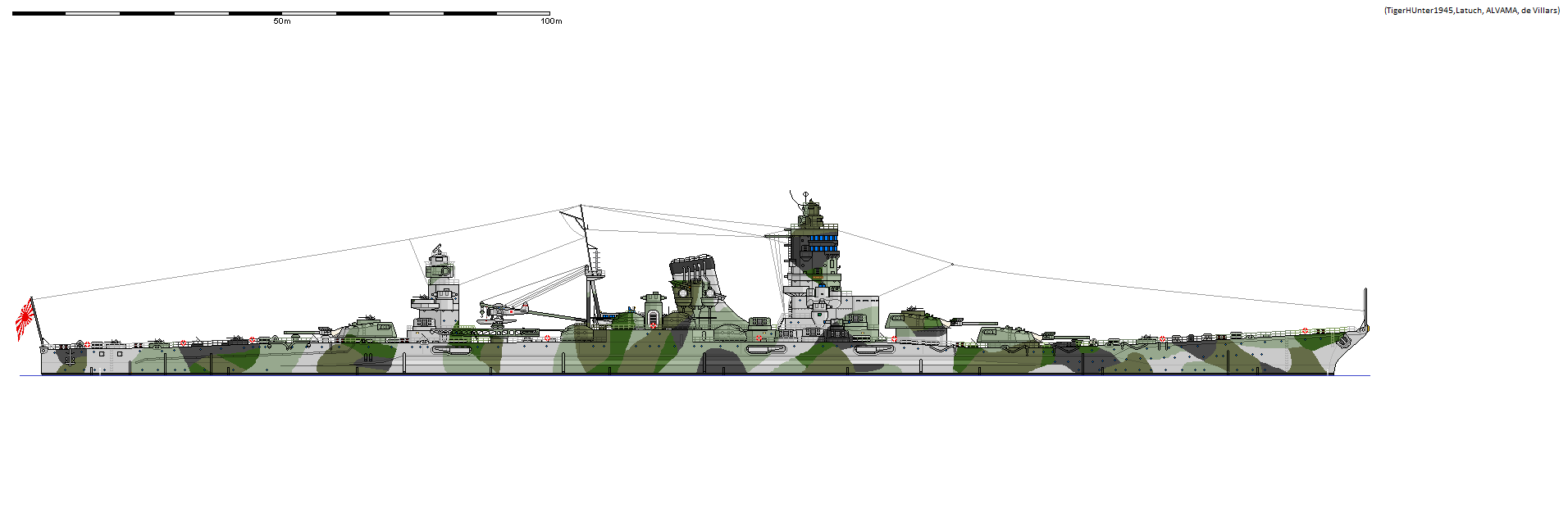
 Krążowniki typu B65 zawsze mnie intrygowały. To wizualnie takie trochę mini-Yamato, a że jak wiadomo małe jest piękne, to postanowiłem się nimi zająć. Oczywiście tak znany (przynajmniej ogólnie) projekt został już narysowany na shipbuckecie, więc nie wyważałem otwartych drzwi, tylko z niego skorzystałem (łącząc najbardziej udane moim zdaniem elementy z różnych rysunków i dodając co nieco od siebie). Okrętów chyba specjalnie nie trzeba przedstawiać, bo na pewno każdy je zna – dla porządku wspomnijmy tylko że są to wielkie krążowniki z 12-calówkami, japońskie odpowiedniki Alaski, zaprojektowane w odpowiedzi na rosnące zbrojenia morski USA (Two Ocean Navy Act z 1940 r.). Ponoć planowano budowę aż 6 takich krążowników, co w warunkach wojny było oczywiście nierealne, ale kto komu zabroni mieć pobożne życzenia. Po bitwie pod Midway plany zrewidowano, tym razem ograniczając się do dwóch jednostek mających wejść do służby w 1945 i 1946 r. A i z tego, rzecz jasna, nic nie wyszło.
Plany okrętów oczywiście się nie zachowały, stąd znana jest tylko ich ogólna charakterystyka. Wiadomo, że miały być nieco większe od Alaski, z cieńszym pancerzem burtowym ale grubszym pokładowym, o podobnej prędkości i słabszym uzbrojeniu plot (aczkolwiek to jeszcze w toku budowy zapewne uległoby wzmocnieniu). Planowano dla tych okrętów ponoć rolę w nocnych starciach, i w tym kontekście mocno dziwi brak wyrzutni torped, które zakładam, że okręty jednak mogły by otrzymać.
Nie wykluczam, że kiedyś, w prehistorii bloga już się tym typem zajmowałem, ale te najstarsze projekty przepadły, zatem można go zasymulować raz jeszcze. Zwłaszcza, że okręty ładne;)


Ishikari, japanese large cruiser laid down 1942 (Engine 1944)

Displacement:
    27 742 t light; 29 119 t standard; 31 892 t normal; 34 110 t full load

Dimensions: Length overall / water x beam x draught
    809,14 ft / 787,60 ft x 89,01 ft x 29,00 ft (normal load)
    246,62 m / 240,06 m x 27,13 m  x 8,84 m

Armament:
      9 - 12,20" / 310 mm guns (3x3 guns), 908,98lbs / 412,31kg shells, 1940 Model
      Breech loading guns in turrets (on barbettes)
      on centreline ends, majority forward, 1 raised mount - superfiring
      16 - 3,94" / 100 mm guns (8x2 guns), 30,51lbs / 13,84kg shells, 1938 Model
      Dual purpose guns in deck mounts with hoists
      on side, all amidships, 4 raised mounts - superfiring
      60 - 0,98" / 25,0 mm guns (20x3 guns), 0,48lbs / 0,22kg shells, 1935 Model
      Anti-aircraft guns in deck mounts
      on side, evenly spread, 6 raised mounts
      12 - 0,98" / 25,0 mm guns (6x2 guns), 0,48lbs / 0,22kg shells, 1935 Model
      Anti-aircraft guns in deck mounts
      on centreline ends, evenly spread, all raised mounts - superfiring
    Weight of broadside 8 704 lbs / 3 948 kg
    Shells per gun, main battery: 150
    12 - 24,0" / 610 mm above water torpedoes

Armour:
   - Belts:        Width (max)    Length (avg)        Height (avg)
    Main:    7,48" / 190 mm    468,80 ft / 142,89 m    13,32 ft / 4,06 m
    Ends:    Unarmoured
    Upper:    5,98" / 152 mm    329,99 ft / 100,58 m    6,50 ft / 1,98 m
      Main Belt covers 92% of normal length
      Main belt does not fully cover magazines and engineering spaces

   - Torpedo Bulkhead:
        1,97" / 50 mm    468,80 ft / 142,89 m    26,12 ft / 7,96 m

   - Gun armour:    Face (max)    Other gunhouse (avg)    Barbette/hoist (max)
    Main:    12,8" / 325 mm    4,92" / 125 mm        8,27" / 210 mm
    2nd:    2,01" / 51 mm    0,98" / 25 mm        0,98" / 25 mm

   - Armour deck: 4,92" / 125 mm, Conning tower: 7,09" / 180 mm

Machinery:
    Oil fired boilers, steam turbines,
    Geared drive, 4 shafts, 204 353 shp / 152 447 Kw = 34,00 kts
    Range 8 000nm at 18,00 kts
    Bunker at max displacement = 4 992 tons

Complement:
    1 193 - 1 551

Cost:
    £16,644 million / $66,574 million

Distribution of weights at normal displacement:
    Armament: 1 088 tons, 3,4%
    Armour: 9 509 tons, 29,8%
       - Belts: 2 590 tons, 8,1%
       - Torpedo bulkhead: 892 tons, 2,8%
       - Armament: 1 424 tons, 4,5%
       - Armour Deck: 4 450 tons, 14,0%
       - Conning Tower: 154 tons, 0,5%
    Machinery: 5 218 tons, 16,4%
    Hull, fittings & equipment: 11 827 tons, 37,1%
    Fuel, ammunition & stores: 4 150 tons, 13,0%
    Miscellaneous weights: 100 tons, 0,3%

Overall survivability and seakeeping ability:
    Survivability (Non-critical penetrating hits needed to sink ship):
      41 051 lbs / 18 620 Kg = 45,2 x 12,2 " / 310 mm shells or 5,5 torpedoes
    Stability (Unstable if below 1.00): 1,22
    Metacentric height 6,0 ft / 1,8 m
    Roll period: 15,2 seconds
    Steadiness    - As gun platform (Average = 50 %): 43 %
            - Recoil effect (Restricted arc if above 1.00): 0,42
    Seaboat quality  (Average = 1.00): 0,76

Hull form characteristics:
    Hull has a flush deck
    Block coefficient: 0,549
    Length to Beam Ratio: 8,85 : 1
    'Natural speed' for length: 28,06 kts
    Power going to wave formation at top speed: 56 %
    Trim (Max stability = 0, Max steadiness = 100): 50
    Bow angle (Positive = bow angles forward): 38,00 degrees
    Stern overhang: 0,49 ft / 0,15 m
    Freeboard (% = measuring location as a percentage of overall length):
       - Stem:        26,94 ft / 8,21 m
       - Forecastle (25%):    17,45 ft / 5,32 m
       - Mid (50%):        20,93 ft / 6,38 m
       - Quarterdeck (22%):    20,44 ft / 6,23 m
       - Stern:        16,47 ft / 5,02 m
       - Average freeboard:    19,96 ft / 6,08 m
    Ship tends to be wet forward

Ship space, strength and comments:
    Space    - Hull below water (magazines/engines, low = better): 103,7%
        - Above water (accommodation/working, high = better): 131,9%
    Waterplane Area: 48 879 Square feet or 4 541 Square metres
    Displacement factor (Displacement / loading): 111%
    Structure weight / hull surface area: 168 lbs/sq ft or 821 Kg/sq metre
    Hull strength (Relative):
        - Cross-sectional: 1,03
        - Longitudinal: 1,02
        - Overall: 1,02
    Hull space for machinery, storage, compartmentation is adequate
    Room for accommodation and workspaces is excellent
    Poor seaboat, wet and uncomfortable, reduced performance in heavy weather

Ishikari (1944)
Iwate (1944)
Furano (1944)
Inamura (1945)
Azuma (1945)
Asama (1945)
 

wtorek, 15 sierpnia 2023

Francuski pancernik Turenne z 1893 r.

W 1890 r. inż. Charles Huin zaproponował dwa projekty pancerników, większy 14000-tonowy i mniejszy 11000-tonowy. Obydwa miały typowo francuskie kształty kadłuba z silnym dośrodkowym pochyleniem burt, nadbudówki z dwoma masztami bojowymi upodabniającymi jednostki do Hoche’a (aczkolwiek od niego różniły się wyższą wolna burtą), silnie wygiętą stewę dziobową w stylu krążownika D’Entrecasteaux z dodatkową ostrogą taranu poniżej linii wodnej i uzbrojenie w wieżach działowych, przy czym artyleria ciężka miała być rozlokowana w 2 wieżach na dziobie i na rufie oraz w dwóch po bokach śródokręcia. Charakterystyczna było wyposażenie okrętu w długolufowe działa, przeznaczone do wykorzystania ładunków miotających z prochu bezdymnego (co w rzeczywistości po raz pierwszy zastosowano na pancerniku Brennus z  1891 r. (w sł. 1896). Opancerzenie najprawdopodobniej miało być wykonane ze stali niklowej. Poniżej prezentuję symulację wariantu większego, uzbrojonego w 2 działa 340 mm i 2 – 274 mm. Okręt ostatecznie nie powstał gdyż uznano go za zbyt drogi (zapewne z uwagi na wielkość), ale niewątpliwie prezentowałby się niezwykle.  Symulacja jest mojego autorstwa, natomiast poniższy rysunek pochodzi z forum shipbucket i został przeze mnie lekko zmodyfikowany i „pokolorowany” w różne schematy malowania. 


Turenne, french battleship laid down 1891 (Engine 1893)

Displacement:
    12 749 t light; 13 228 t standard; 14 101 t normal; 14 799 t full load

Dimensions: Length overall / water x beam x draught
    411,65 ft / 411,65 ft x 72,05 ft x 27,92 ft (normal load)
    125,47 m / 125,47 m x 21,96 m  x 8,51 m

Armament:
      2 - 13,39" / 340 mm guns in single mounts, 1 145,27lbs / 519,49kg shells, 1887 Model
      Breech loading guns in turrets (on barbettes)
      on centreline ends, evenly spread
      2 - 10,79" / 274 mm guns in single mounts, 599,41lbs / 271,89kg shells, 1887 Model
      Breech loading guns in turrets (on barbettes)
      on side, all amidships
      8 - 5,43" / 138 mm guns in single mounts, 80,19lbs / 36,37kg shells, 1891 Model
      Quick firing guns in turrets (on barbettes)
      on side, evenly spread
      8 - 1,85" / 47,0 mm guns in single mounts, 2,93lbs / 1,33kg shells, 1885 Model
      Quick firing guns in deck mounts
      on side, all amidships, all raised mounts - superfiring
      12 - 1,46" / 37,0 mm guns in single mounts, 1,43lbs / 0,65kg shells, 1885 Model
      Quick firing guns in deck mounts
      on side ends, evenly spread, all raised mounts - superfiring
    Weight of broadside 4 171 lbs / 1 892 kg
    Shells per gun, main battery: 80
    8 - 17,7" / 450 mm above water torpedoes

Armour:
   - Belts:        Width (max)    Length (avg)        Height (avg)
    Main:    17,7" / 450 mm    236,38 ft / 72,05 m    7,97 ft / 2,43 m
    Ends:    7,87" / 200 mm    168,27 ft / 51,29 m    7,97 ft / 2,43 m
      6,99 ft / 2,13 m Unarmoured ends
      Main Belt covers 88% of normal length

   - Gun armour:    Face (max)    Other gunhouse (avg)    Barbette/hoist (max)
    Main:    15,0" / 380 mm    9,84" / 250 mm        15,7" / 400 mm
    2nd:    13,8" / 350 mm    7,87" / 200 mm        15,0" / 380 mm
    3rd:    3,94" / 100 mm    3,15" / 80 mm        3,94" / 100 mm

   - Armour deck: 1,97" / 50 mm (2,56" / 65 mm over amidships, 1,18" / 30 mm over ends), Conning tower: 7,87" / 200 mm

Machinery:
    Coal fired boilers, complex reciprocating steam engines,
    Direct drive, 2 shafts, 13 542 ihp / 10 102 Kw = 18,00 kts
    Range 4 500nm at 10,00 kts
    Bunker at max displacement = 1 571 tons (100% coal)

Complement:
    646 - 841

Cost:
    £1,217 million / $4,867 million

Distribution of weights at normal displacement:
    Armament: 521 tons, 3,7%
    Armour: 4 617 tons, 32,7%
       - Belts: 1 919 tons, 13,6%
       - Torpedo bulkhead: 0 tons, 0,0%
       - Armament: 1 812 tons, 12,9%
       - Armour Deck: 787 tons, 5,6%
       - Conning Tower: 99 tons, 0,7%
    Machinery: 2 376 tons, 16,8%
    Hull, fittings & equipment: 5 234 tons, 37,1%
    Fuel, ammunition & stores: 1 352 tons, 9,6%
    Miscellaneous weights: 0 tons, 0,0%

Overall survivability and seakeeping ability:
    Survivability (Non-critical penetrating hits needed to sink ship):
      17 768 lbs / 8 059 Kg = 14,8 x 13,4 " / 340 mm shells or 2,2 torpedoes
    Stability (Unstable if below 1.00): 1,01
    Metacentric height 3,1 ft / 0,9 m
    Roll period: 17,2 seconds
    Steadiness    - As gun platform (Average = 50 %): 92 %
            - Recoil effect (Restricted arc if above 1.00): 0,99
    Seaboat quality  (Average = 1.00): 1,97

Hull form characteristics:
    Hull has rise forward of midbreak, low quarterdeck
    Block coefficient: 0,596
    Length to Beam Ratio: 5,71 : 1
    'Natural speed' for length: 20,29 kts
    Power going to wave formation at top speed: 47 %
    Trim (Max stability = 0, Max steadiness = 100): 47
    Bow angle (Positive = bow angles forward): -67,00 degrees
    Stern overhang: 0,00 ft / 0,00 m
    Freeboard (% = measuring location as a percentage of overall length):
       - Stem:        25,92 ft / 7,90 m
       - Forecastle (15%):    25,92 ft / 7,90 m
       - Mid (71%):        25,43 ft / 7,75 m (17,95 ft / 5,47 m aft of break)
       - Quarterdeck (21%):    10,96 ft / 3,34 m (17,95 ft / 5,47 m before break)
       - Stern:        10,96 ft / 3,34 m
       - Average freeboard:    21,93 ft / 6,69 m

Ship space, strength and comments:
    Space    - Hull below water (magazines/engines, low = better): 82,6%
        - Above water (accommodation/working, high = better): 136,5%
    Waterplane Area: 21 610 Square feet or 2 008 Square metres
    Displacement factor (Displacement / loading): 104%
    Structure weight / hull surface area: 153 lbs/sq ft or 745 Kg/sq metre
    Hull strength (Relative):
        - Cross-sectional: 0,88
        - Longitudinal: 3,11
        - Overall: 1,00
    Hull space for machinery, storage, compartmentation is excellent
    Room for accommodation and workspaces is excellent
    Ship has slow, easy roll, a good, steady gun platform
    Excellent seaboat, comfortable, can fire her guns in the heaviest weather

piątek, 11 sierpnia 2023

Modernizacja krążowników typu Nizamiye

Dziś modernizacja fikcyjnych tureckich krążowników, które prezentowałem w poście z 31 lipca. Pomysł na przebudowę pojawił się w toku dyskusji pod tymi okrętami. Jednym z pomysłów było utrzymanie okrętów w ich pierwotnej funkcji, czyli jako krążowników. Z oryginalnych jednostek zostały w zasadzie tylko skorupy kadłubów. Usunięto oczywiście całe oryginalne omasztowanie  i ożaglowanie. Wymieniony został cały układ napędowy oraz cały zestaw uzbrojenia, w tym zlikwidowano także kazamaty kadłubowe.  Obecnie okręty otrzymały 7 niemieckich dział szybkostrzelnych kal. 105 mm L/40 (z których 5 może strzelać na jedną burtę) oraz 2 wyrzutnie torped kal. 450 mm. Pancerz pokładowy został wymieniony na nowy o grubości 40 mm, wykonany ze stali Kruppa. Nowy układ napędowy zapewnia prędkość 20 w. Z drobniejszych spraw, wymieniono kotwice admiralicji, na kotwice Halla. Myślę, że po przebudowie okręty prezentują sobą całkiem przyzwoity poziom jak na przełom wieków :)


Nizamiye, turkish protected cruiser laid down 1880 (Engine 1900)

Displacement:
    2 542 t light; 2 624 t standard; 2 793 t normal; 2 929 t full load

Dimensions: Length overall / water x beam x draught
    272,93 ft / 263,45 ft x 42,81 ft x 16,77 ft (normal load)
    83,19 m / 80,30 m x 13,05 m  x 5,11 m

Armament:
      3 - 4,13" / 105 mm guns in single mounts, 35,32lbs / 16,02kg shells, 1898 Model
      Quick firing guns in deck mounts
      on centreline, evenly spread
      Aft Main mounts separated by engine room
      4 - 4,13" / 105 mm guns in single mounts, 35,32lbs / 16,02kg shells, 1898 Model
      Quick firing guns in deck mounts
      on side, all amidships
      4 - 1,97" / 50,0 mm guns in single mounts, 3,81lbs / 1,73kg shells, 1892 Model
      Quick firing guns in deck mounts
      on side ends, evenly spread
    Weight of broadside 262 lbs / 119 kg
    Shells per gun, main battery: 150
    2 - 17,7" / 450 mm above water torpedoes

Armour:
   - Gun armour:    Face (max)    Other gunhouse (avg)    Barbette/hoist (max)
    Main:    0,98" / 25 mm    0,59" / 15 mm              -
    2nd:    0,98" / 25 mm    0,59" / 15 mm              -

   - Armour deck: 1,57" / 40 mm, Conning tower: 1,97" / 50 mm

Machinery:
    Coal fired boilers, complex reciprocating steam engines,
    Direct drive, 2 shafts, 8 656 ihp / 6 457 Kw = 20,00 kts
    Range 3 000nm at 9,00 kts
    Bunker at max displacement = 306 tons (100% coal)

Complement:
    191 - 249

Cost:
    £0,295 million / $1,178 million

Distribution of weights at normal displacement:
    Armament: 33 tons, 1,2%
    Armour: 247 tons, 8,8%
       - Belts: 0 tons, 0,0%
       - Torpedo bulkhead: 0 tons, 0,0%
       - Armament: 16 tons, 0,6%
       - Armour Deck: 222 tons, 8,0%
       - Conning Tower: 8 tons, 0,3%
    Machinery: 1 271 tons, 45,5%
    Hull, fittings & equipment: 992 tons, 35,5%
    Fuel, ammunition & stores: 251 tons, 9,0%
    Miscellaneous weights: 0 tons, 0,0%

Overall survivability and seakeeping ability:
    Survivability (Non-critical penetrating hits needed to sink ship):
      1 301 lbs / 590 Kg = 43,3 x 4,1 " / 105 mm shells or 0,4 torpedoes
    Stability (Unstable if below 1.00): 1,43
    Metacentric height 2,6 ft / 0,8 m
    Roll period: 11,1 seconds
    Steadiness    - As gun platform (Average = 50 %): 92 %
            - Recoil effect (Restricted arc if above 1.00): 0,12
    Seaboat quality  (Average = 1.00): 1,83

Hull form characteristics:
    Hull has a flush deck
    Block coefficient: 0,517
    Length to Beam Ratio: 6,15 : 1
    'Natural speed' for length: 16,23 kts
    Power going to wave formation at top speed: 60 %
    Trim (Max stability = 0, Max steadiness = 100): 50
    Bow angle (Positive = bow angles forward): 0,00 degrees
    Stern overhang: 9,48 ft / 2,89 m
    Freeboard (% = measuring location as a percentage of overall length):
       - Stem:        22,44 ft / 6,84 m
       - Forecastle (16%):    17,45 ft / 5,32 m
       - Mid (50%):        14,99 ft / 4,57 m
       - Quarterdeck (14%):    16,47 ft / 5,02 m
       - Stern:        16,96 ft / 5,17 m
       - Average freeboard:    16,62 ft / 5,06 m

Ship space, strength and comments:
    Space    - Hull below water (magazines/engines, low = better): 156,3%
        - Above water (accommodation/working, high = better): 111,0%
    Waterplane Area: 7 634 Square feet or 709 Square metres
    Displacement factor (Displacement / loading): 87%
    Structure weight / hull surface area: 71 lbs/sq ft or 348 Kg/sq metre
    Hull strength (Relative):
        - Cross-sectional: 0,84
        - Longitudinal: 4,41
        - Overall: 1,00
    Hull space for machinery, storage, compartmentation is cramped
    Room for accommodation and workspaces is adequate
    Ship has slow, easy roll, a good, steady gun platform
    Excellent seaboat, comfortable, can fire her guns in the heaviest weather

Nizamiye (1881, rebuilt 1900)
Fevz-i Nusret (1881, rebuilt 1900)