czwartek, 30 stycznia 2020

12-calowy krążownik Hiragi

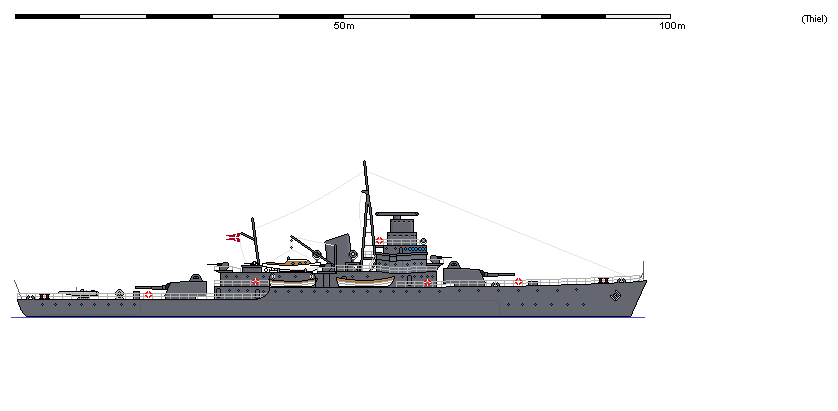
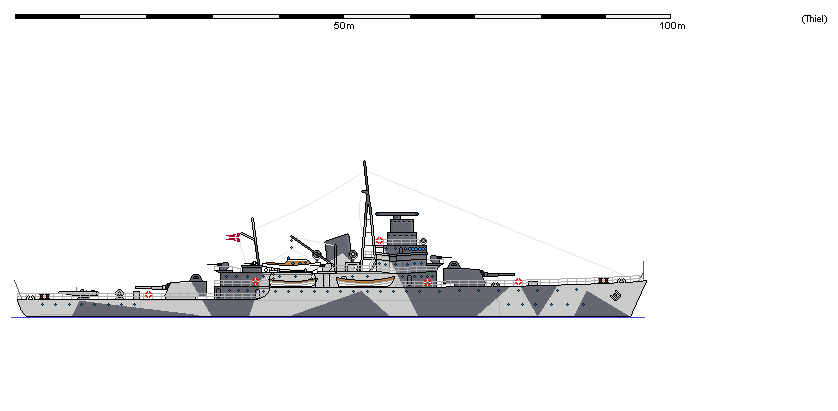
Dziś autentyczny projekt japońskiego krążownika z działami 12-calowymi, pochodzący z lat bezpośrednio po zakończeniu PWS, autorstwa Yuzuru Hiragi. Okręt ma formę wywodzącą się z krążowników lekkich, rozmiarami odpowiada z grubsza krążownikom „waszyngtońskim”, ale za uzbrojenie ma 3 działa kal. 305 mm w pojedynczych wieżach, uzupełnione przez 8 dział kal. 140 mm w kazamatach i stanowiskach pokładowych oraz 4 wyrzutnie torped. Okręt został opancerzony blachami o grubości 76 mm. Posiada kadłub o znacznym wydłużeniu, co sprzyja osiąganiu znacznych prędkości - wg projektu miał rozwijać aż 36 w., aczkolwiek w symulacji udało mi się osiągnąć tylko 32. Kotły miały być opalane w większości (12 szt.) ropą, ale 3 z nich były na węgiel (którego zasobnie zlokalizowano między kotłowniami a barbetą wieży na śródokręciu.
Oryginalnego przeznaczenia krążownika niestety nie znam, ale okręt w takim kształcie postrzegam jako jednostkę rozpoznawczą, przeznaczoną do współpracy z własnymi siłami głównymi. Kaliber artylerii głównej jest taki, że każdy wrogi okręt musiałby się z nią przynajmniej liczyć, a jednocześnie działa kal. 140 mm zapewniają odpowiednią „gęstość” ognia przy zwalczaniu lżejszych jednostek wroga (niszczyciele, lekkie krążowniki). Jednocześnie prędkość jest na poziomie zapewniającym przewagę nad każdym silniejszym przeciwnikiem.  Pozostaje tylko jeden problem – Waszyngton, przez który okręt taki nie mógłby powstać. Chyba żeby ustalono dla krążowników tylko limit wyporności, bez określania maksymalnego kalibru dział – wtedy bardzo możliwe, że takich i podobnych krążowników mogło by powstać więcej. Oprócz japońskich, były projekty podobnych jednostek w USA, a stawiam także na to, że różne mniejsze floty mogły by się zainteresować takim konceptem - w końcu wielkie działa zawsze w cenie, zwłaszcza gdy chcemy jakiś ersatz pancernika, a na prawdziwy nas nie stać;) 
Na koniec kwestia nazw – przyjąłem, że będą one pochodzić od japońskich gór, jak w przypadku krążowników ciężkich.  Wprawdzie projekt bywa określany jako „krążownik lekki”, więc teoretycznie bardziej pasowały by nazwy pochodzące od rzek, ale z drugiej strony – jeśli to miałby być krążownik lekki, to jak miałby wyglądać krążownik ciężki? Chyba  musiałby mieć 20.000 ton i 16-calówki…;)


Warusawa, japanese large light cruiser laid down 1920 (Engine 1922)

Displacement:
    10 653 t light; 11 046 t standard; 11 892 t normal; 12 570 t full load

Dimensions: Length overall / water x beam x draught
    699,98 ft / 691,57 ft x 62,01 ft x 20,01 ft (normal load)
    213,36 m / 210,79 m x 18,90 m  x 6,10 m

Armament:
      3 - 12,01" / 305 mm guns in single mounts, 865,70lbs / 392,67kg shells, 1905 Model
      Breech loading guns in turrets (on barbettes)
      on centreline, evenly spread
      Aft Main mounts separated by engine room
      6 - 5,51" / 140 mm guns in single mounts, 83,72lbs / 37,97kg shells, 1914 Model
      Quick firing guns in casemate mounts
      on side, evenly spread
      2 - 5,51" / 140 mm guns in single mounts, 83,72lbs / 37,97kg shells, 1914 Model
      Quick firing guns in deck mounts with hoists
      on centreline, all amidships
      4 - 2,99" / 76,0 mm guns in single mounts, 13,39lbs / 6,07kg shells, 1922 Model
      Anti-aircraft guns in deck mounts
      on centreline, all amidships, all raised mounts - superfiring
      2 - 2,99" / 76,0 mm guns in single mounts, 13,39lbs / 6,07kg shells, 1922 Model
      Anti-aircraft guns in deck mounts
      on side, all forward, all raised mounts - superfiring
    Weight of broadside 3 347 lbs / 1 518 kg
    Shells per gun, main battery: 80
    4 - 21,0" / 533 mm above water torpedoes

Armour:
   - Belts:        Width (max)    Length (avg)        Height (avg)
    Main:    2,99" / 76 mm    492,13 ft / 150,00 m    16,80 ft / 5,12 m
    Ends:    Unarmoured
      Main Belt covers 109% of normal length
      Main belt does not fully cover magazines and engineering spaces

   - Torpedo Bulkhead:
        0,98" / 25 mm    156,56 ft / 47,72 m    19,09 ft / 5,82 m

   - Gun armour:    Face (max)    Other gunhouse (avg)    Barbette/hoist (max)
    Main:    2,99" / 76 mm    2,99" / 76 mm        2,99" / 76 mm
    2nd:    1,46" / 37 mm          -                  -
    3rd:    1,46" / 37 mm    0,98" / 25 mm              -

   - Armour deck: 0,98" / 25 mm, Conning tower: 2,99" / 76 mm

Machinery:
    Coal and oil fired boilers, steam turbines,
    Geared drive, 4 shafts, 77 306 shp / 57 670 Kw = 32,00 kts
    Range 6 000nm at 14,00 kts
    Bunker at max displacement = 1 524 tons (15% coal)

Complement:
    569 - 740

Cost:
    £2,592 million / $10,367 million

Distribution of weights at normal displacement:
    Armament: 418 tons, 3,5%
    Armour: 1 970 tons, 16,6%
       - Belts: 1 007 tons, 8,5%
       - Torpedo bulkhead: 109 tons, 0,9%
       - Armament: 287 tons, 2,4%
       - Armour Deck: 534 tons, 4,5%
       - Conning Tower: 34 tons, 0,3%
    Machinery: 2 659 tons, 22,4%
    Hull, fittings & equipment: 5 606 tons, 47,1%
    Fuel, ammunition & stores: 1 240 tons, 10,4%
    Miscellaneous weights: 0 tons, 0,0%

Overall survivability and seakeeping ability:
    Survivability (Non-critical penetrating hits needed to sink ship):
      16 733 lbs / 7 590 Kg = 19,3 x 12,0 " / 305 mm shells or 2,0 torpedoes
    Stability (Unstable if below 1.00): 1,15
    Metacentric height 3,2 ft / 1,0 m
    Roll period: 14,6 seconds
    Steadiness    - As gun platform (Average = 50 %): 79 %
            - Recoil effect (Restricted arc if above 1.00): 0,88
    Seaboat quality  (Average = 1.00): 1,58

Hull form characteristics:
    Hull has a flush deck
      and transom stern
    Block coefficient: 0,485
    Length to Beam Ratio: 11,15 : 1
    'Natural speed' for length: 29,81 kts
    Power going to wave formation at top speed: 50 %
    Trim (Max stability = 0, Max steadiness = 100): 50
    Bow angle (Positive = bow angles forward): 17,00 degrees
    Stern overhang: 0,49 ft / 0,15 m
    Freeboard (% = measuring location as a percentage of overall length):
       - Stem:        25,92 ft / 7,90 m
       - Forecastle (19%):    23,95 ft / 7,30 m
       - Mid (50%):        21,95 ft / 6,69 m
       - Quarterdeck (16%):    22,44 ft / 6,84 m
       - Stern:        23,43 ft / 7,14 m
       - Average freeboard:    23,04 ft / 7,02 m
    Ship tends to be wet forward

Ship space, strength and comments:
    Space    - Hull below water (magazines/engines, low = better): 145,9%
        - Above water (accommodation/working, high = better): 207,1%
    Waterplane Area: 29 303 Square feet or 2 722 Square metres
    Displacement factor (Displacement / loading): 112%
    Structure weight / hull surface area: 115 lbs/sq ft or 562 Kg/sq metre
    Hull strength (Relative):
        - Cross-sectional: 0,96
        - Longitudinal: 1,51
        - Overall: 1,00
    Hull space for machinery, storage, compartmentation is cramped
    Room for accommodation and workspaces is excellent
    Ship has slow, easy roll, a good, steady gun platform
    Excellent seaboat, comfortable, can fire her guns in the heaviest weather

Warusawa (1922)
Tsukuba (1923)
Hotaka (1923)
Fuji (1924)

czwartek, 23 stycznia 2020

Kolejna duńska kanonierka

Dziś kolejny projekt duński z okresu międzywojennego – powiększona wersja okrętu prezentowanego 2 stycznia. Co do przeznaczenia trudno się rozpisywać, bo jest ono w zasadzie identyczne jak w tamtym przypadku (kanonierka, patrolowiec, okręt ochrony rybołówstwa). Okręt jest natomiast nieco większy co pozwoliło poprawić ochronę pancerną, uzyskać nieco większą prędkość oraz przenosić cięższe uzbrojenie (działa 150 mm). Co ciekawe – w odróżnieniu do poprzedniego projektu, na tym okręcie nie przewidziano wodnosamolotu, oraz ograniczono uzbrojenie torpedowe. 
Ps. podobnie jak poprzednio, rysunek będący podstawą poszczególnych wariantów malowania okrętu zaczerpnąłem z forum shipbucket.com.


Absalon, danish patrol gunboat laid down 1938 (Engine 1939)

Displacement:
    2 398 t light; 2 501 t standard; 2 798 t normal; 3 035 t full load

Dimensions: Length overall / water x beam x draught
    314,97 ft / 302,26 ft x 42,75 ft x 14,83 ft (normal load)
    96,00 m / 92,13 m x 13,03 m  x 4,52 m

Armament:
      4 - 5,91" / 150 mm guns (2x2 guns), 102,98lbs / 46,71kg shells, 1923 Model
      Quick firing guns in turrets (on barbettes)
      on centreline ends, evenly spread
      2 - 1,57" / 40,0 mm guns in single mounts, 1,95lbs / 0,88kg shells, 1939 Model
      Anti-aircraft guns in deck mounts
      on centreline ends, evenly spread, all raised mounts
      2 - 1,57" / 40,0 mm guns in single mounts, 1,95lbs / 0,88kg shells, 1939 Model
      Anti-aircraft guns in deck mounts
      on side, all amidships, all raised mounts - superfiring
      4 - 0,79" / 20,0 mm guns (2x2 guns), 0,24lbs / 0,11kg shells, 1934 Model
      Anti-aircraft guns in deck mounts
      on side, all aft
    Weight of broadside 421 lbs / 191 kg
    Shells per gun, main battery: 200
    2 - 18,0" / 457 mm above water torpedoes

Armour:
   - Belts:        Width (max)    Length (avg)        Height (avg)
    Main:    0,98" / 25 mm    179,49 ft / 54,71 m    11,98 ft / 3,65 m
    Ends:    0,98" / 25 mm      49,77 ft / 15,17 m    4,99 ft / 1,52 m
      73,00 ft / 22,25 m Unarmoured ends
      Main Belt covers 91% of normal length

   - Gun armour:    Face (max)    Other gunhouse (avg)    Barbette/hoist (max)
    Main:    1,97" / 50 mm    1,18" / 30 mm        1,18" / 30 mm
    2nd:    0,98" / 25 mm          -                  -
    3rd:    0,98" / 25 mm          -                  -

   - Armour deck: 0,98" / 25 mm, Conning tower: 2,95" / 75 mm

Machinery:
    Oil fired boilers, steam turbines,
    Geared drive, 2 shafts, 8 829 shp / 6 587 Kw = 20,50 kts
    Range 9 000nm at 12,00 kts
    Bunker at max displacement = 534 tons

Complement:
    192 - 250

Cost:
    £0,910 million / $3,642 million

Distribution of weights at normal displacement:
    Armament: 53 tons, 1,9%
    Armour: 313 tons, 11,2%
       - Belts: 102 tons, 3,6%
       - Torpedo bulkhead: 0 tons, 0,0%
       - Armament: 40 tons, 1,4%
       - Armour Deck: 158 tons, 5,7%
       - Conning Tower: 13 tons, 0,5%
    Machinery: 239 tons, 8,5%
    Hull, fittings & equipment: 1 793 tons, 64,1%
    Fuel, ammunition & stores: 400 tons, 14,3%
    Miscellaneous weights: 0 tons, 0,0%

Overall survivability and seakeeping ability:
    Survivability (Non-critical penetrating hits needed to sink ship):
      7 394 lbs / 3 354 Kg = 71,8 x 5,9 " / 150 mm shells or 2,4 torpedoes
    Stability (Unstable if below 1.00): 1,15
    Metacentric height 1,8 ft / 0,6 m
    Roll period: 13,3 seconds
    Steadiness    - As gun platform (Average = 50 %): 62 %
            - Recoil effect (Restricted arc if above 1.00): 0,30
    Seaboat quality  (Average = 1.00): 1,24

Hull form characteristics:
    Hull has rise forward of midbreak
    Block coefficient: 0,511
    Length to Beam Ratio: 7,07 : 1
    'Natural speed' for length: 17,39 kts
    Power going to wave formation at top speed: 55 %
    Trim (Max stability = 0, Max steadiness = 100): 50
    Bow angle (Positive = bow angles forward): 24,00 degrees
    Stern overhang: 4,49 ft / 1,37 m
    Freeboard (% = measuring location as a percentage of overall length):
       - Stem:        18,44 ft / 5,62 m
       - Forecastle (26%):    15,45 ft / 4,71 m
       - Mid (60%):        14,96 ft / 4,56 m (8,99 ft / 2,74 m aft of break)
       - Quarterdeck (23%):    8,99 ft / 2,74 m
       - Stern:        8,99 ft / 2,74 m
       - Average freeboard:    13,08 ft / 3,99 m
    Ship tends to be wet forward

Ship space, strength and comments:
    Space    - Hull below water (magazines/engines, low = better): 44,0%
        - Above water (accommodation/working, high = better): 104,7%
    Waterplane Area: 8 696 Square feet or 808 Square metres
    Displacement factor (Displacement / loading): 231%
    Structure weight / hull surface area: 130 lbs/sq ft or 636 Kg/sq metre
    Hull strength (Relative):
        - Cross-sectional: 1,80
        - Longitudinal: 4,47
        - Overall: 1,98
    Hull space for machinery, storage, compartmentation is excellent
    Room for accommodation and workspaces is adequate
    Good seaboat, rides out heavy weather easily

piątek, 17 stycznia 2020

Przebudowa predrednota Re Umberto na krążownik pancerny

Dziś nie będę się rozpisywał jakoś specjalnie, bo okręt który jest „bohaterem” tego posta został już przedyskutowany przy okazji jednego z poprzednich postów, a mianowicie: http://springsharp.blogspot.com/2019/08/ciezki-monitor-amerykanski.html
Zatem skrótowo – jest to konwersja przestarzałego pancernika typu Re Umberto na krążownik pancerny, w ramach dokonano wymiany uzbrojenia artyleryjskiego (w tym dział 343 mm na nowoczesne 254 mm w trójdziałowych wieżach), wymiany napędu z klasycznego parowego na turbinowy, wzmocnienia opancerzenia poprzez wymianę głównego pasa pancernego ze stali Schneidera na grubszy utwardzany metodą Kruppa, oraz lekkiej przebudowy części dziobowej. W nowej postaci okręt osiąga 23 w. przy nienadzwyczajnej dzielności morskiej, co jest pochodną małej wysokości bocznej kadłuba. Teoretycznie springsharp pozwoliłby na większą prędkość, ale uprzedzając ewentualne  zarzuty o nierealistyczność, nie eskalowałem jej nadmiernie.   


Re Umberto, italian armoured cruiser laid down 1888 (Engine 1912)

Displacement:
    11 728 t light; 12 414 t standard; 13 790 t normal; 14 891 t full load

Dimensions: Length overall / water x beam x draught
    426,51 ft / 426,51 ft x 76,87 ft x 30,48 ft (normal load)
    130,00 m / 130,00 m x 23,43 m  x 9,29 m

Armament:
      6 - 10,00" / 254 mm guns (2x3 guns), 500,00lbs / 226,80kg shells, 1908 Model
      Breech loading guns in turrets (on barbettes)
      on centreline ends, evenly spread, all raised mounts
      10 - 5,98" / 152 mm guns in single mounts, 107,15lbs / 48,60kg shells, 1909 Model
      Quick firing guns in casemate mounts
      on side, all amidships
      4 - 5,98" / 152 mm guns in single mounts, 107,15lbs / 48,60kg shells, 1909 Model
      Quick firing guns in deck mounts with hoists
      on side, all amidships, all raised mounts - superfiring
      6 - 2,99" / 76,0 mm guns in single mounts, 13,39lbs / 6,07kg shells, 1909 Model
      Quick firing guns in deck mounts
      on side, all amidships, all raised mounts - superfiring
      4 - 2,99" / 76,0 mm guns in single mounts, 13,39lbs / 6,07kg shells, 1909 Model
      Quick firing guns in deck mounts
      on centreline ends, evenly spread, all raised mounts - superfiring
    Weight of broadside 4 634 lbs / 2 102 kg
    Shells per gun, main battery: 150
    5 - 17,7" / 450 mm submerged torpedo tubes

Armour:
   - Belts:        Width (max)    Length (avg)        Height (avg)
    Main:    5,91" / 150 mm    251,51 ft / 76,66 m    11,45 ft / 3,49 m
    Ends:    0,14" / 3 mm      0,00 ft / 0,00 m    0,00 ft / 0,00 m
      175,00 ft / 53,34 m Unarmoured ends
    Upper:    3,94" / 100 mm    229,66 ft / 70,00 m    7,51 ft / 2,29 m
      Main Belt covers 91% of normal length

   - Gun armour:    Face (max)    Other gunhouse (avg)    Barbette/hoist (max)
    Main:    7,87" / 200 mm    6,30" / 160 mm        13,8" / 350 mm
    2nd:    3,94" / 100 mm          -                  -
    3rd:    1,97" / 50 mm    1,18" / 30 mm              -

   - Armour deck: 2,95" / 75 mm, Conning tower: 11,81" / 300 mm

Machinery:
    Coal and oil fired boilers, steam turbines,
    Geared drive, 2 shafts, 33 352 shp / 24 881 Kw = 23,00 kts
    Range 6 000nm at 13,00 kts
    Bunker at max displacement = 2 477 tons (90% coal)

Complement:
    636 - 827

Cost:
    £1,100 million / $4,399 million

Distribution of weights at normal displacement:
    Armament: 579 tons, 4,2%
    Armour: 3 480 tons, 25,2%
       - Belts: 1 082 tons, 7,8%
       - Torpedo bulkhead: 0 tons, 0,0%
       - Armament: 1 077 tons, 7,8%
       - Armour Deck: 1 175 tons, 8,5%
       - Conning Tower: 146 tons, 1,1%
    Machinery: 1 448 tons, 10,5%
    Hull, fittings & equipment: 6 220 tons, 45,1%
    Fuel, ammunition & stores: 2 062 tons, 15,0%
    Miscellaneous weights: 0 tons, 0,0%

Overall survivability and seakeeping ability:
    Survivability (Non-critical penetrating hits needed to sink ship):
      15 618 lbs / 7 084 Kg = 32,2 x 10,0 " / 254 mm shells or 2,5 torpedoes
    Stability (Unstable if below 1.00): 1,03
    Metacentric height 3,5 ft / 1,1 m
    Roll period: 17,2 seconds
    Steadiness    - As gun platform (Average = 50 %): 48 %
            - Recoil effect (Restricted arc if above 1.00): 0,43
    Seaboat quality  (Average = 1.00): 0,91

Hull form characteristics:
    Hull has a flush deck
    Block coefficient: 0,483
    Length to Beam Ratio: 5,55 : 1
    'Natural speed' for length: 20,65 kts
    Power going to wave formation at top speed: 56 %
    Trim (Max stability = 0, Max steadiness = 100): 50
    Bow angle (Positive = bow angles forward): 0,00 degrees
    Stern overhang: 0,00 ft / 0,00 m
    Freeboard (% = measuring location as a percentage of overall length):
       - Stem:        16,47 ft / 5,02 m
       - Forecastle (24%):    14,99 ft / 4,57 m
       - Mid (50%):        14,47 ft / 4,41 m
       - Quarterdeck (16%):    13,98 ft / 4,26 m
       - Stern:        13,45 ft / 4,10 m
       - Average freeboard:    14,60 ft / 4,45 m
    Ship tends to be wet forward

Ship space, strength and comments:
    Space    - Hull below water (magazines/engines, low = better): 71,3%
        - Above water (accommodation/working, high = better): 93,1%
    Waterplane Area: 21 513 Square feet or 1 999 Square metres
    Displacement factor (Displacement / loading): 125%
    Structure weight / hull surface area: 194 lbs/sq ft or 946 Kg/sq metre
    Hull strength (Relative):
        - Cross-sectional: 1,08
        - Longitudinal: 3,07
        - Overall: 1,19
    Hull space for machinery, storage, compartmentation is excellent
    Room for accommodation and workspaces is adequate
    Poor seaboat, wet and uncomfortable, reduced performance in heavy weather

niedziela, 12 stycznia 2020

Amerykańskie kanonierki pancerne

Po zakończeniu floty secesyjnej liczna flota amerykańska została drastycznie zredukowana. W służbie zachowano jedynie trochę monitorów oraz nieopancerzonych fregat i korwet.  Stanowiły podstawową siłę floty w zasadzie do lat 90tych XIX w. Nowych jednostek w tym czasie prawie nie budowano, a budowa tych które rozpoczęto, wlokła się niemiłosiernie. Główne jednostki floty - Monitory z czasów wojny secesyjnej, wobec braku poważniejszych modernizacji (do końca zachowały odprzodowe działa gładkolufowe Dahlgrena!) szybko się zestarzały.  Nic więc dziwnego że US Navy w tym czasie nie stanowiła żadnej liczącej się siły morskiej, a nawet pełnienie przez nią funkcji stricte defensywnych było mocno problematyczne. Stąd pomysł na w miarę tanie i szybkie podreperowanie stanu floty poprzez budowę stosunkowo niewielkich kanonierek pancernych, uzbrojonych w dużo nowocześniejszą artylerię. Nikłe rozmiary są wymagane,  by utrzymać koszty na niskim poziomie i dziki temu dało się budowę  okrętów przepchnąć przez Kongres, mocno w tym czasie niechętny jakimkolwiek zbrojeniom na morzu. Jednocześnie okręty są na tyle duże że przenoszą ciężkie działo kal. 305 mm L/26. Oczywiście, nie są to jednostki pełnomorskie, sporą ich wadą jest mizerna dzielność morska (choć z pewnością lepsza niż dawnych monitorów), ale do bezpośredniej obrony portów powinny się dość dobrze nadawać.
Ps. Rysunek ilustrujący jednostkę pochodzi z forum shipbucket.com i został przeze mnie zmodyfikowany.


Housatonic, United States armoured gunboat laid down 1882 (Engine 1883)

Displacement:
    1 559 t light; 1 637 t standard; 1 706 t normal; 1 761 t full load

Dimensions: Length overall / water x beam x draught
    207,81 ft / 207,81 ft x 38,62 ft x 13,29 ft (normal load)
    63,34 m / 63,34 m x 11,77 m  x 4,05 m

Armament:
      1 - 12,01" / 305 mm guns in single mounts, 735,85lbs / 333,78kg shells, 1880 Model
      Breech loading gun in a turret (on a barbette)
      on centreline forward
      Main guns limited to end-on fire
      2 - 5,98" / 152 mm guns in single mounts, 95,90lbs / 43,50kg shells, 1883 Model
      Breech loading guns in deck mounts with hoists
      on side, all amidships
      4 - 1,85" / 47,0 mm guns in single mounts, 2,36lbs / 1,07kg shells, 1873 Model
      Quick firing guns in casemate mounts
      on side, evenly spread
      1 - 1,85" / 47,0 mm guns in single mounts, 2,36lbs / 1,07kg shells, 1873 Model
      Quick firing gun in deck mount
      on centreline amidships, 1 raised gun
    Weight of broadside 939 lbs / 426 kg
    Shells per gun, main battery: 80

Armour:
   - Belts:        Width (max)    Length (avg)        Height (avg)
    Main:    4,02" / 102 mm      73,75 ft / 22,48 m    9,58 ft / 2,92 m
    Ends:    Unarmoured
      Main Belt covers 55% of normal length
      Main belt does not fully cover magazines and engineering spaces

   - Gun armour:    Face (max)    Other gunhouse (avg)    Barbette/hoist (max)
    Main:    2,01" / 51 mm    2,01" / 51 mm        4,02" / 102 mm
    2nd:    1,46" / 37 mm    0,98" / 25 mm              -
    3rd:    1,77" / 45 mm          -                  -

   - Armour deck: 0,98" / 25 mm, Conning tower: 2,01" / 51 mm

Machinery:
    Coal fired boilers, simple reciprocating steam engines,
    Direct drive, 1 shaft, 1 032 ihp / 770 Kw = 12,00 kts
    Range 1 500nm at 8,00 kts
    Bunker at max displacement = 125 tons (100% coal)

Complement:
    132 - 172

Cost:
    £0,182 million / $0,728 million

Distribution of weights at normal displacement:
    Armament: 117 tons, 6,9%
    Armour: 318 tons, 18,6%
       - Belts: 153 tons, 8,9%
       - Torpedo bulkhead: 0 tons, 0,0%
       - Armament: 59 tons, 3,5%
       - Armour Deck: 100 tons, 5,9%
       - Conning Tower: 6 tons, 0,4%
    Machinery: 205 tons, 12,0%
    Hull, fittings & equipment: 919 tons, 53,9%
    Fuel, ammunition & stores: 147 tons, 8,6%
    Miscellaneous weights: 0 tons, 0,0%

Overall survivability and seakeeping ability:
    Survivability (Non-critical penetrating hits needed to sink ship):
      1 924 lbs / 873 Kg = 2,5 x 12,0 " / 305 mm shells or 0,7 torpedoes
    Stability (Unstable if below 1.00): 1,04
    Metacentric height 1,3 ft / 0,4 m
    Roll period: 14,2 seconds
    Steadiness    - As gun platform (Average = 50 %): 100 %
            - Recoil effect (Restricted arc if above 1.00): 1,66
    Seaboat quality  (Average = 1.00): 2,00

Hull form characteristics:
    Hull has rise aft of midbreak
    Block coefficient: 0,560
    Length to Beam Ratio: 5,38 : 1
    'Natural speed' for length: 14,42 kts
    Power going to wave formation at top speed: 41 %
    Trim (Max stability = 0, Max steadiness = 100): 50
    Bow angle (Positive = bow angles forward): -12,00 degrees
    Stern overhang: 0,00 ft / 0,00 m
    Freeboard (% = measuring location as a percentage of overall length):
       - Stem:        6,99 ft / 2,13 m
       - Forecastle (17%):    6,99 ft / 2,13 m
       - Mid (24%):        6,99 ft / 2,13 m (14,47 ft / 4,41 m aft of break)
       - Quarterdeck (15%):    14,47 ft / 4,41 m
       - Stern:        14,47 ft / 4,41 m
       - Average freeboard:    12,70 ft / 3,87 m
    Ship tends to be wet forward

Ship space, strength and comments:
    Space    - Hull below water (magazines/engines, low = better): 90,1%
        - Above water (accommodation/working, high = better): 108,6%
    Waterplane Area: 5 492 Square feet or 510 Square metres
    Displacement factor (Displacement / loading): 102%
    Structure weight / hull surface area: 103 lbs/sq ft or 504 Kg/sq metre
    Hull strength (Relative):
        - Cross-sectional: 0,83
        - Longitudinal: 5,12
        - Overall: 1,00
    Hull space for machinery, storage, compartmentation is adequate
    Room for accommodation and workspaces is adequate
    Ship has slow, easy roll, a good, steady gun platform
    Excellent seaboat, comfortable, can fire her guns in the heaviest weather

Housatonic (1883)
Onondaga (1884)
Tecumseh (1885)
Shiloh (1886)
Keokuk (1887)
Wampanoag (1888)

czwartek, 2 stycznia 2020

Duńska kanonierka/patrolowiec

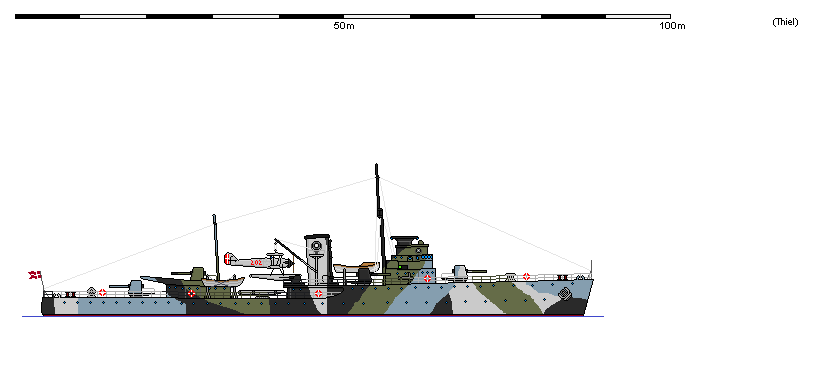
W nowym roku, dla odmiany – coś małego ;) Poniższy okręt to autentyczny projekt duński z okresu międzywojennego. Jednostka jest określana jako kanonierka, patrolowiec, okręt ochrony rybołówstwa, a więc w sumie to taki okręt wielozadaniowy. Z ciekawostek, myślę że na tak małej jednostce uwagę zwraca wodnosamolot na pokładzie oraz szczątkowe opancerzenie w postaci pokładu ochronnego (przy tej grubości raczej trudno go uznać za pancerny, a ponadto znalazłem informację, że miał być wykonany ze zwykłej stali konstrukcyjnej, a nie pancernej). Zwracają uwagę także liczne wyrzutnie torped, dodane chyba na wszelki wypadek, być może do samoobrony, bo na skuteczny atak torpedowy w wykonaniu jednostki rozwijającej tylko 18 w. raczej trudno liczyć.  
Ps. rysunek będący podstawą poniższych wariantów malowania okrętu pochodzi z forum shipbucket.com.


Thor, danish patrol gunboat laid down 1936 (Engine 1937)

Displacement:
    1 472 t light; 1 550 t standard; 1 698 t normal; 1 816 t full load

Dimensions: Length overall / water x beam x draught
    276,22 ft / 269,95 ft x 37,50 ft x 11,98 ft (normal load)
    84,19 m / 82,28 m x 11,43 m  x 3,65 m

Armament:
      3 - 4,72" / 120 mm guns in single mounts, 52,72lbs / 23,91kg shells, 1933 Model
      Quick firing guns in deck mounts with hoists
      on centreline ends, majority aft, 1 raised mount aft
      2 - 4,72" / 120 mm guns in single mounts, 52,72lbs / 23,91kg shells, 1936 Model
      Quick firing guns in deck mounts with hoists
      on side, all amidships
      8 - 1,57" / 40,0 mm guns (4x2 guns), 1,95lbs / 0,88kg shells, 1936 Model
      Anti-aircraft guns in deck mounts
      on side, all amidships, all raised mounts - superfiring
    Weight of broadside 279 lbs / 127 kg
    Shells per gun, main battery: 250
    4 - 18,0" / 457 mm above water torpedoes

Armour:
   - Gun armour:    Face (max)    Other gunhouse (avg)    Barbette/hoist (max)
    Main:    1,46" / 37 mm    0,98" / 25 mm              -
    2nd:    1,46" / 37 mm    0,98" / 25 mm              -
    3rd:    0,98" / 25 mm          -                  -

   - Armour deck: 0,71" / 18 mm

Machinery:
    Oil fired boilers, steam turbines,
    Geared drive, 2 shafts, 4 003 shp / 2 986 Kw = 18,00 kts
    Range 9 000nm at 10,00 kts
    Bunker at max displacement = 267 tons

Complement:
    131 - 171

Cost:
    £0,508 million / $2,033 million

Distribution of weights at normal displacement:
    Armament: 35 tons, 2,1%
    Armour: 111 tons, 6,5%
       - Belts: 0 tons, 0,0%
       - Torpedo bulkhead: 0 tons, 0,0%
       - Armament: 23 tons, 1,4%
       - Armour Deck: 88 tons, 5,2%
       - Conning Tower: 0 tons, 0,0%
    Machinery: 111 tons, 6,5%
    Hull, fittings & equipment: 1 166 tons, 68,7%
    Fuel, ammunition & stores: 225 tons, 13,3%
    Miscellaneous weights: 50 tons, 2,9%

Overall survivability and seakeeping ability:
    Survivability (Non-critical penetrating hits needed to sink ship):
      4 755 lbs / 2 157 Kg = 90,2 x 4,7 " / 120 mm shells or 2,1 torpedoes
    Stability (Unstable if below 1.00): 1,07
    Metacentric height 1,3 ft / 0,4 m
    Roll period: 13,8 seconds
    Steadiness    - As gun platform (Average = 50 %): 84 %
            - Recoil effect (Restricted arc if above 1.00): 0,41
    Seaboat quality  (Average = 1.00): 1,68

Hull form characteristics:
    Hull has rise forward of midbreak
    Block coefficient: 0,490
    Length to Beam Ratio: 7,20 : 1
    'Natural speed' for length: 16,43 kts
    Power going to wave formation at top speed: 49 %
    Trim (Max stability = 0, Max steadiness = 100): 50
    Bow angle (Positive = bow angles forward): 16,00 degrees
    Stern overhang: 0,98 ft / 0,30 m
    Freeboard (% = measuring location as a percentage of overall length):
       - Stem:        18,44 ft / 5,62 m
       - Forecastle (23%):    16,96 ft / 5,17 m
       - Mid (45%):        15,45 ft / 4,71 m (8,99 ft / 2,74 m aft of break)
       - Quarterdeck (16%):    9,48 ft / 2,89 m
       - Stern:        9,48 ft / 2,89 m
       - Average freeboard:    12,72 ft / 3,88 m

Ship space, strength and comments:
    Space    - Hull below water (magazines/engines, low = better): 42,8%
        - Above water (accommodation/working, high = better): 91,5%
    Waterplane Area: 6 685 Square feet or 621 Square metres
    Displacement factor (Displacement / loading): 256%
    Structure weight / hull surface area: 108 lbs/sq ft or 528 Kg/sq metre
    Hull strength (Relative):
        - Cross-sectional: 1,74
        - Longitudinal: 4,82
        - Overall: 1,93
    Hull space for machinery, storage, compartmentation is excellent
    Room for accommodation and workspaces is adequate
    Ship has slow, easy roll, a good, steady gun platform
    Excellent seaboat, comfortable, can fire her guns in the heaviest weather

1 seaplane

Thor (1937)
Odin (1938)
Valkyrien (1939)
Aegir (1940)

sobota, 28 grudnia 2019

C.K. szybki krążownik

No i wysmażyłem austro-węgierski lekki krążownik liniowy (wielki lekki krążownik? – jak zwał tak zwał;)) zainspirowany przez kol. Jasta. Trochę to trwało, ale się udało. Okręt jest przeznaczony do pełnienia funkcji rozpoznawczych, nękania wrogiej żeglugi, niespodziewanych rajdów przeciw jego wybrzeżom i siłom lekkim. Sylwetka okrętu została oparta o rysunek pancernika Radetzky, ma on jednak nieco smuklejsze kształty (czego na rysunku, rzecz jasna, nie widać). Długość wynosząca 152 m jest limitowana gabarytami ówczesnych austriackich pochylni. Ona z kolei determinuje wyporność i uzbrojenie jednostki. W określonych z góry wymiarach nie było szans na pełnoskalowy krążownik liniowy, zatem zdecydowałem się na wersję lekką - czyli jednostkę z 4 działami 12-calowymi. Uzbrojenie główne uzupełnia bateria 12 dział kal. 150 mm L/50 (takich jak typie Viribus Unitis), posiadających wzorem drednotów typu Viribus Unitis własny system kierowania ogniem. Powinno to wpłynąć na skuteczność prowadzonego przez te działa ognia. Trzecią baterię stanowi 10 dział szybkostrzelnych kal. 66 mm. Napęd zapewniają turbiny parowe oraz kotły opalane węglem, zapewniające naprawdę dobrą prędkość 27,5 w. Zasięg wynoszący 5400 Mm nie imponuje, ale też nie można powiedzieć że jest niewystarczający, biorąc pod uwagę spodziewane rejony działania okrętu (Adriatyk i środkowo-zachodnia część Morza Śródziemnego).
Spodziewany sukces tego okrętu, któremu po odesłaniu krążowników liniowych na Morze Północne alianci nie bardzo mieli by co przeciwstawić, może stanowić podstawę do zaprojektowania znacznie powiększonej jego wersji – w postaci „mojego” Laudona prezentowanego w poście z 13 grudnia ;) 
Na koniec zwrócę uwagę na patrona okrętu – którym jest cesarki feldmarszałek z czasów wojny trzydziestoletniej Gottfried von Pappenheim (1594-1632), znakomity dowódca kawalerii, wyróżniający się w wojnie podjazdowej – myślę że pasujący jak ulał do zadań okrętu.


Pappenheim, austro-hungarian large light cruiser laid down 1911 (Engine 1913)

Displacement:
    11 881 t light; 12 433 t standard; 13 644 t normal; 14 613 t full load

Dimensions: Length overall / water x beam x draught
    499,11 ft / 497,61 ft x 75,20 ft x 25,52 ft (normal load)
    152,13 m / 151,67 m x 22,92 m  x 7,78 m

Armament:
      4 - 12,01" / 305 mm guns (2x2 guns), 865,70lbs / 392,67kg shells, 1908 Model
      Breech loading guns in turrets (on barbettes)
      on centreline ends, evenly spread
      8 - 5,91" / 150 mm guns in single mounts, 102,98lbs / 46,71kg shells, 1910 Model
      Quick firing guns in casemate mounts
      on side, all amidships
      4 - 5,91" / 150 mm guns in single mounts, 102,98lbs / 46,71kg shells, 1910 Model
      Quick firing guns in deck mounts with hoists
      on side, all amidships
      8 - 2,60" / 66,0 mm guns in single mounts, 8,77lbs / 3,98kg shells, 1910 Model
      Quick firing guns in deck mounts
      on side, all amidships, all raised mounts - superfiring
      2 - 2,60" / 66,0 mm guns in single mounts, 8,77lbs / 3,98kg shells, 1910 Model
      Quick firing guns in deck mounts
      on centreline ends, evenly spread, all raised mounts
    Weight of broadside 4 786 lbs / 2 171 kg
    Shells per gun, main battery: 100
    4 - 21,0" / 533 mm submerged torpedo tubes

Armour:
   - Belts:        Width (max)    Length (avg)        Height (avg)
    Main:    5,91" / 150 mm    254,43 ft / 77,55 m    14,99 ft / 4,57 m
    Ends:    3,15" / 80 mm    181,50 ft / 55,32 m    10,01 ft / 3,05 m
      61,68 ft / 18,80 m Unarmoured ends
      Main Belt covers 79% of normal length
      Main belt does not fully cover magazines and engineering spaces

   - Torpedo Bulkhead:
        1,18" / 30 mm    254,43 ft / 77,55 m    23,79 ft / 7,25 m

   - Gun armour:    Face (max)    Other gunhouse (avg)    Barbette/hoist (max)
    Main:    9,84" / 250 mm    5,91" / 150 mm        9,84" / 250 mm
    2nd:    5,91" / 150 mm          -                  -
    3rd:    1,97" / 50 mm    1,18" / 30 mm              -

   - Armour deck: 1,77" / 45 mm, Conning tower: 9,84" / 250 mm

Machinery:
    Coal fired boilers, steam turbines,
    Geared drive, 4 shafts, 63 109 shp / 47 080 Kw = 27,50 kts
    Range 5 400nm at 13,00 kts
    Bunker at max displacement = 2 180 tons (100% coal)

Complement:
    630 - 820

Cost:
    £1,299 million / $5,197 million

Distribution of weights at normal displacement:
    Armament: 598 tons, 4,4%
    Armour: 3 395 tons, 24,9%
       - Belts: 1 244 tons, 9,1%
       - Torpedo bulkhead: 264 tons, 1,9%
       - Armament: 948 tons, 7,0%
       - Armour Deck: 817 tons, 6,0%
       - Conning Tower: 121 tons, 0,9%
    Machinery: 2 720 tons, 19,9%
    Hull, fittings & equipment: 5 168 tons, 37,9%
    Fuel, ammunition & stores: 1 763 tons, 12,9%
    Miscellaneous weights: 0 tons, 0,0%

Overall survivability and seakeeping ability:
    Survivability (Non-critical penetrating hits needed to sink ship):
      14 323 lbs / 6 497 Kg = 16,5 x 12,0 " / 305 mm shells or 2,2 torpedoes
    Stability (Unstable if below 1.00): 1,20
    Metacentric height 4,6 ft / 1,4 m
    Roll period: 14,7 seconds
    Steadiness    - As gun platform (Average = 50 %): 51 %
            - Recoil effect (Restricted arc if above 1.00): 0,44
    Seaboat quality  (Average = 1.00): 1,02

Hull form characteristics:
    Hull has a flush deck
    Block coefficient: 0,500
    Length to Beam Ratio: 6,62 : 1
    'Natural speed' for length: 22,31 kts
    Power going to wave formation at top speed: 59 %
    Trim (Max stability = 0, Max steadiness = 100): 50
    Bow angle (Positive = bow angles forward): -13,00 degrees
    Stern overhang: 1,51 ft / 0,46 m
    Freeboard (% = measuring location as a percentage of overall length):
       - Stem:        23,92 ft / 7,29 m
       - Forecastle (20%):    19,95 ft / 6,08 m
       - Mid (50%):        18,93 ft / 5,77 m
       - Quarterdeck (18%):    19,95 ft / 6,08 m
       - Stern:        20,93 ft / 6,38 m
       - Average freeboard:    20,04 ft / 6,11 m
    Ship tends to be wet forward

Ship space, strength and comments:
    Space    - Hull below water (magazines/engines, low = better): 139,5%
        - Above water (accommodation/working, high = better): 146,5%
    Waterplane Area: 24 931 Square feet or 2 316 Square metres
    Displacement factor (Displacement / loading): 100%
    Structure weight / hull surface area: 136 lbs/sq ft or 664 Kg/sq metre
    Hull strength (Relative):
        - Cross-sectional: 0,92
        - Longitudinal: 2,07
        - Overall: 1,00
    Hull space for machinery, storage, compartmentation is cramped
    Room for accommodation and workspaces is excellent

czwartek, 19 grudnia 2019

Krążownik przeciwlotniczy Adelaide

Jednym z najstarszych krążowników w składzie Royal Navy na początku DWS był australijski Adelaide. W 1939 r. była to już przestarzała jednostka, choć ukończona w 1922 r. to konstrukcyjnie wywodząca się z czasów poprzedniej wojny, a konkretnie – pochodząca z brytyjskiego typu Birmingham. Z prędkością na poziomie 25,5 w., w 1939 r. trudno było już ten okręt rozpatrywać jako pełnoprawny krążownik. Wpadłem więc na pomysł przebudowy na jednostkę przeciwlotniczą. W tym czasie Brytyjczycy dość licznie przebudowywali w ten sposób swoje starsze krążowniki typu C, a istniały analogiczne plany wobec nowszych, typu D, czemu ostatecznie przeszkodził wybuch wojny. Uznałem więc za możliwą i prawdopodobną podobną konwersję jednostki australijskiej. Miała by ona mieć miejsce w 1939 r., więc siłą rzeczy nie jest specjalnie obszerna i ingerująca w strukturę okrętu. Ograniczyłem się do likwidacji dotychczasowego uzbrojenia artyleryjskiego i torpedowego, w zamian instalując 8 dział kal. 114 mm w podwójnych stanowiskach podobnych od tych na krążownikach Scylla i Charybdis, uzupełnionych przez 2 ośmiolufowe pom-pomy i 6 pojedynczych Oerlikonów, które akurat w 1939 r. pojawiły się w Royal Navy.  Do tego zamontowano urządzenia kierowania ogniem dla dział 114 mm, wyremontowano maszyny oraz przystosowano kotły w całości do opalania ropą, co pozwoliło podnieść prędkość do 28 w.  oraz zasięg do 5500 Mm. Lekko zmodyfikowano także kształt dziobu. Na tym zmiany w zasadzie się kończą. Pewnie tak zakreślona przebudowa entuzjazmu nie wzbudzi, ale wydaje się być dość realistyczna i możliwa do przeprowadzenia.
ps. o C.K. krążowniku nie zapomniałem, zaczyna on nabierać realnych kształtów ;)


Adelaide, australian anti-aircraft cruiser laid down 1915 (Engine 1922), rebuilt 1939

Displacement:
    4 742 t light; 4 911 t standard; 5 547 t normal; 6 056 t full load

Dimensions: Length overall / water x beam x draught
    464,73 ft / 451,64 ft x 50,00 ft x 16,01 ft (normal load)
    141,65 m / 137,66 m x 15,24 m  x 4,88 m

Armament:
      8 - 4,49" / 114 mm guns (4x2 guns), 45,20lbs / 20,50kg shells, 1935 Model
      Dual purpose guns in deck mounts with hoists
      on centreline, evenly spread, 2 raised mounts
      Aft Main mounts separated by engine room
      16 - 1,57" / 40,0 mm guns (2x8 guns), 1,95lbs / 0,88kg shells, 1923 Model
      Anti-aircraft guns in deck mounts
      on centreline, evenly spread, 1 raised mount
      6 - 0,79" / 20,0 mm guns in single mounts, 0,24lbs / 0,11kg shells, 1939 Model
      Anti-aircraft guns in deck mounts
      on side, evenly spread
    Weight of broadside 394 lbs / 179 kg
    Shells per gun, main battery: 250

Armour:
   - Belts:        Width (max)    Length (avg)        Height (avg)
    Main:    2,99" / 76 mm    188,06 ft / 57,32 m    12,50 ft / 3,81 m
    Ends:    2,01" / 51 mm    263,58 ft / 80,34 m    8,99 ft / 2,74 m
      Main Belt covers 64% of normal length
      Main belt does not fully cover magazines and engineering spaces

   - Gun armour:    Face (max)    Other gunhouse (avg)    Barbette/hoist (max)
    Main:    0,98" / 25 mm    0,51" / 13 mm              -

   - Armour deck: 1,50" / 38 mm, Conning tower: 4,02" / 102 mm

Machinery:
    Oil fired boilers, steam turbines,
    Geared drive, 2 shafts, 39 515 shp / 29 478 Kw = 28,00 kts
    Range 5 500nm at 16,00 kts
    Bunker at max displacement = 1 146 tons

Complement:
    320 - 417

Cost:
    £0,575 million / $2,298 million

Distribution of weights at normal displacement:
    Armament: 49 tons, 0,9%
    Armour: 972 tons, 17,5%
       - Belts: 498 tons, 9,0%
       - Torpedo bulkhead: 0 tons, 0,0%
       - Armament: 16 tons, 0,3%
       - Armour Deck: 431 tons, 7,8%
       - Conning Tower: 27 tons, 0,5%
    Machinery: 1 340 tons, 24,2%
    Hull, fittings & equipment: 2 380 tons, 42,9%
    Fuel, ammunition & stores: 805 tons, 14,5%
    Miscellaneous weights: 0 tons, 0,0%

Overall survivability and seakeeping ability:
    Survivability (Non-critical penetrating hits needed to sink ship):
      8 793 lbs / 3 989 Kg = 194,5 x 4,5 " / 114 mm shells or 1,5 torpedoes
    Stability (Unstable if below 1.00): 1,27
    Metacentric height 2,7 ft / 0,8 m
    Roll period: 12,8 seconds
    Steadiness    - As gun platform (Average = 50 %): 58 %
            - Recoil effect (Restricted arc if above 1.00): 0,19
    Seaboat quality  (Average = 1.00): 1,16

Hull form characteristics:
    Hull has rise forward of midbreak
    Block coefficient: 0,537
    Length to Beam Ratio: 9,03 : 1
    'Natural speed' for length: 21,25 kts
    Power going to wave formation at top speed: 58 %
    Trim (Max stability = 0, Max steadiness = 100): 50
    Bow angle (Positive = bow angles forward): 18,00 degrees
    Stern overhang: 5,48 ft / 1,67 m
    Freeboard (% = measuring location as a percentage of overall length):
       - Stem:        23,43 ft / 7,14 m
       - Forecastle (18%):    19,95 ft / 6,08 m
       - Mid (72%):        18,96 ft / 5,78 m (11,48 ft / 3,50 m aft of break)
       - Quarterdeck (13%):    12,96 ft / 3,95 m
       - Stern:        14,99 ft / 4,57 m
       - Average freeboard:    18,02 ft / 5,49 m

Ship space, strength and comments:
    Space    - Hull below water (magazines/engines, low = better): 86,4%
        - Above water (accommodation/working, high = better): 165,8%
    Waterplane Area: 15 569 Square feet or 1 446 Square metres
    Displacement factor (Displacement / loading): 137%
    Structure weight / hull surface area: 93 lbs/sq ft or 452 Kg/sq metre
    Hull strength (Relative):
        - Cross-sectional: 1,16
        - Longitudinal: 2,01
        - Overall: 1,22
    Hull space for machinery, storage, compartmentation is adequate
    Room for accommodation and workspaces is excellent