wtorek, 11 września 2012

Habbakuk


Dziś proponuję coś monstrualnego – słynny „lodowy” lotniskowiec Habbakuk. Chyba nic większego nie można już wymyślić;-)  600-metrowej długości pływająca góra lodowa o wyporności blisko 2 mln ton! Coś takiego musiało się zrodzić w naprawdę szalonej głowie – i to nie tylko z racji rozmiarów projektu, ale też niekonwencjonalnego materiału z jakiego miano go wykonać – pykretu (lodu z domieszką 14% trocin). Projekt opracował w 1943 r. niejaki Geoffrey Pyke, i jak się wydaje – przez pewien czas brano go całkiem na serio. Ponoć pracowano nad nim w trzech niezależnych zespołach konstrukcyjnych w Wielkiej Brytanii, Kanadzie i USA, przeprowadzano próby wytrzymałościowe pokładu z pykretu itp. Z racji przewidzianego materiału konstrukcyjnego okręt miał operować głównie na wodach północnych – cieplejsze temperatury, pomimo zastosowania instalacji chłodzącej groziły by zapewne roztopieniem jednostki;-D Że już nie wspomnę, że trudno nie było takiego portu na świecie gdzie okręt mógłby wpłynąć.. Takie ograniczone zastosowanie, a do tego niewątpliwie gigantyczne koszty realizacji pogrzebały cały pomysł, ale że w wirtualnym świecie możemy sobie „wodować” co nam się tylko podoba, to przedstawiam moją symulację Habbakuka. Znane mi dane mówiły, iż okręt miał mieć grupę lotniczą liczącą ok. 300 maszyn, w tym bombowce dwusilnikowe. Przy zastosowaniu reguł obliczania liczebności grupy lotniczej przyjętych dla Springsharpa, liczebność grupy lotniczej można szacować na skromne 800 samolotów;-) Oczywiście chodzi tu o lekkie maszyny jednosilnikowe, jakie w owym czasie standardowo stacjonowały na lotniskowcach, jeśli przyjmiemy, że w skład grupy lotniczej mają wchodzić cięższe maszyny, liczebność będzie odpowiednio mniejsza, ale i tak wciąż imponująca. Wrażenie robią też wyliczone przez program odporność na trafienia artyleryjskie czy torped. 
Poniżej jedna z wizji artystycznych Habbakuka jaki można znaleźć w Internecie (ciekawie wyglądają przy nim Nimitz i Iowa;-)) i raport ze Springsharpa:   

Habbakuk, british giant aircraft carrier laid down 1943 (Engine 1944)

Displacement:
    1 732 230 t light; 1 769 553 t standard; 1 800 000 t normal; 1 824 357 t full load

Dimensions: Length overall / water x beam x draught
    2 016,05 ft / 2 000,00 ft x 300,00 ft x 150,00 ft (normal load)
    614,49 m / 609,60 m x 91,44 m  x 45,72 m

Armament:
      80 - 4,49" / 114 mm guns (40x2 guns), 45,20lbs / 20,50kg shells, 1943 Model
      Dual purpose guns in deck mounts with hoists
      on side, evenly spread
      360 - 1,57" / 40,0 mm guns (90x4 guns), 1,95lbs / 0,88kg shells, 1943 Model
      Anti-aircraft guns in deck mounts
      on side, evenly spread
    Weight of broadside 4 318 lbs / 1 959 kg
    Shells per gun, main battery: 500

Armour:
   - Belts:        Width (max)    Length (avg)        Height (avg)
    Main:    5,98" / 152 mm    1 300,00 ft / 396,24 m    20,01 ft / 6,10 m
    Ends:    Unarmoured
      Main Belt covers 100% of normal length

   - Torpedo Bulkhead:
        2,01" / 51 mm    1 300,00 ft / 396,24 m    100,00 ft / 30,48 m

   - Gun armour:    Face (max)    Other gunhouse (avg)    Barbette/hoist (max)
    Main:    1,46" / 37 mm          -                  -
    2nd:    0,51" / 13 mm          -                  -

   - Armour deck: 4,02" / 102 mm

Machinery:
    Battery powered
    Electric motors, 26 shafts, 61 674 shp / 46 009 Kw = 12,00 kts
    Range 20 000nm at 10,00 kts
    Bunker at max displacement = 54 804 tons

Complement:
    24 569 - 31 942

Cost:
    £401,250 million / $1 605,000 million

Distribution of weights at normal displacement:
    Armament: 540 tons, 0,0%
    Armour: 52 487 tons, 2,9%
       - Belts: 6 822 tons, 0,4%
       - Torpedo bulkhead: 9 658 tons, 0,5%
       - Armament: 279 tons, 0,0%
       - Armour Deck: 35 728 tons, 2,0%
       - Conning Tower: 0 tons, 0,0%
    Machinery: 1 575 tons, 0,1%
    Hull, fittings & equipment: 1 037 628 tons, 57,6%
    Fuel, ammunition & stores: 67 770 tons, 3,8%
    Miscellaneous weights: 640 000 tons, 35,6%

Overall survivability and seakeeping ability:
    Survivability (Non-critical penetrating hits needed to sink ship):
      3 054 291 lbs / 1 385 403 Kg = 67 565,8 x 4,5 " / 114 mm shells or 1 026,8 torpedoes
    Stability (Unstable if below 1.00): 1,00
    Metacentric height 25,9 ft / 7,9 m
    Roll period: 24,8 seconds
    Steadiness    - As gun platform (Average = 50 %): 34 %
            - Recoil effect (Restricted arc if above 1.00): 0,00
    Seaboat quality  (Average = 1.00): 0,97

Hull form characteristics:
    Hull has a flush deck
    Block coefficient: 0,700
    Length to Beam Ratio: 6,67 : 1
    'Natural speed' for length: 44,72 kts
    Power going to wave formation at top speed: 7 %
    Trim (Max stability = 0, Max steadiness = 100): 24
    Bow angle (Positive = bow angles forward): 5,00 degrees
    Stern overhang: 11,68 ft / 3,56 m
    Freeboard (% = measuring location as a percentage of overall length):
       - Stem:        50,00 ft / 15,24 m
       - Forecastle (20%):    50,00 ft / 15,24 m
       - Mid (50%):        50,00 ft / 15,24 m
       - Quarterdeck (15%):    50,00 ft / 15,24 m
       - Stern:        50,00 ft / 15,24 m
       - Average freeboard:    50,00 ft / 15,24 m

Ship space, strength and comments:
    Space    - Hull below water (magazines/engines, low = better): 43,4%
        - Above water (accommodation/working, high = better): 186,4%
    Waterplane Area: 480 911 Square feet or 44 678 Square metres
    Displacement factor (Displacement / loading): 257%
    Structure weight / hull surface area: 1 443 lbs/sq ft or 7 045 Kg/sq metre
    Hull strength (Relative):
        - Cross-sectional: 3,53
        - Longitudinal: 4,90
        - Overall: 3,64
    Hull space for machinery, storage, compartmentation is excellent
    Room for accommodation and workspaces is excellent
    Poor seaboat, wet and uncomfortable, reduced performance in heavy weather

piątek, 7 września 2012

Pancernik Sowieckij Sojuz


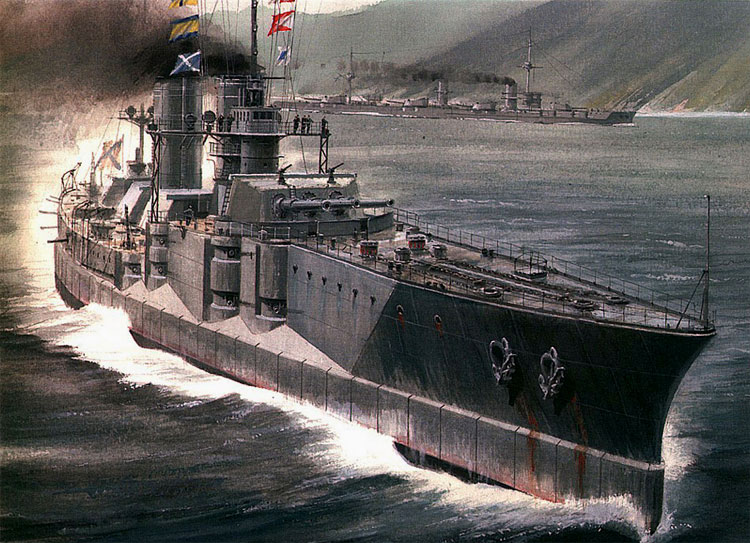
Pierwsze przymiarki do budowy nowych pancerników poczyniono w ZSRR w 1936 r., kiedy to w ramach rozbudowy floty postanowiono wybudować 8 pancerników po 35000 ton i 18 krążowników najcięższych po 26000 ton. Stopniowo koncepcje rozwoju floty ewoluowały w kierunku budowy dwóch typów pancernika: większego (typ A – 55000-68000 ton, 9-12x406/460) i mniejszego (typ B – 35000-48000 ton, 9x356/406). Typ A miał być przeznaczony na otwarte akweny oceaniczne, podczas gdy typ B dla flot bałtyckiej i czarnomorskiej. Opracowano wiele wariantów obu typów pancernika, a zatwierdzony ostatecznie do realizacji projekt 23, przewidywał dużą jednostkę o wyporności 59150 ton standard, uzbrojoną w 9x406, 12x152 i 8x100, rozwijającą 28-29 w. i mającą pancerz na burcie grubości 380 mm. Okręt nosił wyraźne ślady wpływów włoskich m.in. w postaci systemu ochrony przeciwtorpedowej Pugliese, skopiowanego z przekazanego ZSRR w 1936 r. włoskiego projektu pancernika U.P.41 (rozwinięcie typu Vittorio Veneto). Stępkę pod pierwszą (z czterech) jednostek nowego typu położono 15.07.1938 r. w Leningradzie. Początkowo budowa postępowała bardzo wolno (brak było ostatecznego projektu technicznego – ten zatwierdzono dopiero w lipcu 1939 r., ponadto swoje zrobiły też czystki stalinowskie), a wybuch wojny dodatkowo ją spowolnił. Ostateczny cios pancernikom zadał atak Niemiec na ZSRR w czerwcu 1941 r. – 19.07.1941 r. budowa została wstrzymana (według niepotwierdzonych informacji, budowa prototypowego Sowieckiego Sojuza została na krótko wznowiona w 1947 r.)    
Sowieckij Sojuz, soviet battleship laid down 1938 (Engine 1943)

Displacement:
    56 217 t light; 59 151 t standard; 61 640 t normal; 63 631 t full load

Dimensions: Length overall / water x beam x draught
    883,86 ft / 856,30 ft x 119,42 ft x 34,12 ft (normal load)
    269,40 m / 261,00 m x 36,40 m  x 10,40 m

Armament:
      9 - 15,98" / 406 mm guns (3x3 guns), 2 041,96lbs / 926,22kg shells, 1938 Model
      Breech loading guns in turrets (on barbettes)
      on centreline ends, majority forward, 1 raised mount - superfiring
      12 - 5,98" / 152 mm guns (6x2 guns), 107,15lbs / 48,60kg shells, 1938 Model
      Quick firing guns in turrets (on barbettes)
      on side, all amidships, 2 raised mounts - superfiring
      8 - 3,94" / 100 mm guns (4x2 guns), 30,51lbs / 13,84kg shells, 1938 Model
      Dual purpose guns in turrets (on barbettes)
      on side, all amidships, all raised mounts - superfiring
      4 - 3,94" / 100 mm guns (2x2 guns), 30,51lbs / 13,84kg shells, 1938 Model
      Dual purpose guns in turrets (on barbettes)
      on centreline, all aft
      32 - 1,46" / 37,0 mm guns (8x4 guns), 1,55lbs / 0,70kg shells, 1938 Model
      Anti-aircraft guns in deck mounts
      on centreline, all amidships, all raised mounts - superfiring
    Weight of broadside 20 079 lbs / 9 108 kg
    Shells per gun, main battery: 150

Armour:
   - Belts:        Width (max)    Length (avg)        Height (avg)
    Main:    16,5" / 420 mm    486,88 ft / 148,40 m    20,57 ft / 6,27 m
    Ends:    8,66" / 220 mm    169,13 ft / 51,55 m    20,57 ft / 6,27 m
      200,30 ft / 61,05 m Unarmoured ends
    Upper:    7,09" / 180 mm    208,40 ft / 63,52 m    7,19 ft / 2,19 m
      Main Belt covers 87% of normal length

   - Torpedo Bulkhead:
        2,60" / 66 mm    513,45 ft / 156,50 m    30,35 ft / 9,25 m

   - Gun armour:    Face (max)    Other gunhouse (avg)    Barbette/hoist (max)
    Main:    19,5" / 495 mm    9,06" / 230 mm        16,7" / 425 mm
    2nd:    3,94" / 100 mm    2,56" / 65 mm        3,94" / 100 mm
    3rd:    2,56" / 65 mm    2,56" / 65 mm        3,94" / 100 mm
    4th:    2,56" / 65 mm    2,56" / 65 mm        3,94" / 100 mm
    5th:    0,98" / 25 mm          -                  -

   - Armour deck: 8,74" / 222 mm, Conning tower: 16,73" / 425 mm

Machinery:
    Oil fired boilers, steam turbines,
    Electric motors, 3 shafts, 146 365 shp / 109 188 Kw = 28,00 kts
    Range 7 260nm at 14,50 kts
    Bunker at max displacement = 4 480 tons

Complement:
    1 955 - 2 542

Cost:
    £25,956 million / $103,824 million

Distribution of weights at normal displacement:
    Armament: 2 510 tons, 4,1%
    Armour: 28 221 tons, 45,8%
       - Belts: 9 090 tons, 14,7%
       - Torpedo bulkhead: 1 498 tons, 2,4%
       - Armament: 4 770 tons, 7,7%
       - Armour Deck: 12 301 tons, 20,0%
       - Conning Tower: 563 tons, 0,9%
    Machinery: 3 780 tons, 6,1%
    Hull, fittings & equipment: 21 555 tons, 35,0%
    Fuel, ammunition & stores: 5 423 tons, 8,8%
    Miscellaneous weights: 150 tons, 0,2%

Overall survivability and seakeeping ability:
    Survivability (Non-critical penetrating hits needed to sink ship):
      112 623 lbs / 51 085 Kg = 55,2 x 16,0 " / 406 mm shells or 21,1 torpedoes
    Stability (Unstable if below 1.00): 1,15
    Metacentric height 8,5 ft / 2,6 m
    Roll period: 17,2 seconds
    Steadiness    - As gun platform (Average = 50 %): 59 %
            - Recoil effect (Restricted arc if above 1.00): 0,43
    Seaboat quality  (Average = 1.00): 1,20

Hull form characteristics:
    Hull has low quarterdeck
    Block coefficient: 0,618
    Length to Beam Ratio: 7,17 : 1
    'Natural speed' for length: 29,26 kts
    Power going to wave formation at top speed: 48 %
    Trim (Max stability = 0, Max steadiness = 100): 49
    Bow angle (Positive = bow angles forward): 28,00 degrees
    Stern overhang: 9,97 ft / 3,04 m
    Freeboard (% = measuring location as a percentage of overall length):
       - Stem:        33,07 ft / 10,08 m
       - Forecastle (24%):    23,95 ft / 7,30 m
       - Mid (50%):        21,95 ft / 6,69 m
       - Quarterdeck (16%):    14,70 ft / 4,48 m (21,95 ft / 6,69 m before break)
       - Stern:        18,96 ft / 5,78 m
       - Average freeboard:    22,73 ft / 6,93 m

Ship space, strength and comments:
    Space    - Hull below water (magazines/engines, low = better): 63,2%
        - Above water (accommodation/working, high = better): 165,9%
    Waterplane Area: 76 079 Square feet or 7 068 Square metres
    Displacement factor (Displacement / loading): 110%
    Structure weight / hull surface area: 212 lbs/sq ft or 1 034 Kg/sq metre
    Hull strength (Relative):
        - Cross-sectional: 0,99
        - Longitudinal: 1,06
        - Overall: 1,00
    Hull space for machinery, storage, compartmentation is excellent
    Room for accommodation and workspaces is excellent


wtorek, 4 września 2012

Japoński krążownik ciężki 12x203 - wersja czterowieżowa

Oto modyfikacja projektu z poprzedniego posta. Artyleria tym razem została zgrupowana w czterech wieżach trójdziałowych, a zaoszczędzone w ten sposób miejsce i wyporność spożytkowano na montaż dodatkowych dział 100 mm  w liczbie 8, tak że ich sumaryczna liczba wynosi teraz 16.
Asahi, japanese heavy cruiser laid down 1943 (Engine 1945)

Displacement:
    15 969 t light; 16 586 t standard; 17 901 t normal; 18 953 t full load

Dimensions: Length overall / water x beam x draught
    740,79 ft / 724,67 ft x 73,00 ft x 22,01 ft (normal load)
    225,79 m / 220,88 m x 22,25 m  x 6,71 m

Armament:
      12 - 7,99" / 203 mm guns (4x3 guns), 255,24lbs / 115,77kg shells, 1943 Model
      Breech loading guns in turrets (on barbettes)
      on centreline ends, evenly spread, 2 raised mounts - superfiring
      8 - 3,94" / 100 mm guns (4x2 guns), 30,51lbs / 13,84kg shells, 1943 Model
      Dual purpose guns in deck mounts with hoists
      on side, all amidships, all raised mounts - superfiring
      8 - 3,94" / 100 mm guns (4x2 guns), 30,51lbs / 13,84kg shells, 1943 Model
      Dual purpose guns in deck mounts with hoists
      on side ends, evenly spread, all raised mounts - superfiring
      60 - 0,98" / 25,0 mm guns (20x3 guns), 0,48lbs / 0,22kg shells, 1943 Model
      Anti-aircraft guns in deck mounts
      on side, evenly spread, 9 raised mounts
      2 - 0,51" / 13,0 mm guns in single mounts, 0,07lbs / 0,03kg shells, 1943 Model
      Machine guns in deck mounts
      on side, all amidships, all raised mounts - superfiring
    Weight of broadside 3 580 lbs / 1 624 kg
    Shells per gun, main battery: 125
    18 - 24,0" / 610 mm above water torpedoes

Armour:
   - Belts:        Width (max)    Length (avg)        Height (avg)
    Main:    6,10" / 155 mm    281,92 ft / 85,93 m    10,50 ft / 3,20 m
    Ends:    6,10" / 155 mm    201,35 ft / 61,37 m    8,50 ft / 2,59 m
      241,40 ft / 73,58 m Unarmoured ends
      Main Belt covers 60% of normal length
      Main belt does not fully cover magazines and engineering spaces

   - Torpedo Bulkhead:
        1,46" / 37 mm    483,27 ft / 147,30 m    15,62 ft / 4,76 m

   - Gun armour:    Face (max)    Other gunhouse (avg)    Barbette/hoist (max)
    Main:    7,52" / 191 mm    4,92" / 125 mm        7,01" / 178 mm
    2nd:    2,01" / 51 mm          -                  -
    3rd:    2,01" / 51 mm          -                  -

   - Armour deck: 2,95" / 75 mm, Conning tower: 7,52" / 191 mm

Machinery:
    Oil fired boilers, steam turbines,
    Geared drive, 4 shafts, 114 049 shp / 85 080 Kw = 32,00 kts
    Range 8 000nm at 15,00 kts
    Bunker at max displacement = 2 366 tons

Complement:
    773 - 1 005

Cost:
    £8,758 million / $35,031 million

Distribution of weights at normal displacement:
    Armament: 447 tons, 2,5%
    Armour: 4 690 tons, 26,2%
       - Belts: 1 212 tons, 6,8%
       - Torpedo bulkhead: 407 tons, 2,3%
       - Armament: 966 tons, 5,4%
       - Armour Deck: 1 994 tons, 11,1%
       - Conning Tower: 111 tons, 0,6%
    Machinery: 2 880 tons, 16,1%
    Hull, fittings & equipment: 7 851 tons, 43,9%
    Fuel, ammunition & stores: 1 932 tons, 10,8%
    Miscellaneous weights: 100 tons, 0,6%

Overall survivability and seakeeping ability:
    Survivability (Non-critical penetrating hits needed to sink ship):
      27 501 lbs / 12 474 Kg = 107,7 x 8,0 " / 203 mm shells or 4,1 torpedoes
    Stability (Unstable if below 1.00): 1,17
    Metacentric height 4,2 ft / 1,3 m
    Roll period: 15,0 seconds
    Steadiness    - As gun platform (Average = 50 %): 49 %
            - Recoil effect (Restricted arc if above 1.00): 0,40
    Seaboat quality  (Average = 1.00): 0,96

Hull form characteristics:
    Hull has a flush deck
    Block coefficient: 0,538
    Length to Beam Ratio: 9,93 : 1
    'Natural speed' for length: 26,92 kts
    Power going to wave formation at top speed: 52 %
    Trim (Max stability = 0, Max steadiness = 100): 50
    Bow angle (Positive = bow angles forward): 26,00 degrees
    Stern overhang: 2,00 ft / 0,61 m
    Freeboard (% = measuring location as a percentage of overall length):
       - Stem:        28,94 ft / 8,82 m
       - Forecastle (18%):    18,44 ft / 5,62 m
       - Mid (50%):        18,44 ft / 5,62 m
       - Quarterdeck (15%):    18,44 ft / 5,62 m
       - Stern:        18,44 ft / 5,62 m
       - Average freeboard:    19,19 ft / 5,85 m
    Ship tends to be wet forward

Ship space, strength and comments:
    Space    - Hull below water (magazines/engines, low = better): 100,0%
        - Above water (accommodation/working, high = better): 115,0%
    Waterplane Area: 36 506 Square feet or 3 392 Square metres
    Displacement factor (Displacement / loading): 127%
    Structure weight / hull surface area: 147 lbs/sq ft or 716 Kg/sq metre
    Hull strength (Relative):
        - Cross-sectional: 1,16
        - Longitudinal: 0,95
        - Overall: 1,00
    Hull space for machinery, storage, compartmentation is adequate
    Room for accommodation and workspaces is adequate
    Poor seaboat, wet and uncomfortable, reduced performance in heavy weather

sobota, 1 września 2012

Japoński krążownik ciężki - 12x203


Ostatnimi krążownikami ciężkimi japońskiej marynarki wojennej, których budowę zdołano rozpocząć w trakcie wojny, były dwie jednostki typu Ibuki (zmodyfikowany typ Mogami), z których prototyp w trakcie budowy postanowiono ukończyć jako lotniskowiec, a budowy drugiego poniechano ledwie miesiąc po rozpoczęciu. Jednakże nie były to ostatnie projekty okrętów tej klasy jakie rozważano – kolejnym typem miał być okręt uzbrojony w 12 dział 8-calowych w 6 wieżach (możliwe, że był to pomysł jeszcze z okresu, zanim Japonia została w wojnie zepchnięta do defensywy). Poniższy rysunek i symulacja w Springsharpie pokazują, jak taki krążownik mógłby wyglądać. Nie jest to dokładne odwzorowanie przewidywanej jednostki, bo jej specyfikacji nie znam, a jedynie swobodna wariacja na temat – znany mi jest tylko ogólny układ artylerii (na podstawie widzianego kiedyś w Internecie rysunku), cała reszta to już moja fantazja:) (poza rysunkiem, do którego podstawą była grafika autorstwa Colosseum, przedstawiająca krążownik Tone) W przeciwieństwie do poprzednich typów, odpuściłem sobie jakieś super prędkości, bo jak się okazało w praktyce (np. na typie Mogami) był to raczej złudny walor, a w zamian postawiłem na lepsze opancerzenie. Poprzednie typy nie miały więcej niż 100-125 mm w rejonie odpowiednio maszynowni i komór amunicyjnych, dla porównania amerykańskie typy Baltimore czy Des Moines miały na burcie 152 mm. Do tego okręt ma wreszcie przyzwoite opancerzenie wież, porównywalne z jednostkami amerykańskimi, a nie jak na poprzednich typach, gdzie wieże chronił nędzny 1 cal (!) blachy.. Sądzę, że dla pierwszego z wspomnianych typów amerykańskich krążowników, proponowany okręt byłby co najmniej równorzędnym przeciwnikiem (typ Des Moines, z racji swojej nadzwyczaj szybkostrzelnej artylerii, to już byłby raczej poza zasięgiem Japończyków). Okręty w typie: Asahi, Fuji, Ikeda, Notori.
 Asahi, japanese heavy cruiser laid down 1943 (Engine 1945)

Displacement:
    15 897 t light; 16 491 t standard; 17 801 t normal; 18 849 t full load

Dimensions: Length overall / water x beam x draught
    740,79 ft / 724,67 ft x 73,00 ft x 22,01 ft (normal load)
    225,79 m / 220,88 m x 22,25 m  x 6,71 m

Armament:
      12 - 7,99" / 203 mm guns (6x2 guns), 255,24lbs / 115,77kg shells, 1943 Model
      Breech loading guns in turrets (on barbettes)
      on centreline ends, evenly spread, 2 raised mounts - superfiring
      8 - 3,94" / 100 mm guns (4x2 guns), 30,51lbs / 13,84kg shells, 1943 Model
      Dual purpose guns in deck mounts with hoists
      on side, all amidships, all raised mounts - superfiring
      60 - 0,98" / 25,0 mm guns (20x3 guns), 0,48lbs / 0,22kg shells, 1943 Model
      Anti-aircraft guns in deck mounts
      on side, evenly spread, 9 raised mounts
      2 - 0,51" / 13,0 mm guns in single mounts, 0,07lbs / 0,03kg shells, 1943 Model
      Machine guns in deck mounts
      on side, all amidships, all raised mounts - superfiring
    Weight of broadside 3 336 lbs / 1 513 kg
    Shells per gun, main battery: 125
    18 - 24,0" / 610 mm above water torpedoes

Armour:
   - Belts:        Width (max)    Length (avg)        Height (avg)
    Main:    6,10" / 155 mm    281,92 ft / 85,93 m    10,50 ft / 3,20 m
    Ends:    6,10" / 155 mm    201,35 ft / 61,37 m    8,50 ft / 2,59 m
      241,40 ft / 73,58 m Unarmoured ends
      Main Belt covers 60% of normal length
      Main belt does not fully cover magazines and engineering spaces

   - Torpedo Bulkhead:
        1,46" / 37 mm    483,27 ft / 147,30 m    15,62 ft / 4,76 m

   - Gun armour:    Face (max)    Other gunhouse (avg)    Barbette/hoist (max)
    Main:    7,52" / 191 mm    4,92" / 125 mm        7,01" / 178 mm
    2nd:    2,01" / 51 mm          -                  -

   - Armour deck: 2,95" / 75 mm, Conning tower: 7,52" / 191 mm

Machinery:
    Oil fired boilers, steam turbines,
    Geared drive, 4 shafts, 113 507 shp / 84 676 Kw = 32,00 kts
    Range 8 000nm at 15,00 kts
    Bunker at max displacement = 2 358 tons

Complement:
    769 - 1 001

Cost:
    £8,561 million / $34,244 million

Distribution of weights at normal displacement:
    Armament: 417 tons, 2,3%
    Armour: 4 807 tons, 27,0%
       - Belts: 1 212 tons, 6,8%
       - Torpedo bulkhead: 407 tons, 2,3%
       - Armament: 1 089 tons, 6,1%
       - Armour Deck: 1 989 tons, 11,2%
       - Conning Tower: 110 tons, 0,6%
    Machinery: 2 866 tons, 16,1%
    Hull, fittings & equipment: 7 707 tons, 43,3%
    Fuel, ammunition & stores: 1 904 tons, 10,7%
    Miscellaneous weights: 100 tons, 0,6%

Overall survivability and seakeeping ability:
    Survivability (Non-critical penetrating hits needed to sink ship):
      27 879 lbs / 12 646 Kg = 109,2 x 8,0 " / 203 mm shells or 4,2 torpedoes
    Stability (Unstable if below 1.00): 1,17
    Metacentric height 4,2 ft / 1,3 m
    Roll period: 15,0 seconds
    Steadiness    - As gun platform (Average = 50 %): 49 %
            - Recoil effect (Restricted arc if above 1.00): 0,36
    Seaboat quality  (Average = 1.00): 0,97

Hull form characteristics:
    Hull has a flush deck
    Block coefficient: 0,535
    Length to Beam Ratio: 9,93 : 1
    'Natural speed' for length: 26,92 kts
    Power going to wave formation at top speed: 52 %
    Trim (Max stability = 0, Max steadiness = 100): 50
    Bow angle (Positive = bow angles forward): 26,00 degrees
    Stern overhang: 2,00 ft / 0,61 m
    Freeboard (% = measuring location as a percentage of overall length):
       - Stem:        28,94 ft / 8,82 m
       - Forecastle (18%):    18,44 ft / 5,62 m
       - Mid (50%):        18,44 ft / 5,62 m
       - Quarterdeck (15%):    18,44 ft / 5,62 m
       - Stern:        18,44 ft / 5,62 m
       - Average freeboard:    19,19 ft / 5,85 m
    Ship tends to be wet forward

Ship space, strength and comments:
    Space    - Hull below water (magazines/engines, low = better): 98,5%
        - Above water (accommodation/working, high = better): 115,3%
    Waterplane Area: 36 404 Square feet or 3 382 Square metres
    Displacement factor (Displacement / loading): 127%
    Structure weight / hull surface area: 144 lbs/sq ft or 705 Kg/sq metre
    Hull strength (Relative):
        - Cross-sectional: 1,19
        - Longitudinal: 0,94
        - Overall: 1,00
    Hull space for machinery, storage, compartmentation is adequate
    Room for accommodation and workspaces is adequate
    Poor seaboat, wet and uncomfortable, reduced performance in heavy weather

czwartek, 30 sierpnia 2012

Monitor Swierdłow (1927) - 26.08.2012

Ogólna słabość gospodarki radzieckiej w latach 20-tych i na początku 30-tych, a przemysłu stoczniowego w szczególności, powodowały iż nie był on w stanie dostarczyć w owym czasie własnej flocie dużych okrętów wojennych w wymaganej przez nią liczbie. W efekcie tego, flota w ciągle była oparta w dużej mierze o modernizowane jednostki z czasów carskich, a w kolejnych programach budowy okrętów, nawet nie ujmowano budowy pancerników,postulując budowę monitorów dla obrony własnych baz i wybrzeży (przykładowo – w planie z 25.03.1925 r. miały to być 4 monitory do 1931 r., w planie z19.10.1925 r. – 2 monitory w ciągu 3 lat, w planie z 28.05.1926 r. – 2 monitory do 1931 r., itd.).
Zastanawiając się jak mogły by wyglądać postulowane monitory, a także biorąc pod uwagę ogólna prawidłowość, że trudniejsze i pracochłonniejsze bywa wyprodukowanie ciężkich dział niż okrętów mających je nosić, wpadłem na pomysł wykorzystania istniejących dział, a konkretnie 14-calowych(356 mm)armat pierwotnie przeznaczonych dla nie zbudowanych krążowników liniowych typu Izmaił. Rosjanie zamówili w 1913 r. u Vickersa 36 szt., a w rodzimych Zakładach Obuchowskich 40 szt. tych dział. Przed rewolucją Brytyjczycy zdążyli zbudować16 szt., z których dostarczyli do Rosji 10. Zakładając, że działa te by  ły w latach 20-tych wciąż dostępne, można by spróbować zbudować do nich 5 stosunkowo niedużych i prostych dwudziałowych jednostek, które były by jakąś ochroną (nie mówię że wystarczającą, ale na pewno lepszą niż żadna) na Morzu Czarnym przed tureckim Yavuzem czy na Bałtyku przed wyjątkowo wówczas słabą flotą niemiecką..  
 
Swierdłow, soviet monitor laid down 1926 (Engine 1927)

Displacement:
    5 624 t light; 5 905 t standard; 6 003 t normal; 6 082 t full load

Dimensions: Length overall / water x beam x draught
    360,63 ft / 358,01 ft x 84,51 ft x 10,01 ft (normal load)
    109,92 m / 109,12 m x 25,76 m  x 3,05 m

Armament:
      2 - 14,02" / 356 mm guns (1x2 guns), 1 376,64lbs / 624,43kg shells, 1926 Model
      Breech loading guns in a turret (on a barbette)
      on centreline forward
      8 - 5,12" / 130 mm guns in single mounts, 67,03lbs / 30,40kg shells, 1926 Model
      Quick firing guns in deck mounts with hoists
      on side, all amidships
      4 - 1,77" / 45,0 mm guns in single mounts, 2,78lbs / 1,26kg shells, 1926 Model
      Anti-aircraft guns in deck mounts
      on centreline ends, evenly spread, all raised mounts - superfiring
    Weight of broadside 3 301 lbs / 1 497 kg
    Shells per gun, main battery: 85

Armour:
   - Belts:        Width (max)    Length (avg)        Height (avg)
    Main:    3,74" / 95 mm    197,67 ft / 60,25 m    10,01 ft / 3,05 m
    Ends:    Unarmoured
      Main Belt covers 85% of normal length

   - Gun armour:    Face (max)    Other gunhouse (avg)    Barbette/hoist (max)
    Main:    9,06" / 230 mm    5,98" / 152 mm        8,39" / 213 mm
    2nd:    0,98" / 25 mm          -                  -

   - Armour deck: 1,85" / 47 mm, Conning tower: 5,51" / 140 mm

Machinery:
    Diesel Internal combustion motors,
    Geared drive, 2 shafts, 2 313 shp / 1 725 Kw = 12,00 kts
    Range 2 550nm at 8,00 kts
    Bunker at max displacement = 178 tons

Complement:
    340 - 443

Cost:
    £1,912 million / $7,650 million

Distribution of weights at normal displacement:
    Armament: 413 tons, 6,9%
    Armour: 1 582 tons, 26,4%
       - Belts: 363 tons, 6,0%
       - Torpedo bulkhead: 0 tons, 0,0%
       - Armament: 354 tons, 5,9%
       - Armour Deck: 826 tons, 13,8%
       - Conning Tower: 39 tons, 0,7%
    Machinery: 73 tons, 1,2%
    Hull, fittings & equipment: 3 556 tons, 59,2%
    Fuel, ammunition & stores: 380 tons, 6,3%
    Miscellaneous weights: 0 tons, 0,0%

Overall survivability and seakeeping ability:
    Survivability (Non-critical penetrating hits needed to sink ship):
      16 751 lbs / 7 598 Kg = 12,2 x 14,0 " / 356 mm shells or 3,6 torpedoes
    Stability (Unstable if below 1.00): 1,50
    Metacentric height 7,8 ft / 2,4 m
    Roll period: 12,7 seconds
    Steadiness    - As gun platform (Average = 50 %): 55 %
            - Recoil effect (Restricted arc if above 1.00): 0,18
    Seaboat quality  (Average = 1.00): 1,20

Hull form characteristics:
    Hull has a flush deck
    Block coefficient: 0,694
    Length to Beam Ratio: 4,24 : 1
    'Natural speed' for length: 18,92 kts
    Power going to wave formation at top speed: 28 %
    Trim (Max stability = 0, Max steadiness = 100): 46
    Bow angle (Positive = bow angles forward): 4,00 degrees
    Stern overhang: 1,51 ft / 0,46 m
    Freeboard (% = measuring location as a percentage of overall length):
       - Stem:        15,94 ft / 4,86 m
       - Forecastle (32%):    13,45 ft / 4,10 m
       - Mid (50%):        13,45 ft / 4,10 m
       - Quarterdeck (17%):    13,45 ft / 4,10 m
       - Stern:        14,47 ft / 4,41 m
       - Average freeboard:    13,86 ft / 4,22 m
    Ship tends to be wet forward

Ship space, strength and comments:
    Space    - Hull below water (magazines/engines, low = better): 55,7%
        - Above water (accommodation/working, high = better): 181,8%
    Waterplane Area: 24 122 Square feet or 2 241 Square metres
    Displacement factor (Displacement / loading): 119%
    Structure weight / hull surface area: 130 lbs/sq ft or 636 Kg/sq metre
    Hull strength (Relative):
        - Cross-sectional: 0,92
        - Longitudinal: 2,01
        - Overall: 1,00
    Hull space for machinery, storage, compartmentation is excellent
    Room for accommodation and workspaces is excellent

Krążownik liniowy Izmaił - 11.08.2012

Kolejnymi, po typie Gangut, drednotami rosyjskiej flotybałtyckiej miały być krążowniki liniowe (a w zasadzie to szybkie pancerniki)typu Izmaił/Borodino. W najogólniejszym zarysie stanowiły one powiększonąwersję poprzedniego typu, z podwyższoną o jeden pokład dziobówką, niecogrubszym pancerzem i przede wszystkim – cięższymi działami 14-calowymi (356 mm) opracowanymipierwotnie dla czarnomorskich drednotów typu Impieratrica Marija (ostatecznieotrzymały one działa 12-calowe). Okręty typu Izmaił zostały zatwierdzone wramach programu rozbudowy Floty Bałtyckiej z 1912 r. Pierwotne ich założeniaprzewidywały jednostki 9-cio działowe, mające sporą prędkość 28 w. W toku pracprojektowych zdecydowano jednak o dodaniu czwartej wieży trójdziałowej, kosztem1,5 w. prędkości, która ostatecznie miała wynieść 26,5 w. Ostateczniejednostki, których budowę podjęto, sylwetką przypominały Ganguty, miałysilniejsze uzbrojenie niż równolegle budowane odpowiedniki niemieckie,jednocześnie ustępując im w kwestii opancerzenia. Poważną wadą wydaje sięrozmieszczenie artylerii średniej powielające wady z poprzedniego typu – działaw kazamatach kadłuba mogły by być używane w zasadzie tylko przy morzu płaskimjak stół, jakiekolwiek fale w zasadzie uniemożliwiały by z zasadzie ich użycie,może poza czterema działami w kazamatach dziobowych, położonych o pokład wyżejw stosunku do pozostałych. Ponadto, wadliwe wydaje się zgrupowania kazamatdział 130 mmw bezpośrednim sąsiedztwie wież działa artylerii głównej, przez co jednoczesneich użycie wydaje się co najmniej problematyczne. Stępki pod wszystkie czteryokręty typu położono w dniu 19 grudnia 1913 r., wodowania miały miejsce wlatach 1915-1916. Ostatecznie żadnego z nich nie ukończono – oczywiście naskutek trudności wynikających z trwającej wojny oraz wydarzeń politycznychjakie nastąpiły w Rosji w 1917 r. i późniejszych ich następstw.


Izmaił, russian battlecruiser laid down 1912 (Engine 1915)

Displacement:
    29 600 t light; 31 078 t standard; 32 509 t normal; 33 654 t full load

Dimensions: Length overall / water x beam x draught
    734,43 ft / 729,66 ft x 100,00 ft x 28,90 ft (normal load)
    223,85 m / 222,40 m x 30,48 m  x 8,81 m

Armament:
      12 - 14,02" / 356 mm guns (4x3 guns), 1 376,64lbs / 624,43kg shells, 1912 Model
      Breech loading guns in turrets (on barbettes)
      on centreline, evenly spread
      Aft Main mounts separated by engine room
      24 - 5,12" / 130 mm guns in single mounts, 67,03lbs / 30,40kg shells, 1912 Model
      Quick firing guns in casemate mounts
      on side, evenly spread
      20 guns in hull casemates - Limited use in heavy seas
      8 - 2,95" / 75,0 mm guns in single mounts, 12,87lbs / 5,84kg shells, 1912 Model
      Quick firing guns in deck mounts
      on centreline, evenly spread, all raised mounts
      4 - 2,48" / 63,0 mm guns in single mounts, 7,63lbs / 3,46kg shells, 1912 Model
      Anti-aircraft guns in deck mounts
      on side, all amidships, all raised mounts - superfiring
    Weight of broadside 18 262 lbs / 8 283 kg
    Shells per gun, main battery: 80
    6 - 21,0" / 533 mm submerged torpedo tubes

Armour:
   - Belts:        Width (max)    Length (avg)        Height (avg)
    Main:    9,37" / 238 mm    496,10 ft / 151,21 m    16,47 ft / 5,02 m
    Ends:    4,92" / 125 mm    134,78 ft / 41,08 m    16,47 ft / 5,02 m
      98,79 ft / 30,11 m Unarmoured ends
    Upper:    3,94" / 100 mm    616,57 ft / 187,93 m    9,48 ft / 2,89 m
      Main Belt covers 105% of normal length
      Main belt does not fully cover magazines and engineering spaces

   - Torpedo Bulkhead:
        0,39" / 10 mm    496,10 ft / 151,21 m    16,86 ft / 5,14 m

   - Gun armour:    Face (max)    Other gunhouse (avg)    Barbette/hoist (max)
    Main:    9,37" / 238 mm    5,98" / 152 mm        9,72" / 247 mm
    2nd:    2,95" / 75 mm          -                  -

   - Armour deck: 2,52" / 64 mm, Conning tower: 15,75" / 400 mm

Machinery:
    Coal and oil fired boilers, steam turbines,
    Geared drive, 4 shafts, 81 353 shp / 60 690 Kw = 26,50 kts
    Range 4 850nm at 12,50 kts
    Bunker at max displacement = 2 576 tons (55% coal)

Complement:
    1 209 - 1 573

Cost:
    £3,408 million / $13,631 million

Distribution of weights at normal displacement:
    Armament: 2 283 tons, 7,0%
    Armour: 10 086 tons, 31,0%
       - Belts: 4 602 tons, 14,2%
       - Torpedo bulkhead: 122 tons, 0,4%
       - Armament: 2 666 tons, 8,2%
       - Armour Deck: 2 350 tons, 7,2%
       - Conning Tower: 346 tons, 1,1%
    Machinery: 3 244 tons, 10,0%
    Hull, fittings & equipment: 13 988 tons, 43,0%
    Fuel, ammunition & stores: 2 909 tons, 8,9%
    Miscellaneous weights: 0 tons, 0,0%

Overall survivability and seakeeping ability:
    Survivability (Non-critical penetrating hits needed to sink ship):
      39 244 lbs / 17 801 Kg = 28,5 x 14,0 " / 356 mm shells or 4,5 torpedoes
    Stability (Unstable if below 1.00): 1,12
    Metacentric height 6,2 ft / 1,9 m
    Roll period: 16,8 seconds
    Steadiness    - As gun platform (Average = 50 %): 71 %
            - Recoil effect (Restricted arc if above 1.00): 0,80
    Seaboat quality  (Average = 1.00): 1,43

Hull form characteristics:
    Hull has rise forward of midbreak
    Block coefficient: 0,540
    Length to Beam Ratio: 7,30 : 1
    'Natural speed' for length: 27,01 kts
    Power going to wave formation at top speed: 46 %
    Trim (Max stability = 0, Max steadiness = 100): 50
    Bow angle (Positive = bow angles forward): 6,00 degrees
    Stern overhang: 1,71 ft / 0,52 m
    Freeboard (% = measuring location as a percentage of overall length):
       - Stem:        29,17 ft / 8,89 m
       - Forecastle (21%):    29,17 ft / 8,89 m
       - Mid (38%):        27,03 ft / 8,24 m (20,47 ft / 6,24 m aft of break)
       - Quarterdeck (17%):    20,47 ft / 6,24 m
       - Stern:        21,29 ft / 6,49 m
       - Average freeboard:    23,68 ft / 7,22 m
    Ship tends to be wet forward

Ship space, strength and comments:
    Space    - Hull below water (magazines/engines, low = better): 109,4%
        - Above water (accommodation/working, high = better): 179,2%
    Waterplane Area: 50 424 Square feet or 4 685 Square metres
    Displacement factor (Displacement / loading): 93%
    Structure weight / hull surface area: 196 lbs/sq ft or 955 Kg/sq metre
    Hull strength (Relative):
        - Cross-sectional: 0,96
        - Longitudinal: 1,40
        - Overall: 1,00
    Hull space for machinery, storage, compartmentation is adequate
    Room for accommodation and workspaces is excellent
    Ship has slow, easy roll, a good, steady gun platform
    Good seaboat, rides out heavy weather easily

Krążownik Lamotte-Picquet (1915) - 06.08.2012

U progu Pierwszej Wojny Światowej francuska Marynarka Wojenna nie posiadała żadnych nowoczesnych krążowników lekkich z prawdziwego zdarzenia. Najnowszy z posiadanych, Jurien de La Graviere był zdecydowanie zbyt wolny jak na ówczesne wymagania, był zresztą tylko jeden. Istniejące braki dostrzegano, w efekcie czego podjęto działania zmierzające do zbudowania nowoczesnych i szybkich krążowników. Do roku 1914 rozpatrzono wiele projektów okrętów o wyporności od 4500 do 6000 ton, prędkości od 25 do 30 w. i uzbrojonych w różną (zależną od wielkości) liczbę dział 138 mm model 1910.Ostatecznie do realizacji wybrano wariant 4500-tonowy o wymiarach 138x13,8x4,8,szybkości 29 w. i uzbrojeniu w 8 dział 138 mm (4 w pojedynczych wieżach w superpozycji na dziobie i rufie i 4 w opancerzonej kazamacie na śródokręciu). Stępkę pod prototypowy Lamotte-Picquet planowano położyć w listopadzie 1914 r., czemu jednak przeszkodził wybuch wojny i w efekcie projekt krążownika nie został zrealizowany a flota francuska do końca zmagań borykać musiała się z brakiem jednostek tej klasy. Poniżej przedstawiam rzuty boczny i górny oraz symulację omawianej jednostki w Springsharpie:
 
Lamotte-Picquet, french light cruiser laid down 1914 (Engine 1915)

Displacement:
    3 870 t light; 4 038 t standard; 4 500 t normal; 4 870 t full load

Dimensions: Length overall / water x beam x draught
    452,76 ft / 451,25 ft x 45,24 ft x 15,75 ft (normal load)
    138,00 m / 137,54 m x 13,79 m  x 4,80 m

Armament:
      4 - 5,43" / 138 mm guns in single mounts, 80,19lbs / 36,37kg shells, 1914 Model
      Quick firing guns in deck mounts with hoists
      on centreline ends, evenly spread, 2 raised mounts - superfiring
      4 - 5,43" / 138 mm guns in single mounts, 80,19lbs / 36,37kg shells, 1914 Model
      Quick firing guns in casemate mounts
      on side, all amidships
      2 - 1,85" / 47,0 mm guns in single mounts, 3,17lbs / 1,44kg shells, 1914 Model
      Quick firing guns in deck mounts
      on centreline, all forward, all raised mounts - superfiring
    Weight of broadside 648 lbs / 294 kg
    Shells per gun, main battery: 200
    4 - 17,7" / 450 mm submerged torpedo tubes

Armour:
   - Belts:        Width (max)    Length (avg)        Height (avg)
    Main:    1,10" / 28 mm    190,03 ft / 57,92 m    15,19 ft / 4,63 m
    Ends:    Unarmoured
      Main Belt covers 65% of normal length
      Main belt does not fully cover magazines and engineering spaces

   - Gun armour:    Face (max)    Other gunhouse (avg)    Barbette/hoist (max)
    Main:    1,46" / 37 mm          -                  -
    2nd:    1,10" / 28 mm          -                  -

   - Armour deck: 0,91" / 23 mm, Conning tower: 3,54" / 90 mm

Machinery:
    Coal and oil fired boilers, steam turbines,
    Geared drive, 4 shafts, 38 547 shp / 28 756 Kw = 29,00 kts
    Range 3 300nm at 16,00 kts
    Bunker at max displacement = 831 tons (38% coal)

Complement:
    274 - 357

Cost:
    £0,528 million / $2,113 million

Distribution of weights at normal displacement:
    Armament: 81 tons, 1,8%
    Armour: 421 tons, 9,4%
       - Belts: 143 tons, 3,2%
       - Torpedo bulkhead: 0 tons, 0,0%
       - Armament: 32 tons, 0,7%
       - Armour Deck: 226 tons, 5,0%
       - Conning Tower: 21 tons, 0,5%
    Machinery: 1 512 tons, 33,6%
    Hull, fittings & equipment: 1 856 tons, 41,2%
    Fuel, ammunition & stores: 631 tons, 14,0%
    Miscellaneous weights: 0 tons, 0,0%

Overall survivability and seakeeping ability:
    Survivability (Non-critical penetrating hits needed to sink ship):
      3 743 lbs / 1 698 Kg = 46,7 x 5,4 " / 138 mm shells or 0,7 torpedoes
    Stability (Unstable if below 1.00): 1,25
    Metacentric height 2,3 ft / 0,7 m
    Roll period: 12,6 seconds
    Steadiness    - As gun platform (Average = 50 %): 81 %
            - Recoil effect (Restricted arc if above 1.00): 0,43
    Seaboat quality  (Average = 1.00): 1,63

Hull form characteristics:
    Hull has rise aft of midbreak
    Block coefficient: 0,490
    Length to Beam Ratio: 9,97 : 1
    'Natural speed' for length: 21,24 kts
    Power going to wave formation at top speed: 57 %
    Trim (Max stability = 0, Max steadiness = 100): 50
    Bow angle (Positive = bow angles forward): 0,00 degrees
    Stern overhang: 1,51 ft / 0,46 m
    Freeboard (% = measuring location as a percentage of overall length):
       - Stem:        22,80 ft / 6,95 m
       - Forecastle (18%):    22,80 ft / 6,95 m
       - Mid (24%):        15,19 ft / 4,63 m (22,80 ft / 6,95 m aft of break)
       - Quarterdeck (16%):    15,19 ft / 4,63 m
       - Stern:        15,19 ft / 4,63 m
       - Average freeboard:    19,08 ft / 5,82 m
    Ship tends to be wet forward

Ship space, strength and comments:
    Space    - Hull below water (magazines/engines, low = better): 132,7%
        - Above water (accommodation/working, high = better): 178,0%
    Waterplane Area: 13 479 Square feet or 1 252 Square metres
    Displacement factor (Displacement / loading): 110%
    Structure weight / hull surface area: 72 lbs/sq ft or 354 Kg/sq metre
    Hull strength (Relative):
        - Cross-sectional: 0,90
        - Longitudinal: 2,62
        - Overall: 1,00
    Hull space for machinery, storage, compartmentation is cramped
    Room for accommodation and workspaces is excellent
    Ship has slow, easy roll, a good, steady gun platform
    Excellent seaboat, comfortable, can fire her guns in the heaviest weather